Lliquimuni drillsite arises out of a cleared area in a cloud-shrouded forest

Lliquimuni: The petroleum threat in Bolivia’s northern Amazon

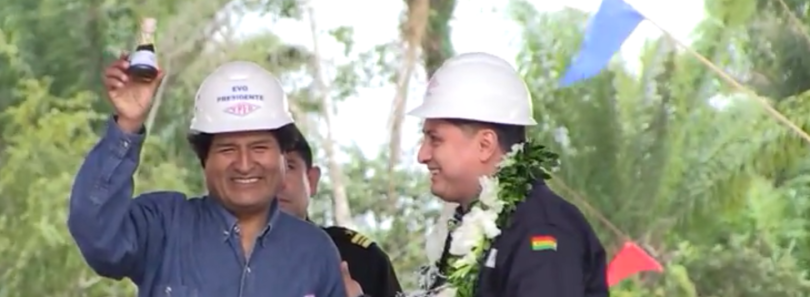
The Lliquimuni oil block could be the beginning of oil extraction in the northern Bolivian Amazon. This video, circulated by Alerta Amazónica, surveys the environmental dangers that accompany the project:

That beginning could come sooner than expected. On June 22, the Bolivian–Venezuelan consortium Petroandina announced “encouraging results” partway through the exploratory drilling at well LQC-X1. Company representatives expect to deliver a full report on the test well, which is operated by in  September.

Seismic studies carried out from 2008 to 2010 provided an estimate of 50 million barrels of oil in the area. Already last December, President Evo Morales was naming the underground oil reserves as reason enough to develop a large-scale petroleum industry presence in the northern part of La Paz department, a forested and mountainous area that lies to the north of the capital city of the same name.
“One the study is done, then comes the exploitation. I have said, if we find oil in La Paz, it will be our obligation to install a refinery here in the north of La Paz. Una vez hecho el estudio, perforación, vendrá la explotación. Yo lo decía, si encontramos petróleo en La Paz, será nuestra obligación instalar una refinería acá en el Norte de La Paz.
LQC-X1, the current center of exploration is near the community of Inicua, in Alto Beni municipality, part of Caranavi province (the municipality of Teoponte, in Larecaja province is nearby, and a border conflict driven by possible royalties was already active in 2014). Creating even this bit of petroleum infrastructure required something of an epic effort, perhaps inspiring the cinematic soundtrack for a promotional video from Petroandina. (You can see the government-owned oil company’s rather more heroic view of the project in the first two videos shown here.) Building either a refinery or oil pipelines out of the region would be a far greater challenge, which is perhaps the greatest factor holding back the transformation of the northern Bolivia rainforest into an oil-producing region.
Cropped cover of Eduardo Gudynas' book _Extractivismos_

Bolivia in the age of extractivism (a field report)

This is Bolivia 2015.

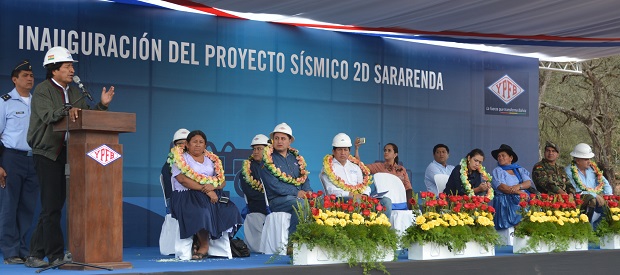
Unprecedented ambition is transforming the landscape into a source of new exports, an ambition that is measured more in dizzying numbers than individual projects. A feasibility study begins for a dam, El Bala, that would submerge the heart of Madidi National Park to produce 1600 to 4800 MW of electricity, but in announcing the contract, President Evo Morales speaks of a potential 48,000 MW of new projects across the country. Government aspirations for energy production also include investing US$2 billion in a nuclear power plant in Viacha, a still-hypothetical prospect that would place the vast El Alto–La Paz metropolis at risk in the event of a major accident. When exploratory drilling in the Lliquimuni petroleum block in the northern Bolivian Amazon is inaugurated, Morales proposes building an improbable but possible oil refinery to commoditize oil from a cluster of oil fields underneath the rainforest. At an agricultural policy forum, co-hosted by the government, the peasant confederation CSUTCB, and big agribusiness (the Chamber of Agriculture of the East), the government proposes quintupling the land under cultivation in the next decades, mostly by expanding mechanized monoculture. While the peasants are partners in the summit, it is the Chamber who drafts the legislation that follows. Speaking to the European Union, the president vows that global South governments “will not be park rangers” on behalf of the global North. He returns home to sign a decree authorizing oil and gas extraction in National Parks as a national strategic priority. In public speeches, Morales has also pledged that NGOs and foundations that stand in the way of using Bolivia’s natural resources face expulsion from the country.

This was the country I visited for the past three weeks. I’m at a point of inflection in my research agenda from studying how movements build power and exert pressure to looking at the how conflicts between indigenous peoples and extractive industries will evolve under the Plurinational State. In part because of the power built by indigenous movements, Bolivia is a place where indigenous territories and rights have some of the most extensive protections in written law. Those legal commitments contradict equally formal commitments by the government to fulfill oil, mining, and logging contracts, and the government’s drive for new revenues to fund its anti-poverty social agenda. Conceptualized from afar, this should be a complex story of uncertainty and contradiction, of the indigenous state official who is pulled in two directions, of hard choices and ambivalences. But as the list of extractivist plans makes clear, the government of the Plurinational State is anything but ambivalent on this issue.Read More »

Bolivian op-ed confesses “30 Environmental Sins” as Pope arrives

The following was published in the Cochabamba daily newspaper Opinión on Monday, in anticipation of today’s arrival of Pope Francis to Bolivia. The author is Gastón Cornejo Bascopé, President of the Geographical and Historical Society of Cochabamba It gives a picture both of the variety of environmental issues and the sharp tongue of the press in Bolivia:
Read More »

Bolivian-Venezuelan Military construction team begins work on TIPNIS highway

Putting new pressure on a polarizing national conflict, the Bolivian government re-started construction work on the Villa Tunari–San Ignacio de Moxos highway, whose central segment would run through the Isiboro-Sécure National Park and Indigenous Territory. The construction, which began yesterday June 28, is on Segment Three of the highway, stretching 100 kilometers from San Ignacio de Moxos to Santo Domingo, a community within the Park. A joint Bolivian-Venezuelan unit of military engineers will carry out the project, using forty dump trucks. They currently project completion of the project by 2016, although such timelines are often unreliable. The segment is projected to cost US$144 million.Read More »

Plurinational Bolivia cultivates new image as oil and gas state (in videos)

The Bolivian government of Evo Morales is enthusiastically celebrating two new finds of petroleum and gas this month, at the Boquerón-Norte well in the east and in the Lliquimuni block in the Bolivian Amazon. These findings come just as new presidential decrees have opened parks and environmentally protected areas to oil and gas drilling.  You can get a flavor of the government’s excitement by seeing some of its image production around these finds.

First is this wordless video produced by Petroandina (the Bolivian-Venezuelan consortium of state-run oil companies) celebrating the construction of the test well LQC-X1, which began operation last December. Preliminary results presented this week place this block as the place where large-scale oil drilling could come to the northern Bolivian Amazon. The soundtrack befits a cinematic drama, and the intent is clearly to make drilling for oil into a national heroic endeavor.Read More »

Map: Bolivian parks and protected areas opened to oil & gas drilling

This map, produced by the Bolivian Documentation and Information Center (CEDIB) shows the country’s national parks, biosphere reserves, and other protected areas in green, and both existing and planned oil and gas concessions. Oil and gas concessions are colored by the corporation involved, while light purple indicates blocks to be auctioned off in the future. The map appeared in CEDIB’s magazine PetroPress in 2013, where it accompanied a longer article.

Evo Morales reopens proposal for highway through TIPNIS

Bolivian President Evo Morales has renewed his efforts to build a controversial highway through the heart of the Isiboro Sécure National Park and Indigenous Territory (TIPNIS), a forested park that is home to over 12,000 indigenous people. The central segment of the highway would bisect the territory and accelerate already high rates of deforestation. Protests spearheaded by the Confederation of Indigenous Peoples of Bolivia (CIDOB) in 2011 and 2012 postponed its construction, while funding by the Brazilian Development Bank (BNDES) was withdrawn. The Bolivian government had previously said it would tackle extreme poverty in the territory before mounting any new effort to build the highway.

On June 4, however, President Morales told an audience in his home base of Villa Tunari, Cochabamba, that the project “will be realized.” His remarks followed on earlier statements leading up to the April regional elections and a May runoff that put the highway back on the official agenda. Now, with an overwhelming victory for Morales’ MAS party in Cochabamba and a very narrow win in the Beni runoff, the national government seems committed to restarting the project. In the president’s words,

On the subject of integration, good voices come from the new governors of Beni [Alex Ferrier] and Cochabamba [Iván Canelas]. The Villa Tunari – San Ignacio de Moxos, comrades, will be realized.Read More »