Boliviaʼs newest park, Ñembi Guasu, hit by fires

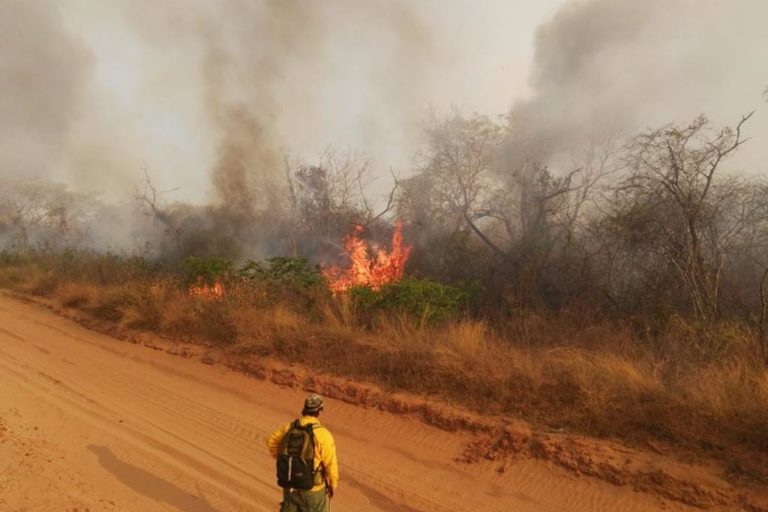
The ongoing fire crisis in the Eastern Bolivia department of Santa Cruz has burned 187,800 hectares of the Ñembi Guasu Area of Conservation and Ecological Importance, scorching forests and leaving behind burnt out wildlife carcasses. The destruction in one-sixth of the Ñembi Guasu comes just four months after the Guaraní Charagua Iyambae autonomous government designated the park as protected on April 29, 2019.

According to reporting from El Deber, the Fires started in Roboré municipality, which has received much of the local attention during the ongoing Chiquitano dry forest fire crisis. But Charagua is the worst-affected municipality in the country, with 239,073 hectares burned according to recently released satellite analysis from the Fundación de Amigos de la Naturaleza.

El Deber reports the fire rages uncontrolled:

Today, it is the largest fire in the country; the only one that no one has taken care of up til now. Since August 9, when a chaqueo [slash and burn fire] got out of control 15 kilometers from Roboré, the flames have devoured land, reaching over 100 km away… and spilling over as far as Paraguay, towards Otoquis [Park] and still no one has done anything to put it out.

Hoy es el incendio más grande del país; el único que nadie ha atendido hasta ahora. Desde el 9 de agosto, cuando un chaqueo se descontroló a 15 kilómetros de Roboré, las llamas han devorado más de 100 kilómetros en línea recta, 187.800 hectáreas hasta ayer, ya se ha desbordado hasta Paraguay y hacia el Otuquis y aún nadie hace nada por apagarlo.

Pablo Ortiz, “Nadie atiende el incendio de Ñembi Guasu: el área protegida más joven,” El Deber, August 27, 2019.

The current fire in Ñembi Guasu stands as a potent metaphor of the risks that agricultural deforestation poses to both indigenous autonomy and conservation. Unless they have the resources to defend the territory, manage disasters, and shape policy, so-called Protected Areas will remain unprotected.

FAN visualization of fires in 2019 in Santa Cruz department

Deforestation in Bolivia: The bigger picture

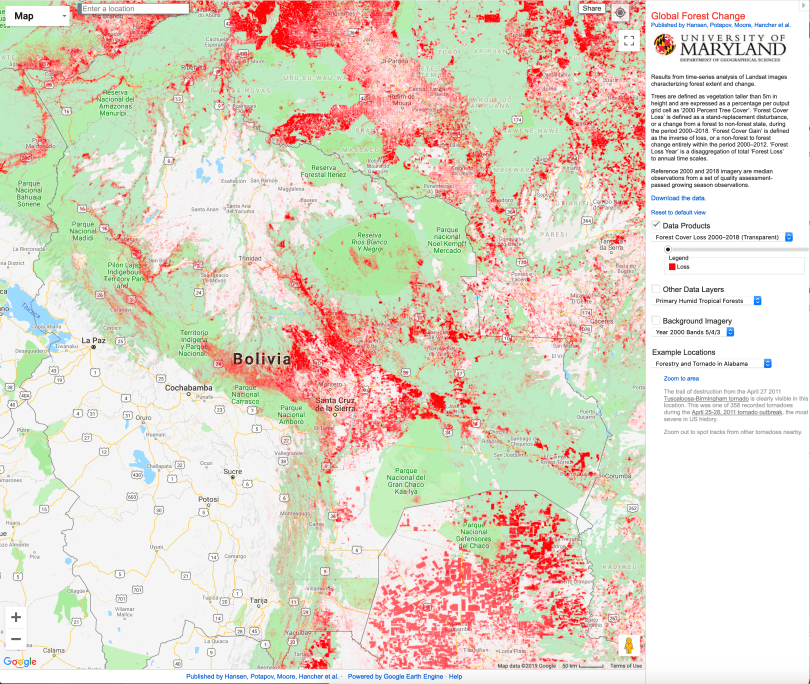
The image above, produced by the University of Maryland’s Global Forest Change explorer, shows the loss of forest in Bolivia and surrounding countries from 2000 to 2018. As the fires continue to burn in Bolivia’s Chiquitano dry forest in Santa Cruz department, as well as in Beni, Pando, and Cochabamba departments, it’s important to take a longer look at the problem of deforestation in Bolivia. This post discusses its scale, hot spots, and how the current trend will break Bolivia’s climate pledges to the international community.

Deforestation is an ongoing, massive problem in Bolivia

According to official figures by the Bolivian government, deforestation exceeded 200,000 hectares (494 thousand acres) in 11 of the 13 years from 2004 to 2017, the last year for which I could find data from ABT, Bolivia’s Forest and Lands Authority. Here are their annual estimates.

Read More »

Like Brazil, Bolivia is burning due to deliberate government policy

With the world’s eyes turned towards the fires in the Amazon rainforest, and primarily on Brazil, there is good reason to survey the larger problem of deliberate deforestation across South America. Right now Bolivia is several weeks into the most devastating season of fires in at least a decade. As of August 22, the Bolivian government reported that 744,000 hectares of the country were affected by the blazes, and by Saturday, August 24, the regional government of Santa Cruz raised that estimate to over one million hectares.

A key driver of the fires in both countries is the deliberate clearing of forest land for agricultural production, which has been prioritized by left-wing government of Evo Morales as well as the right-wing government of Jair Bolsonaro. Last week, both presidents reacted flippantly to the growing international attention surrounding the fires. (On August 19, Morales called the fires “natural phenomena” that “will continue” in years to come and seemed preoccupied with avoiding blame: “This is not the first time that there have been fires, they have always been around. Now they want to blame Evo Morales for the fires.” ) After the fires became a key discussion point at the G7 meeting, and following growing protests demanding international aid in eastern Bolivia, however, both men have attempted to show their governments are proactively responding to the emergency. Nonetheless, government policy in Brazil and Bolivia is fueling and authorizing the underlying drive to convert more of primary forests into croplands and grazing fields for cattle. This fact has been widely recognized for the government of Bolsonaro, who defied environmental regulators on his own private property before taking office, and who has dismantled environmental protections as president.

Unfortunately, the same policy priorities are at work in Bolivia under President Evo Morales. While from a different social class, as the leader of the Chapare coca grower’s union, Morales shares a similar orientation towards the forests of their respective countries. Both men see the Amazon rainforest (and in Bolivia’s case, the Chiquitano dry forest as well) as underpopulated areas of land that ought to be incorporated into the national economy through production for the market. (Contrary to some wild-eyed  Twitter claims, however, the current fires in Bolivia are in the service of cattle and lowland export crops like soy, not coca.)

In 2013, the Morales government laid out its territorial vision as part of its 2025 Patriotic Agenda, a thirteen-point series of goals whose target date is the bicentennial of Bolivian independence. The plan, describing “how we want our beloved Bolivia to be” in Morales’ words, proposes an ambitious reterritorialization of Bolivia that will affect large portions of the country’s land surface, with millions of hectares altered by new agricultural, hydrocarbon, and infrastructural initiatives. It offers quantitative targets for the use of Bolivia’s land, water, and natural resources. In writing the plan, Bolivian government planners worked on a wide canvas: the full area of Bolivia’s national territory, which consists of nearly 110 million hectares and land and domestic waters.

The most dramatic shift proposed in the Patriotic Agenda is the so-called “expansion of the agrarian frontier”: increasing the total land under cultivation from 3.3 million hectares (in 2013) to as many as 13 million hectares by 2025. This staggering figure has been put forward by the president, vice president, and ministers, but their reach exceeds their grasp. The technical data used by the government’s planning staff, according to Fundación Tierra researcher Enrique Castañón Ballivián, corresponds to a still-startling 6-million-hectare cultivated area. Nearly half of the projected expansion would come in the eastern department of Santa Cruz, where soy (and soy oil)-exporting agribusiness dominates the economy. Costañón argues that this expansion would inevitably clash with indigenous collective titles, as well as forested areas.

While this agricultural land goal seemed unrealistically ambitious at the time, it has set the direction for Bolivia’s forest and land management agencies and for new decrees like the one that set off the current fires in the Chiquitanía.

Read More »

Fires rage in Brazilian Amazon, Bolivian Chiquitanía, Paraguayan Pantanal

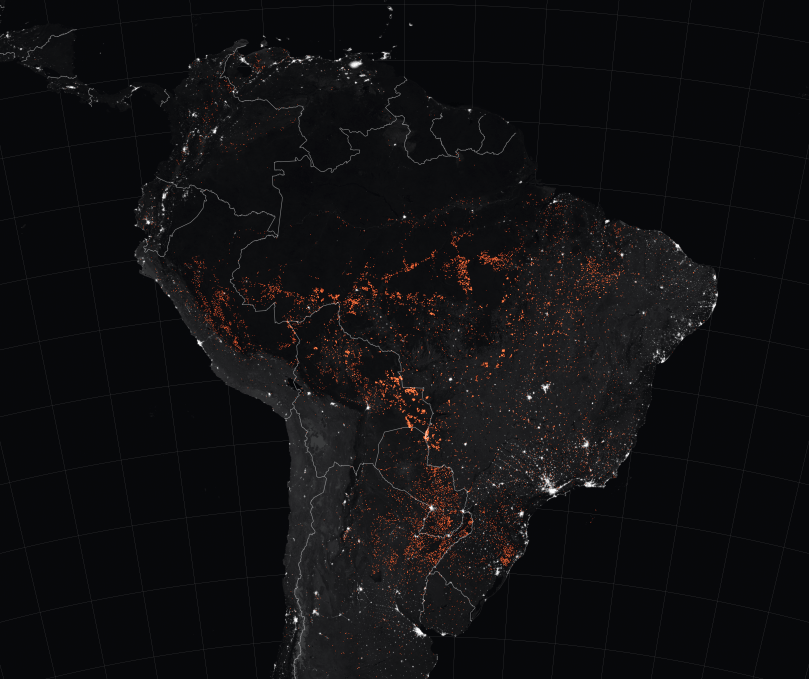
This image from NASA offers a panorama of the fires raging across South America during the week of August 15 – 22, 2019. World attention has turned to the Amazon rainforest fires in Brazil, where ultra-right President Jair Bolsonaro has drastically cut back environmental enforcement. This week, there has been needed attention brought to Bolivia’s rapidly expanding fires, primarily in the Chiquitano dry forest. Claire Wordley offers a solid primer on the situation in English.

As of August 22, the Bolivian government reported that 744,000 hectares of the country were affected by the blazes, and by Saturday, August 24, the regional government of Santa Cruz raised that estimate to over one million hectares. These are parallel crises, caused by independently set fires. A key driver of the fires in both countries is the deliberate clearing of forest land for agricultural production, which has been prioritized by left-wing government of Evo Morales as well as the right-wing government of Bolsonaro.

Read More »

In the field: Building a database of deaths in Bolivian political conflict

Earlier this month, I spent ten days in La Paz working on Ultimate Consequences: A database of deaths in Bolivian political conflict during the democratic era. This project is a compilation of detailed information about the human cost of political struggle in the country I have been research and writing about for over a decade. It includes people killed when movements challenged the state and the state responded with violence—the initial spark for my research—but also a variety of deaths associated with coca erradication and resistance to it, deaths caused and endured by guerrilla and paramilitary forces, prolonged inter-ethnic conflict (mainly the “war of the ayllus” between the Laymi and Qaqachaka communities), political assassinations (both due to partisan politics and patriarchal rejection of women coming to forma leadership), and the times when self-sacrificial protest (hunger strikes and prolonged marches under adverse conditions) claimed the lives of protesters and their children.

As of today, we have 512 deaths recorded, 477 of them with names. It has been a grim, if captivating tour through recent Bolivian history. While I’ve had the collaborative support of two research assistants over the course of the project, I think I’ve read every story of death, and the process has been at turns sobering, enraging, frustrating, and deeply informative.

Right now, I am focused on getting two things done with this database: ensuring that our dataset is as complete as we can make it, and making several of the many variables that we are recording—starting with location and the role of the state—as completely specified as possible so that we can share complete summary data, maps, and other statistical visualizations with the public. In La Paz, this meant taking my camera on a lot of trips to the Archive of the Plurinational Legislative Assembly, which has decades of Bolivian newspapers bound into massive volumes, and coordinating with colleagues in a Bolivian NGO on a graphic visualization front-end for the database.

Binding Leaders to the Community: The Ethics of Bolivia’s Organic Grassroots

Just published in Journal of Latin American and Caribbean Anthropology. Bjork-James, Carwil. 2018. Binding Leaders to the Community: The Ethics of Boliva’s Organic Grassroots (full text). Journal of Latin American and Caribbean Anthropology 23, no. 2 (July): 363–82. Abstract: Bolivia’s largest social movement organizations—including its labor unions, rural communities, and neighborhood organizations—are bound together by a hierarchical […]

Blockade: The Power of Interruption

Think of this as the trailer for my ethnography, photography, and the book I’m revising for publication…

On June 23, 2008, three of us ascend an eerily empty highway from the tropical town of Coroico to Bolivia’s capital, La Paz. Foreigners, we stare at the majestic valley below as we pass above the line where the tropical tree cover of the Yungas gives way to pure rock. The so-called Death Highway has been rebuilt on a more secure footing, but it is still marked by hairpin turns, intruded upon by fallen boulders of a terrifying scale, and undermined by landslides. Its predecessor, once calculated as the world’s deadliest roadway, has been preserved as a downhill biking path for tourists seeking “100 percent adrenaline.” Where the road has fallen or washed out, drivers let their wheels dig tracks into the mud and gravel tracks, and peer over the edges of their vehicles to avoid falling off the side.

Today, however, both roads are nearly silent. None of the half dozen minibus unions are operating their vehicles, bike tours are cancelled, and the taxi we found cruises over empty roads and easily steers clear of both the rock faces and the treacherous edges. Once finally inside La Paz however, it comes to a stop at the cause of all the earlier silence: an urban road blockade. Residents of the northeastern District 13, organized through 46 neighborhood councils, have plugged the main arteries through their neighborhood with stones and their collective presence. They are calling on the municipality to meet an eight-point platform of demands concerning crime, public works, and water provision. Taxis like ours can approach the protest zone but only to discharge their passengers. Dozens of men and women walk—their goods stacked on their heads, bundled in fabric on their backs, or dragged along in suitcases—across the vehicle-free stretch of urban pavement, littered with stones and occupied by protesters who gather in the middle.

Every point along the road we have travelled is a potential chokepoint. Since the main road from La Paz to the Yungas passes through this district, a single blockade is enough to cut off all traffic to Coroico, the Yungas, Caranavi, and the northern Bolivian Amazon. Whether accomplished by simply sitting down in the street, dragging in boulders and tree limbs, or coordinating crowds of thousands to take over key thoroughfares, road blockades bring a sudden urgency to political protest. By blocking the circulation of people and goods, they ensure that the impacts of protest ripple across an entire region.

Read more at Limn Magazine…

Bolivia’s limited de-criminalization of abortion has been reversed

After a year of drafting and debate, the significant but limited liberalization of Bolivia’s abortion laws lasted just six weeks. It was signed into law on December 15, 2017, as part of an omnibus reform of the country’s Criminal Code, but that law was repealed in its entirety on January 27, 2018. Between these two dates, the major challenge to the law was not about abortion but rather an extended strike by medical workers who opposed provisions in the law that criminalize malpractice. Transport workers also objected to new ways of being held liable for traffic accidents.

Reportedly, the abortion provisions—which would have exempted more women from the general criminalization of abortion in Bolivia, and allowed qualifying women to fill out a form rather than seek authorization from a judge—were a matter of internal tension within the ruling Movement Towards Socialism party.

The medical strike unexpectedly became a convergence point for various critics of the government, who formed the Coordinadora de Defensa de la Democracia (Coordination in Defense of Democracy) and demanded the government respect the February 2016 referendum vote that rejected President Morales running for a fourth term.

President Evo Morales signed the full repeal of the Criminal Code amendments in an unusual ceremony in which he did not speak a word.

Culverting of the Choqueyapu River, under construction in 2008

La Paz’s water pollution crisis, as retold by comic book artists

The metropolis of La Paz and El Alto, Bolivia, is living on the edge of multiple water crises. Water suppliers struggle to keep pace with its rapid population growth. Its overall supply is dependent on glacial melt water, which may not survive the 21st century (as covered previously on this blog: “Bolivia’s current water crisis is the tip of a melting iceberg”). And the cities’ principal river, the Choqueyapu, is a site of dramatic pollution.

This last issue is the subject of Choqueyapu: Un río enfermo que nos alimenta (Choqueyapu: A sick river that feeds us). Bolivian newspaper Página Siete has re-released one of its most important investigative pieces of 2017 in an online comic-book format.  The narrative follows a drop of glacial meltwater as it travels past industrial sites, through the city center, and out to the vegetable and fruit-growing fields that lie downstream of the city. There, farmer Eugenia Mamani explains how her downstream community has adapted: “In the early morning the clean water comes” (because polluting industries and the slaughterhouse aren’t operating). “We irrigate from 3am onwards; during the day it comes in dirty and we no longer use it. We have to make sacrifices [to make] our products.”

La Paz’s water pollution has many causes, from industrial waste to the riverside slaughterhouse to urban runoff to mining waste to inadequate water treatment. It all ends up flowing downstream. As the comic and other reporting shows, solutions like pollution inspectors, slaughterhouse modernization, and a new water treatment plant are all behind schedule. One of the few public works that affects the river, the culverting of its downtown segment in 2008 (see above photo), has only added to its problems by creating de-oxygenated segment right in the middle of its flow.

Like many environmental matters, this is a slow-motion crisis with no end in sight.


Bolivia moves to decriminalize some early-term abortions, sparking misogynist outbursts

Bolivia is on the verge of a mild liberalization of its abortion laws after the Plurinational Legislative Assembly approved changes this week. On Wednesday, December 6, the Bolivian Senate approved a rewrite of the article of the country’s penal code that deals with abortion. While the code continues to treat abortion as a crime, and to threaten women who have them with one to three years in jail, it carves out new exceptions for some women who terminate their pregnancies within the first eight weeks of pregnancy. Women who are parents or caregivers to elderly or disabled members of their household, or who are students, may seek abortions without penalty. Perhaps more importantly, the revised law replaces a system that required pregnant women to seek judicial authorization for abortion with a simple form to be filled out within a medical setting. The simpler process will also be available under cases that were already permitted: abortion to protect the life or health of the mother, in the cases of rape, incest, or assisted reproduction without the woman’s consent; detection of fetal abnormalities that are fatal, and if the woman is a minor. The governing MAS-IPSP party backed the changes and President Evo Morales is expected sign them into law.

Bolivia’s current abortion law (es), enacted in 1973 under dictator Hugo Banzer, has been a public health disaster. Since it required authorization from a judge, and provided a very narrow set of circumstances to do so, it made seeking a legal abortion into a slow, uncertain, and costly process. In a recent two and half-year period, Bolivian hospitals recorded performing just 120 legal abortions, an average of fewer than 50 per year. Meanwhile, some 200 women seek clandestine abortions each day, according to a March 2017 Health Ministry estimate. Of these, around 115 seek follow-up care in hospitals for the side effects of abortion-inducing drugs or in recovery from clandestine surgeries. Over forty women died from the side effects of clandestine abortion in 2011, making unsafe abortion a major contributor to the country’s alarmingly high maternal mortality rate (National Study of Maternal Mortality (es), using 2011 data). Abortion led to 8% of all deaths of pregnant or post-partum women, and 13% of deaths under obstetric care.

The revisions to the law will not change the overarching framework surrounding abortion in Bolivia: criminalization. They do, however, acknowledge the ways that limiting family size and ending unwanted pregnancies can support women’s roles as caregivers and as students. These roles are the ones foregrounded by the Bolivian campaign group

Bolivian feminists continue to demand that the state “Decriminalize my decision.”: “Our demand is the decriminalization! (It) is an… advance in the context of a conservative onslaught… we continue moving towards decriminalization.” (translation by Telesur)

https://twitter.com/monicanovillo/status/938408989934669824

For Elizabeth Salguero, former Minister of Cultures and prominent MAS-IPSP politician, the changes mark “a great step forward for sexual and reproductive rights.”

The yearlong debate on this bill has been marked by protest from the Catholic hierarchy and evangelical Christian groups who frame their opposition in terms of defending life. The Plataforma por la Vida y la Familia (Platform for Life and the Family) is calling on President Evo Morales to veto the legislation. However, the opposition campaign has been marred by impolitic outbursts from within its own ranks. As the Senate bill was being voted upon (eventually backed 23–9), opposition Senator Arturo Murillo shocked the audience by saying:

Kill yourselves. Let those women who say they want to do whatever they want with their bodies kill themselves. Do it, commit suicide, but don’t kill the life of another.

Mátense ustedes, mátense las mujeres que dicen que quieren hacer lo que les da la gana con su cuerpo, háganlo, suicídense, pero no maten una vida ajena

It was a phrase that stripped away all pretense of religious conviction, and the sanctity of human life, from his opposition to abortion. Yet Murillo’s apology “to those I offended” demanded “respect for my principles and my way of thinking about this sensitive topic.”

Senator Perez was not the first abortion opponent to be moved to a public outburst during this debate. Back in April, Jesuit priest and Radio Fides personality Eduardo Pérez Iribarne complained on the morning show Cafe de la Mañana that the president’s cabinet was unqualified to speak to family issues like abortion:

In the cabinet, I would like to ask who, besides [Vice President] Álvaro García Linera and his wife, lives with their family? Starting with Evo, [they are] divorce women and men, living separately, here and there. And this cabinet of people displaced for life is going to set the standard for how to have abortions?!

En el gabinete me gustaría preguntar, fuera de Álvaro García Linera y su esposa ¿qué miembros del gabinete tienen una convivencia familiar? Empezando de Evo, divorciadas, divorciados, separados, con aquí allá. Y ese gabinete de gente desplazada por la vida va a dar pautas sobre cómo hay que hacer los abortos.

If this weren’t enough, Father Pérez also piled on to Health Minister Ariana Campero (Wikipedia), a single woman who became the Bolivia’s younger cabinet member at age 28. Since then, she has endured cringe-inducing on-stage sexual harassment from a gubernatorial candidate and the Vice President, as well as a presidential admonition not to become a lesbian. On the same morning as his comments about divorcées in the cabinet Pérez effectively suggested that Campero was unqualified and had slept her way onto the cabinet:

Excuse me, miss, I don’t dare call her doctor, I don’t dare! It could be because I am gay man, but I don’t dare call her a doctor, I prefer to call her the Minister of Health. And why are you the Minister? I don’t know, I have been told rumors, but I don’t want to broadcast them because they are gossip.

¡Discúlpeme, señora, no me atrevo a llamarla médica, no me atrevo! Será porque soy un maricón, pero no me atrevo a llamarle médica, prefiero llamarla Ministra de Salud. ¿Por qué está de ministra? No sé, me han contado chismes, pero no quiero difundir porque son chismes.
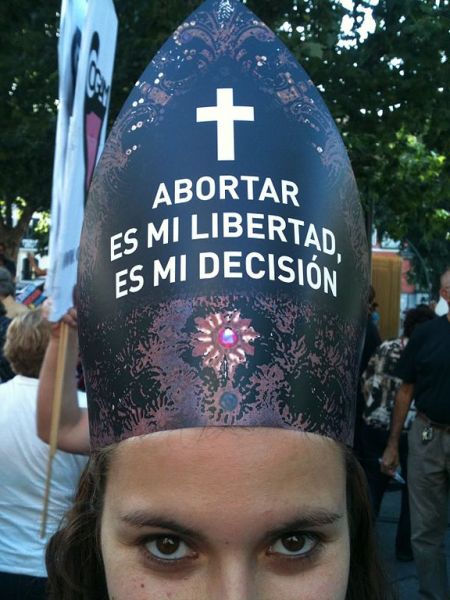
576px-Protesta_papa_abortoMinister Campero responded in an op-ed: “Surely for you my six sins are being a woman, young, a doctor who studied medicine in Cuba, feminist, communist, and single; that is why you said what you said. Seguramente para usted mis seis pecados sean ser mujer, joven, médica graduada en Cuba, feminista, comunista y soltera; por ello dijo lo que dijo.

The abortion debate has long revolved around the question of whether restrictions on abortion are born of concern for the sanctity of life, as one side claims, or about restricting the behavior of women who simply can’t be trusted. In this year’s Bolivian debate, the mildest steps to liberalize access to abortion have set off extreme attacks on women from abortion opponents, reinforcing the pro-choice claims that anti-abortion politics is rooted in misogyny.

Photos: Panel: National Pact for Depenalizing Abortion (Cambio newspaper). Abortion hat photo by Stéphane M. Grueso (El Perroflauta Digital).