International solidarity statement with Bolivian indigenous march and Isiboro Sécure

An international sign-on letter has been released in support of the Isiboro-Secure National Park and Indigenous Territory in the Bolivian Amazon and plains, currently threatened by a proposed highway that would cut the territory in two. The letter calls for the Bolivian government to recognize the right of indigenous people to freely accept or reject development projects, including the highway, and to negotiate in good faith with the cross-country indigenous march in its defense.

The signers—sixty-one environmental, human rights, indigenous, health, anti-privatization, and global justice organizations— hail from five continents and identify as supporters of Bolivian social movements and the Plurinational State of Bolivia’s proactive diplomacy on environmental and human rights issues. However, they warn: “the country’s pioneering work on all these issues
also comes with a great responsibility. Bolivia’s continued ability to press forward this vital agenda will be affected by its consistency and moral credibility on matters of human rights and environmental protection.”

The Eighth Grand Indigenous March, which set off from Trinidad in mid-October, has travelled half of its planned route to La Paz, but currently faces a blockade by some members of the Union Confederation of Intercultural Communities of Bolivia (formerly the Union Confederation of Colonizers, that is agricultural settlers on frontier lands). Both the blockaders and Bolivian police are currently preventing the advance of the march towards La Paz, as well as additional volunteers, food, medicine, and supplies sent from La Paz.

In Spanish after the jump / En castellano después

Read More »

Indigenous to confront Bolivian government over highway through Isiboro-Sécure National Park

In the coming weeks, Bolivia’s indigenous movement is organizing a new national march. For the eighth time, the Confederation of Indigenous Peoples of Bolivia (CIDOB; the acronym reflects its origins in the Oriente, or East of the country) is preparing a national march on La Paz. The National Council of Ayllus and Markas of Qullasuyu (CONAMAQ), an organization of traditionally organized highland communities has pledged to join CIDOB in this effort. Unlike CIDOB’s past marches, this one brings a single, local struggle to the national spotlight: the planned building of a major inter-departmental highway through an indigenous territory called Isiboro-Sécure.

The Isiboro-Sécure Indigenous Territory and National Park (known by the Spanish acronym TIPNIS) is supposed to be a new kind of territory. Combining indigenous self-government and environmental protection, TIPNIS is both a protected natural area and a self-governing indigenous territory. These lands lie on the undemarcated frontier between Cochabamba and Beni departments in Bolivia around the Isiboro and Sécure Rivers. They are home to members of the Yuki, Yuracaré, and Trinitario Mojeño peoples, who govern the territory through indigenous community organizations which are federated into the Subcentral of TIPNIS. This novel arrangement was made possible by the first CIDOB march, back in 1990, which put indigenous autonomy on Bolivia’s national radar.

Twenty years later, Bolivia is also supposed to be carrying forward a radical redefinition of its political life around a new agenda. Three pillars of that agenda are indigenous rights, autonomy, and care for the natural world. The government of Evo Morales backed the UN Declaration on the Rights of Indigenous Peoples to its passage by the UN General Assemby in 2007, and was the first government to incorporate its text into domestic legislation. The country’s new constitution, approved by a 2009 referendum, defines the a “Unitary Social State of Plurinational, Community-Based Law, … intercultural, decentralized, and with autonomies,” probably the strongest acknowledgment of decentralization in any national constitution. The Bolivian government’s support for environmental protection on the world stage—at Copenhagen and Cancun, in hosting the Cochabamba climate summit, and at the United Nations—has become almost legendary. The passage of a non-binding “Law on the Rights of Mother Earth” last December attracted enthusiastic praise from outside observers.

On the drawing board for decades, the Villa Tunari–San Ignacio de Moxos Highway started to become a reality over the past few years thanks to funding from Brazil’s National Bank for Economic and Social Development (BNDES). The highway has provoked a string of environmental controversies. At last April’s Cochabamba Climate Summit, the planned road was one of several dozen “megaprojects” discussed by local activists at Mesa 18, the so-called Eighteenth Table of the meeting and the only one devoted to environmental problems within Bolivia itself. In May, a summit of local and regional leaders met in the community of San Miguelito inside TIPNIS. Attending organizations declared:

We are tired of sending letters and resolutions stating our position of rejection against the initiative to construct a highway uniting Villa Tunari and San Ignacio de Moxos, which have never been heard and attended to by the current or previous governments; …

We resolve … To overwhelmingly and non-negotiably reject the construction of the Villa Tunari – San Ignacio de Moxos highway and of any highway segment that would affect our territory, our [collective] big house (full text in English)

Several months later, Vice Minister of the Environment Juan Pablo Ramos resigned rather than approve an environmental license for the highway. Yet, even as President Evo Morales inaugurated the project on June 5 of this year, no consultation has taken place with the peoples living in Isiboro-Sécure.

The objections to the highway, put forward by TIPNIS residents themselves through their Subcentral, should be familiar to anyone who follows the continent-wide story of deforestation in the Amazon basin. Across South America, large “primary actors” like road builders or oil drilling installations have had a disproportionate impact in opening new regions to systematic deforestation. The pattern is simple: one a route is cleared into a region, colonists follow with short-term cropping on cleared forest. Since the rainforest lives atop paradoxically poor soils (heavy rainfall washes the nutrients out of the soil, so the complex, multi-tier ecosystem has evolved mechanisms for preserving as much useful matter above the surface as possible). Often, such colonial agriculture depletes what is left after burning in a decade or two and colonists move on to repeat the cycle. For people who depend instead on the resources and wildlife of the forest for survival, this process is disastrous.  The indigenous peoples of TIPNIS are no exception: they too maintain a livelihood that is built around local self-sufficiency and depends on the forests for food and rivers for transportation. Deforestation is not a hypothetical threat in TIPNIS either. Where dirt and gravel roads have been cleared along the southern part of the proposed highway route, thousands of acres within the Park have been cleared for coca cultivation. New coca farms inside of TIPNIS violate understandings between the the Chapare coca farmers on one side and the international community on the other, and the Morales government has pledged to remove them. However, TIPNIS representatives have signaled that both land for cultivation and concessions for logging are being offered for speculative sale as road construction nears.

In short, the highway has become a key point in the battle over Bolivia’s future, and over the extent to which dreams of ecological sustainability and indigenous self-governance will become a reality. Deforestation, cultural survival, the indigenous right to self determination, and the protection of indigenous territories are all at issue. These broader concerns explain why both CIDOB and CONAMAQ are preparing to march alongside indigenous community representatives from Isiboro-Sécure, in late July or early August. For those around the world who have put hopes in the Morales government for the same reasons, now is a good time to let it know you’re watching.

Facts on coca from UN question politics of drug war

The UN Office of Drugs and Crime issued its annual World Drug Report this week. Despite its fluffy image in the United States, the UN and this office in particular are committed to the global drug war. However, the office is also one of the most important factual sources on the production, circulation, and use of drugs.

Participation in the drug war is a vital metric on which the richest countries rate the progress/goodness/aid-worthiness of countries like Colombia, Peru, and Bolivia. In Colombia, this has meant American drug enforcers, military trainers, and herbicidal chemicals on the ground for over a decade now. However, the United States’ annual evaluation of countries’ cooperation in the drug war often has more to do with access for these arms of the American state, and rewarding loyal allies while punishing governments that question US foreign policy, than with actual results. In recent years, this has meant annual certification of Peru as effectively carrying out the drug war, while decertifying Bolivia. The main cost of decertification is cutting off drug aid funds and market supports for alternative products grown in coca-producing regions.

Let’s look at some facts provided by the UN to put this in perspective:

  • Coca leaf cultivation by country (p. 99): Back in 1999, coca eradication efforts had peaked in Bolivia, due to the militarization of the Chapare coca-growing region. Lethal clashes had accompanied eradication, but the area of Bolivia where coca is grown reached its low point: 14,600 hectares.  Colombia then dominated coca growing: 163 thousand hectares out of the global total of 221 thousand. In the past decade, coca growing in Bolivia bounced back (to 25,400 hectares in the years before Evo Morales, and since then more slowly to around 31,000 hectares). Meanwhile Peruvian cultivation has shown steady growth (two small annual declines vs. eight years of annual growth), moving from under 39 thousand hectares to around 61 thousand. The big squeeze in Colombia through eradication (including aerial spraying of pesticides and burning of fields) got production there down to about 62,000 hectares.
  • Overall, Colombia, Peru, and Bolivia now have a 40-40-20 split of coca production, but only Bolivia is decertified by the United States. Peru, which is open to DEA agents and has been welcoming to US corporations, seems to have gotten a free pass on its doubling coca cultivation.
  • The global burden of cocaine seizures has shifted to police in South America (p. 99-100): Who’s fighting the drug war on cocaine? Measuring by seizures of the drug, it’s primarily South Americans, who accounted for 60% of the 732 metric tons of cocaine captured by drug enforces in 2009. This is a dramatic shift from 30-40% around the turn of the century.
  • Most cocaine consumed in the United States and Europe comes from Colombia: US authorities trace 90% of the US supply to Colombia. European drug seizures with a country of origin are 25% from Colombia, but another 44% comes from primarily Colombian transit markets in Venezuela, Ecuador, and Panama. “Cocaine produced in Peru and the Plurinational State of Bolivia, in contrast, is used more within South America, notably in countries of the Southern Cone.”
  • All of these seizures are failing to put any economic squeeze on cocaine use: The cocaine industry is the deadliest in terms of trafficking related violence, but this death and the drug war have not diminished overall use. As with production, we see a move in the centers of use. In this case, however, there’s no overall reduction. US consumption has slumped over the past twelve years, but European usage doubled from 1998 to 2006 and stayed steady since. (by the way: Despite these shifts, US users are still more common and consume more total cocaine than European users.)

Events in all three producer countries are linked to increased questioning of the role of coca eradication in the drug war. While Bolivia’s case is the most dramatic—the current president leads a union of coca-growing farmers—the traditional importance of coca leaves to Andean cultures is a shared factor in all three countries. The Plurinational State of Bolivia is committed to a formal expansion of the legal area for cultivation to include part of the Chapare. It has invested in the commercialization of products other than the ancient uses of coca leaves for chewing and brewing mate, such as coca candies, liquor, and foods. It also is interested in exporting leaves for traditional use by the 1-2 million Bolivians living in Argentina.

In Peru, President-Elect Ollanta Humala has expressed support for greater freedom for traditional cultivation and concerns about Peru’s eradication policy. And Colombia withdrew its initial objections and backed the removal of coca chewing as a penalized activity under the 1961 Vienna drug convention. And Colombia’s high court ruled Thursday that indigenous peoples must be consulted about coca eradication on their lands.

It’s important to note that none of these policies constitute a general open growing policy. In Bolivia, “social control” of coca cultivation which limits acreage per family and continues eradication outside authorized regions is the policy of the day. Social control policies are backed by the European Union, and Brazil has stepped in to replace US funds for drug control measures.

Finally, Ollanta Humala’s election offers a new test of the politicization of US drug war certification. Will the new government take the blame for Peru’s rising coca production, while friendlier governments have gotten a pass for the past decade? If the US moves to decertify Peru this year, blaming Humala for Alan Garcías failed policies, it will be a clear case of making drug aid a political stick to attack critics of American economic policies.

Bolivia in Price Crisis (part I)

Eighteen months ago, when I was applying for funds to conduct research in Bolivia, one of the criticisms I had to respond to was this: How do you know that mass protest events will be going on while you’re there? In the end, I resorted to putting a table of recent events of large-scale space-claiming protests in my two focus cities in my proposal to make this point: there has not been a 12-month period without such protests since last century.

And here we are again.

On the day after Christmas, the Vice President (then acting president since Bolivian law requires that the office must always be filled by someone physically in the country) announced that the Bolivian government would remove all subsidies on fuel: primarily gasoline and diesel, and let the prices float to international levels. Fuel prices went up 70-80% overnight. This was not the first time that such a drastic move has happened in Bolivia, but it was the first time that the popular movement-linked MAS government had taken the step. In fact, the MAS had led major protests against exactly the same move less than a decade ago.

The politics of subsidies in general and the gasolinazo in particular are fascinating, and fully getting the arguments requires putting aside everything that Westerners are taught about prices, markets, and subsidies, but that’s a whole other post (several pages of which are in my notebook waiting to be typed into an article).

In any case, the social movements that brought the MAS to power, including Evo Morales’ coca grower base, did not hesitate to mobilize against the gasolinazo. (And the transport sector quickly moved to double fares.) Despite some pressure on their leadership, the Neighborhood Councils, Factor Workers, labor confederation, and others mobilized mass protests. The scene in El Alto in particular, especially on December 29 and 30, brought back collective memories of the mobilizations that toppled presidents in 2003 and 2005, even though the numbers were not yet as great. Evo and Álvaro reversed course, and returned fuel prices to their former levels.

However, the price hike genie was out of the bottle. While some in the government promised the gasolinazo was over, others have made it clear that the prices will be raised in smaller doses over the coming year. Several weekends in January and February, there has been panic buying in La Paz over rumors of an imminent price hike.

More pressingly, this year’s extremely late rainy season (normally beginning around November 1, it didn’t really kick in until the New Year) and other factors have led to a national sugar shortage, grain price hikes, and a squeeze on the milk producing industry. The national government’s response was first to use its agricultural production support company, Emapa, to supply sugar directly at low prices to the cities, in an attempt to push the price down. However, Emapa itself abruptly raised prices in late January, and the government has been embarrassed by former ministers and senators illegally wholesaling government sugar out of their homes. Finally this month, the transport sector has moved to increase urban transit fares in a half dozen cities, and began charging the new fares without official approval.

The economic situation has brought multiple sectors into the streets, although without unified demands. Buyers and sellers of the same product are both mobilizing. Ideologies conflict as well: some are demanding the enforcement of the free-market principals of Supreme Decree 21060, while more are calling for it to be revoked. Shopkeepers demand that Emapa be abolished, while neighborhood councils in Oruro demand that it distribute basic goods directly to neighborhood suppliers. And in Cochabamba, drivers demanding higher fares and factory workers and neighborhood council marchers who oppose them have each attacked the property of the other side.

On February 18, the national worker confederation known as the COB (Bolivian Worker’s Central) carried out a 24-hour strike. And when Bolivians strike, they march. That included a 10,000+ worker march down the main highway from El Alto to La Paz. The COB is demanding either wages or wage increases in line with a study it performed on the cost of basic goods in the country. However, this analysis showed that the baseline cost of living is 8,300 Bolivianos per month for a family, about $1200. This is above and beyond the typical Bolivian’s earnings, leading the government to disqualify the study as anything more than a pipe dream for workers.

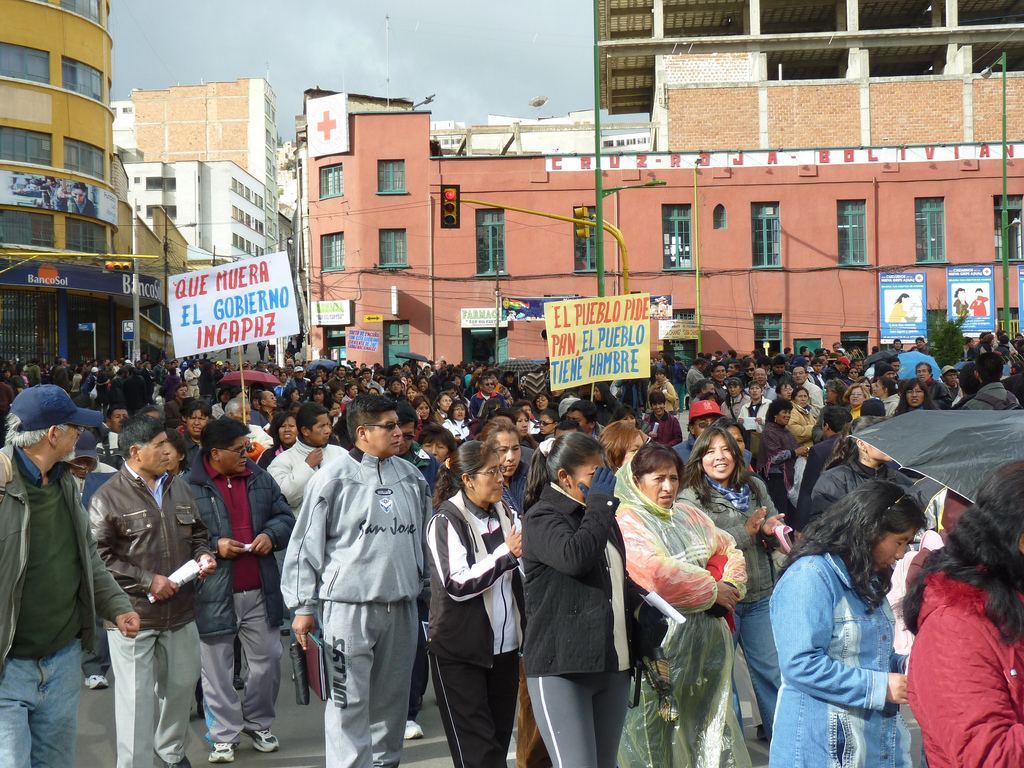
A second march on the 18th, led by the more radical teachers’ unions of La Paz department brought an harsher indictment of the Evo Morales-led government. Placards, chants and speakers labelled the government “incapable” and committed to neoliberal policies like the gasolinazo. Once again the slogans of seven years ago rang in streets, and a working-class crowd was calling for the indigenous peasant union leader who is president to resign and make way for “a government born of struggle in the streets.” Such a government, radical unionists claim, could guarantee larger wage increases for workers by expropriating transnational corporations in extractive industries and redistributing their wealth to enlarge workers’ salaries.

Health care workers and teachers rally in La Paz, February 18: Signs read "Death to the incapable government" and "The people ask for bread; the people are hungry"

It is not so much that this rhetoric is new as that it has migrated from the pamphlets of the radicals at sides of the march to the main stage. Like a stopped clock that is right twice a day, those who are always skeptical that the government has sold out the public, and turned against the grassroots are now in sync with at least a large portion of the popular mood. And they can speak to broadly shared concerns about the cost of living, the subcontracting of work, and the lack of sufficient investment in the industries that provide employment and public revenues to Bolivia.

Five years of MAS rule, and two years since its decisive victory over right-wing resistance to the project of a new, plurinational constitution have allowed a lot of tensions, mistrusts, and frustrations to accumulate within the party’s diverse grassroots base.  Movements that always knew how to mobilize on their own have frequently been in the streets in the past years. Unfortunately, the first response of the MAS government has often been to accuse those who mobilize of being aligned with, misled by, or even “infiltrated” by the right-wing opposition. If anything, it now seems that independent protest and even independent opposition has been made more likely by these accusations.

International Day of Action in Defense of Coca Chewing Underway

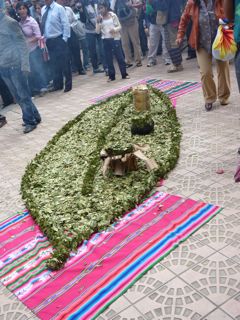
Massive coca leaf made out of coca leaves
On the plaza, a giant coca leaf made out of coca leaves

Coca growers from the Chapare (Cochabamba Department) and the Yungas (La Paz Department)—Bolivia’s two coca-growing regions—have travelled to Bolivia’s nine departmental capitals today to publicly chew the traditional leaf and to support the Bolivian government campaign to end the UN prohibition on coca chewing. Coca leaves are a traditional crop in the Andes and are both chewed in the mouth and boiled into a tea called mate de coca. Both forms are valued for their medicinal properties and cultural role in Andean culture, particularly the protection they offer against altitude sickness, fatigue, and upset stomachs. Bolivia’s demand that a 1961 UN drugs convention be amended has attracted broad support, including from the Union of South American Nations (UNASUR) and Africa, and several countries that had expressed doubts about the move have been won over. However, the United States—a major cocaine-consuming country and the main international sponsor of Bolivia’s once-heavily-militarized war on drugs—and Sweden continue to block the move. The deadline for changing their position is January 31.

Events in Cochabamba are still underway, but here is an early preview of the gathering in the city’s main square, the Plaza 14 de Septiembre.


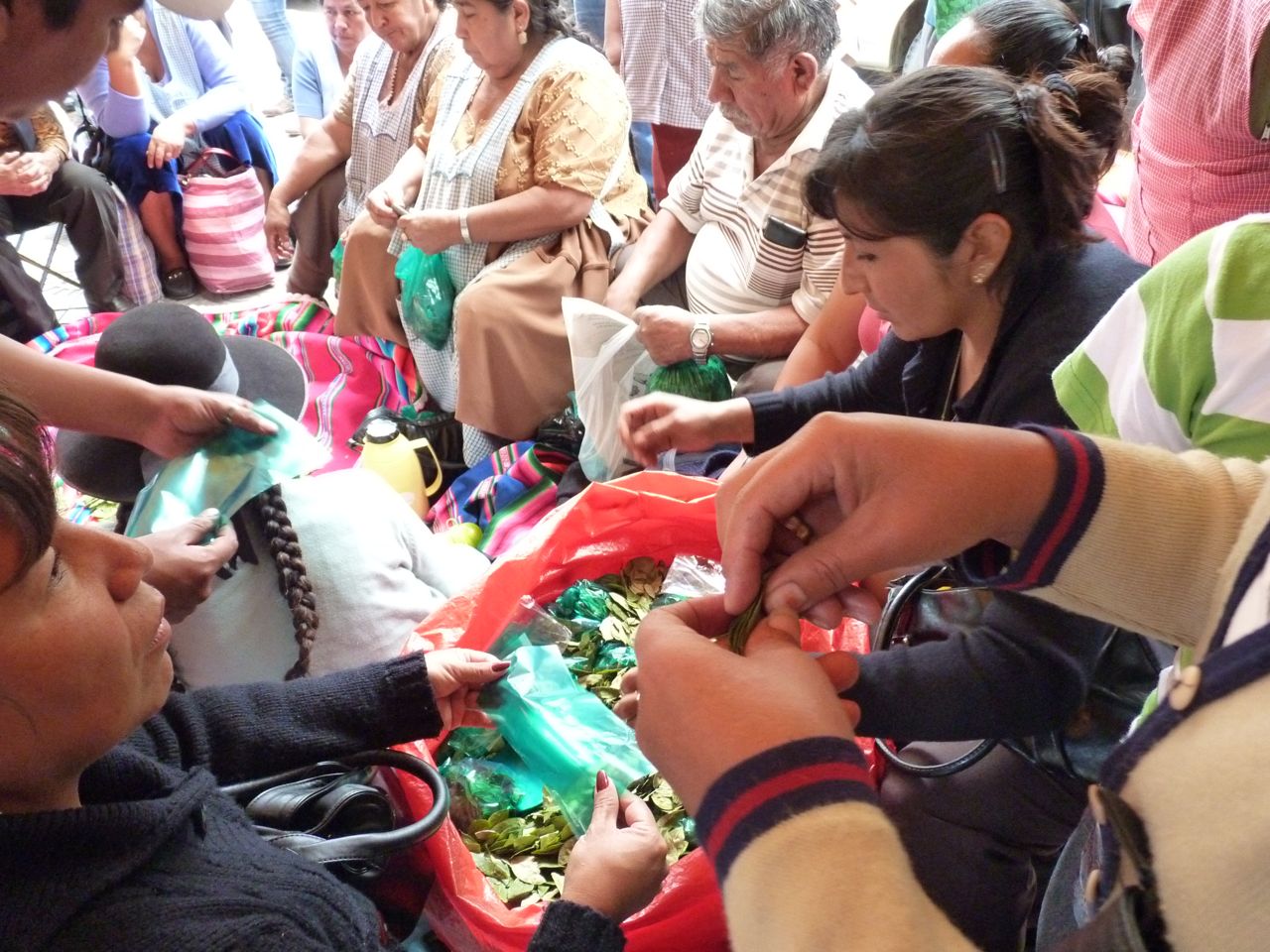
bagging and sorting coca leaves
Vendors from the May 27 Association bag coca leaves to give away
Marchers with coca plants
Two women from the Six Federations of the Tropics of Cochabamba march with young coca plants and bags of coca leaves
TV journalist interviews Leonilda Zurita, president of Coca Growers' Women's Federation

A more complete set of photos from today’s protest is online at flickr.

The US-Bolivia Relationship

Last week, Bolivia hosted a conference of defense ministers from all the countries in the Americas. This became front-page news here mainly because of the speech by President Evo Morales and proposals put forward by Bolivia. It also seems to have attracted at least a little attention in the United States.

US Defense Secretary Robert Gates came to Bolivia with the public agenda of discouraging Bolivia-Iran economic cooperation. He was actually surprisingly diplomatic in his complaints, saying from the outset that Bolivia has the right to have relationships with whomever it chose, but cautioning that Iranian interest in Bolivia’s untapped uranium and joined Bolivia-Iran plans for civilian nuclear plants will be closely monitored.

During the summit, Evo’s opening speech criticized the United States’ history of intervention in Latin American democracies. He claimed that popular democracies are “three and one” in resisting attempted coups backed by the United States. The three are Venezuela (2002), Bolivia (2008), and Ecuador (2010); with the one being Honduras (2009). In fact, they are two inaccuracies in this score: the recent police revolt in Ecuador did not have any apparent American backing, as President Rafael Correa has said publicly; and Evo, like many other observers, leaves out Haiti (2004), the only case in which Americans had an on-the-ground role. The real score is a less optimistic two for the democracies, two for the United States-backed coups against them.

Nevertheless, what has gathered media attention is not Evo’s accuracy, but his audacity in making such a comment in front of a senior American official. The Heritage Foundation responded by saying that, “Morales demonstrated in his speech a quantity of venom, a lack of restraint, and complete disrespect for the U.S. that befits a bully and tyrant.” Heritage joins several right-wing congress members and urging more hostile relations between the United States and Bolivia.

It is difficult to imagine exactly what that would mean since the two countries have had not had ambassador-level relations since 2008, when Bolivia expelled the US ambassador for coordinating Bolivia’s right-wing opposition at a time when it was seizing and burning government buildings and taking over gas infrastructure. After the Obama election, both countries have expressed a desire for renewed relations and cooperation, but the Bolivian proposal for a treaty of mutual respect has languished inside the United States State Department. While in August of this year, the countries announced “90% agreement” on the treaty, there is then no action since. Now that members of the new Republican House majority are making angry noises about Bolivia, it will be even more difficult for the Obama administration to make headway on mending the relationship.

I’ve been meaning to write a bit of background about the US-Bolivian relationship, and the realistic and unrealistic fears of the Morales administration about US intervention. The threat is real; no one who pursues an independent policy as a Latin American president can ignore what happened to Salvador Allende (Chile, ousted by a US-backed coup in 1973); Maurice Bishop (Grenada, invaded by the US in 1983); and Jean-Bertrand Aristide (ousted by CIA-paid Army officials in 1991); and what nearly happened to Hugo Chavez in 2002. However, the rhetoric of foreign interference often gets carried over into domestic politics. A quick summary might be: Just because they are out to get you doesn’t mean you’re not paranoid; and, Just because you’re paranoid doesn’t mean they aren’t out to get you. However, since nearly 1,300 documents on just what the US Embassy has been doing in Bolivia are being released by Wikileaks beginning this week, I’ll suspend judgment on just who is paranoid until I read the documents.

What’s behind the Potosí regional strike?

As the department-wide strike in Potosí continues to edge into the international press (primarily through its effect on tourists and now upon mining companies that operate in the region), I want to give more of the background on the strike and its demands, so it’s at least understandable why people are blockading and hunger striking there.

“It can be summed up in one single thing: in misery. … We are fighting for a hill that as of yet is not a factory, just a hill; it’s raw material. For the dream that some time we, that the families that live there, might have something. They are places forgotten by the hand of God: they don’t have water. They are using up the water in the wells. There is no electricity. It is misery.”
Saúl Juarez, Potosino hunger striker in Cochabamba

If you are from North America, this use of misery might be unfamiliar to you, but it is common in the language of Latin America. We must first organize, then-Haitian president Jean Bertrand Aristide once said, to move from misery to poverty. Here in the hemisphere’s second-poorest country (after Haiti), Potosí is the poorest of nine departments. The rate of extreme poverty, which is falling nationwide, is still 66.7%; meaning that two-thirds of Potosinos cannot afford to buy their family’s basic necessities. Of every 1000 live births there, 101 children will die before their fifth birthday. Both of these figures are the highest in Bolivia; in the case of child mortality, the second place departments—La Paz and Chuquisaca—see 63 deaths per 1000 children. It is for this reason that Potosinos have spread to the rest of the country in search of better opportunities.

“We can say that we are fighting for the reactivation of the productive apparatus of Potosí.”
Claudia López, Potosino hunger striker in Cochabamba

Most of the demands advanced by the Potosí mobilization are focused on specific industrial or economic projects, which in the eyes of protesters, have languished for the lack of state interest. The boundary dispute with Oruro centers around two hills that contain limestone, a key ingredient for cement, and a second demand is for a cement plant to earn money and create jobs from that resource. Likewise, Potosinos are calling for the activation of a metallurgy plant and for the creation of an international airport to connect Uyuni and its phenomenal salt flats to international tourists.

Potosí, of course, is not poor for the simple lack of investment from the outside. It has never simply languished in the absence of foreign interest. Instead, it was once the largest the city in the Western world precisely because of the rich attraction its mineral wealth held for the Spanish state and its investors. Immense wealth was symbolized by the Cerro Rico which sits above the city, or simply by the phrase “it’s worth a Potosí.” Every Bolivian, rich or poor, left or right, knows how Bolivian wealth enriched Spain, and through it Europe. And every Bolivian understands that to take part in that wealth requires doing more than extracting minerals from the ground and shipping them out of the country.

More recently, Potosí was hit hard by the shock-therapy program of neoliberal economic restructuring that began in 1985. At the time, the miners who worked for COMIBOL—the national mining company that took over the mines run by three wealthy tin barons in 1952—were the strongest social movement in the country. The government of Paz Estenssoro aimed to break this power, and essentially shut down the government-run mining sector to do so, laying off tens of thousands of workers. Those miners who did not resettle elsewhere in the country became the backbone of the cooperative mining sector, a collection of small scale mining projects that engage in uncoordinated mining of the Cerro Rico, and other mountains like it, in search of rich veins of minerals. Decades of such drilling have brought the Cerro to the brink of structural collapse, posing the threat that the hill—recognized as a World Heritage Site by UNESCO—could become a ruin.

“They all come to promise and promise, and to say this and that could be done. The [current] government has done the same: it has promised. But after five years of their rule, of creating new laws and a new constitution, of re-electing them, there is nothing. … So, we want dates; we want concrete responses of when and how; we want specific studies; we want operational plans that establish dates for the processes that are going to happen.”
Claudia López

If one had to choose a symbol of the capacity for delay in pursuing development projects in Bolivia, it might well be Karachipampa, the metallurgical plant that the mobilization is demanding to be activated. This lead and silver smelter was built between 1985 and 1988. It has never operated.

Several years ago, in 2005, the Canadian firm Atlas Precious Metals Inc. entered a shared-risk agreement to invest in the plant. You can see on their web page an optimistic assessment of the plant’s production capacity. As of April, only 20% of the firm’s promised investment had been realized (article in Spanish). Currently, Atlas and COMIBOL are in a legal dispute in which Atlas demands its $12 million investment be repaid, and COMIBOL seeks compensation for the value of the plant, which remains unused. In a letter to the government (es), the Potosinista Civic Committee washes its hands of the whole dispute and demands:

The only thing the Potosí people want is to see, in an immediate manner, the effective functioning of the Karachipampa Plant, whether it is with the [foreign] company or through state intervention.

Beyond all these details, the strongest emotion visible here is simple, exhausted, impatience. Whether the timeline is 21 years for the plant, or 5 years for the MAS government, or three generations for the border dispute (more on that when I can provide a fuller background, or transcribe more of my interview with a Coroma resident), those who have thrown themselves into this protest have run out of patience. Against the experience of delay, they have enacted tactics based on urgency: extended blockades, hunger strikes, and so on. So far, Potosinos themselves, beginning with the hunger strikers have borne most of the costs of these urgent tactics themselves, or imposed them on the surrounding communities. However, they are increasingly enacting or talking about tactics that will cost companies operating in the region substantial losses on a daily basis.

Potosí isolated by 12-day regional protest

[There is, as of today, rising hope for negotiations to begin between the Government and Potosinos (and for three-way dialogue with Oruro on the border issue to take place as well) soon. More on that soon. This post comes as written yesterday. Also, I added a little bit on Pablo Solón’s comments on Democracy Now at the end.]

A department-wide general strike in Potosí department, Bolivia’s traditional mining center, has entered its thirteenth day today, with no clear end in sight. The strike is now taking three major forms: a comprehensive blockade of transport in and out of the department, a general closure of businesses by both their workers and owners, and a growing hunger strike reported at more than 500 people on Sunday. The mobilization was backed by a remarkable show of unity on last Tuesday, August 3, when some 100,000 people marched in the city of Potosí in support of the effort. The number is phenomenal relative to the city’s population of 160,000, and even the department’s of some 700,000.

The systematic isolation of the department has made it impossible for me to visit the protests, once it became clear (with the march) just how significant this event is. Hundreds of trucks and buses are lined up at the various entrances to the department. As of Sunday, the Governor of Chuquisaca was mobilizing food and supplies to people stranded on the border.

Potosinos in protest are coordinated by the Civic Committee of Potosí, a coordinating committee of major institutions. Other key actors include the community of Coroma (part of which is in territory also claimed by a neighboring community in the department of Oruro), the Federation of Cooperative Miners, and since the massive march, major politicians including Governor Félix Gonzales (MAS). Gonzales and four Potosino members of the Plurinational Legislative Assembly (formerly, the National Congress) are at the head of the hunger strike.

Compared to the mobilization, the demands are quite modest:

  1. Delimitation of the inter-departmental border between Quillacas (Oruro) and Coromo (Potosí), which centers around control over limestone resources in the area
  2. Installation of a cement plant in the Coroma region, using those resources
  3. Reactivation of the metallurgy plant in Karachipampa, currently suspended due to a legal conflict among two companies
  4. Preservation of the Cerro Rico, the massive mining mountain just outside the city of Potosí, whose structural future is in jeopardy after five centuries of mining
  5. Construction of an international airport for Potosí as soon as possible
  6. Completion of delayed highway projects

The protests seemed to have expanded as rapidly as they did because in the first week the national government insisted, primarily through its Minister of Autonomy Carlos Romero, that they were a purely partisan effort in defense of Potosí Mayor René Joaquino (see ). This added to a sense of indignation at being ignored by a MAS government to which they have supplied an overwhelming vote for the past five years. Their sense of being slighted has rebounded into the chant (heard at a solidarity march of Potosinos here, as well) of “Potosí Federal,” a call for devolving power to the region. (This is clearly not a demand of the mobilization, however, and it’s unclear how such a demand would differ from the departmental autonomy approved by referendum in December, and soon to be delimited by a Statute of Autonomy.) Comcipo leader Celestino Condori emphasized a new sense of unity on the day of the march, “We’d like to demonstrate to the government that in Potosí, there is unity, among Moors and Christians; everyone is changing their polleras [traditional indigenous women’s dress] to put on the red and white which are the colors of the Potosino flag.” In action, this is taking the form of a wide variety of hunger strike pickets led by different organizations, and since the weekend, spreading to other cities in Bolivia.

Currently, the impasse blocking negotiations concerns where and how they might take place. As with movements across the continent (and using good strategic sense), the Potosí movement has demanded to negotiate at their place of strength, while the pressure of mobilization is on. On the other hand, the Morales government is insisting that discussion of border must occur in neutral territory and that no negotiations can take place without an intermediate truce that suspends mechanisms of pressure. On the question of territory, they are backed up by concerns that Oruro might mobilize as well if discussions began on non-neutral ground. Oruro’s civil society placed themselves in a “state of emergency,” preparing to mobilize last weekend.

In a broader sense, this mobilization is one of a growing number of signs that MAS allies (and members, such as the governor) are moving to pressure the national government over particular demands, making Evo Morales’ second administration a period of serious conflict, though of a very different kind than the years of confrontation with the right-wing of the media luna. It also is an early sign that the new autonomy in the western departments will come with genuine political independence on the part of regional leaders.

Incompetent English-language coverage: As a side note, this central political story in the last week here in Bolivia is being described to the English-speaking world by reporters who can only be described as myopically focused on the lives of wealthy foreign tourists and stunningly ignorant of local realities. Local realities such as the front page stories of every single national newspaper. Associated Press, I’m talking about you. Here, in its entirety is Saturday’s AP story on the Potosí situation:

Protest traps tourists in Bolivian highland city

(AP) – 1 day ago

LA PAZ, Bolivia — A protest by Bolivian miners has trapped more than 100 mostly European tourists in the southern Bolivia mining city of Potosi for more than a week.

The protesters piled rocks on the runway of the Potosi airport Friday to prevent a plane from landing to pick up some of the foreign tourists.

The miners have also blocked roads into the area for 10 days.

Also trapped are about 500 Bolivians, and local media say the blockade is beginning to cause food shortages in the city of 200,000 people.

The miners have a series of grievances with the government, including a demand to reactivate mines that officials ordered closed and to settle land disputes. (“Protest traps tourists in Bolivian highland city,” The Associated Press)

I’ve highlighted in red things that are basically wrong, or reflect the listening-to-other media’s-stories as reporting that seems to have gone into this story, filed from La Paz. As noted above, cooperative miners are one of many groups that have folded into the department-wide protest. There are substantial reports of Bolivians being stranded, but descriptions of around five hundred people refer to people on vehicles waiting to get in to the region. “The area” is actually the Department of Potosí, which has one “land dispute” on the table, its border with Oruro. The only mine under discussion in the demands is the Cerro Rico, whose structural instability could result in the closure of mining, under a review currently underway and encouraged by UNESCO, which maintains the mountain (as well as the city) on its World Heritage list. For details of the actual airport incident, which did involve miners, you can see this article in Spanish. For consolation on the ability of English reporters to competently discuss life in Bolivia, see this piece from Agence France Presse: Protesters seize Bolivia airfield, seal off Potosi.

Pablo Solón on Democracy Now: Potosí got a sliver of further US media coverage today with the mention of the protest made by Amy Goodman while interviewing Bolivian Ambassador to the United Nations Pablo Solón. Amy’s question got to the heart of the protest: “The demonstrators are calling for more investment by the Bolivian government in the lithium-rich area.” And Solón basically dodged her question by talking about borders and not development commitment. It’s hard not to be sympathetic with him having to explain this issue alongside the other awesome work he’s doing, which the interview does a good job of describing.
Pando Massacre trial underway: 314 witnesses named by the prosecution

The Prosecutor’s Office has tendered its list of witnesses (article in Spanish) in the trial of twenty-five officials and right-wing activists for the 2008 massacre in and around El Porvenir, Pando. The witness list includes 314 people, reflecting an extensive investigation of the day’s deadly events. The key defendant in the trial is Leopoldo Fernández, then Prefect of Pando, who is accused of coordinating the massacre of at least 19 campesino protesters on September 11, 2008. Fernández was removed from office shortly thereafter and has remained in prison for the past 20 months. During last year’s presidential elections, the right-wing Progress Plan for Bolivia slate nominated him as their Vice Presidential candidate.

Some background: The large massacre of MAS-aligned campesinos occurred on September 11, 2008, the deadliest political violence in Bolivia since 2003. The confrontations of that day are the subject of a recent documentary by César Brie, the playwright and director who produced the documentary about the May 2008 public humiliation of peasant activists in Sucre. Brie’s documentary, Morir en Pando (To Die in Pando), broadly confirms the investigation by UNASUR, South America’s equivalent of the European Union. I saw it in its depressing length during my first week here. As the media luna governors mounted their most serious challenge to national power, local campesinos (and in Santa Cruz, slum dwellers) mobilized against them. Two contingents of campesinos were marching to Pando’s capital by way of Cobija on that fateful day. Right-wing civicos (there is no good translation for this “civic movement”) attempted to block both marches, threatening the use of deadly force. A complex series of confronations, during which Brie argues a civico was brought down by “friendly fire” gave way to an all out assault by civicos on the peasant protesters. At least twenty were killed; and angry right-wing crowds outside the hospital in Pando’s capital Cobija attempted to assault wounded campesinos receiving treatment. Some were evacuated to La Paz for their own safety, and many had their injuries downgraded and misrepresented in their eventual autopsies.

This dire event was in several ways a turning point for the 2008 political crisis. The MAS government, which had been pursuing an apparent strategy of falling back in the face of right-wing violence, cancelling presidential visits for example when right-wing protesters threatened to disrupt them, made its first major show of force. Pando’s Prefect (the new, post-2010, title is Governor) Leopoldo Fernandez was linked to the civic movement and the violence, a state of emergency was declared, and Fernandez was arrested.

Stunning political turnaround: Despite the clear depth of the right-wing movement in Pando, the department broke from the so-called media luna block of four eastern departments in this past April’s regional elections. Both the new governor of Pando, Luis Flores, and the new mayor of its capital Cobija, Ana Lucía Reis, represent the indigenous-popular Movement towards Socialism, Bolivia’s governing party.