
The MAS [the governing Movement Towards Socialism party] is no longer the MAS of 2005, it has been changing its proposal, it is not as communitarian anymore, now it has embraced the Santa Cruz model, which is capitalist.

The MAS [the governing Movement Towards Socialism party] is no longer the MAS of 2005, it has been changing its proposal, it is not as communitarian anymore, now it has embraced the Santa Cruz model, which is capitalist.

Putting new pressure on a polarizing national conflict, the Bolivian government re-started construction work on the Villa Tunari–San Ignacio de Moxos highway, whose central segment would run through the Isiboro-Sécure National Park and Indigenous Territory. The construction, which began yesterday June 28, is on Segment Three of the highway, stretching 100 kilometers from San Ignacio de Moxos to Santo Domingo, a community within the Park. A joint Bolivian-Venezuelan unit of military engineers will carry out the project, using forty dump trucks. They currently project completion of the project by 2016, although such timelines are often unreliable. The segment is projected to cost US$144 million.Read More »
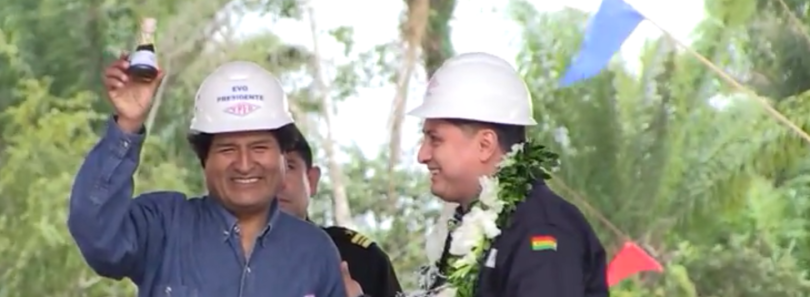
The Bolivian government of Evo Morales is enthusiastically celebrating two new finds of petroleum and gas this month, at the Boquerón-Norte well in the east and in the Lliquimuni block in the Bolivian Amazon. These findings come just as new presidential decrees have opened parks and environmentally protected areas to oil and gas drilling. You can get a flavor of the government’s excitement by seeing some of its image production around these finds.
First is this wordless video produced by Petroandina (the Bolivian-Venezuelan consortium of state-run oil companies) celebrating the construction of the test well LQC-X1, which began operation last December. Preliminary results presented this week place this block as the place where large-scale oil drilling could come to the northern Bolivian Amazon. The soundtrack befits a cinematic drama, and the intent is clearly to make drilling for oil into a national heroic endeavor.Read More »

I’m in Bolivia on a three-week trip to this country where political engagement, creativity, and reclaiming respect are watchwords of recent life.

This map, produced by the Bolivian Documentation and Information Center (CEDIB) shows the country’s national parks, biosphere reserves, and other protected areas in green, and both existing and planned oil and gas concessions. Oil and gas concessions are colored by the corporation involved, while light purple indicates blocks to be auctioned off in the future. The map appeared in CEDIB’s magazine PetroPress in 2013, where it accompanied a longer article.
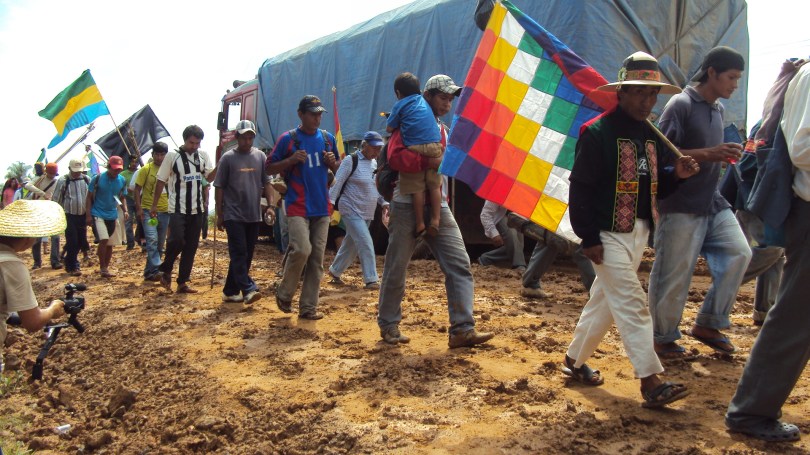
Bolivian President Evo Morales has renewed his efforts to build a controversial highway through the heart of the Isiboro Sécure National Park and Indigenous Territory (TIPNIS), a forested park that is home to over 12,000 indigenous people. The central segment of the highway would bisect the territory and accelerate already high rates of deforestation. Protests spearheaded by the Confederation of Indigenous Peoples of Bolivia (CIDOB) in 2011 and 2012 postponed its construction, while funding by the Brazilian Development Bank (BNDES) was withdrawn. The Bolivian government had previously said it would tackle extreme poverty in the territory before mounting any new effort to build the highway.
On June 4, however, President Morales told an audience in his home base of Villa Tunari, Cochabamba, that the project “will be realized.” His remarks followed on earlier statements leading up to the April regional elections and a May runoff that put the highway back on the official agenda. Now, with an overwhelming victory for Morales’ MAS party in Cochabamba and a very narrow win in the Beni runoff, the national government seems committed to restarting the project. In the president’s words,
On the subject of integration, good voices come from the new governors of Beni [Alex Ferrier] and Cochabamba [Iván Canelas]. The Villa Tunari – San Ignacio de Moxos, comrades, will be realized.Read More »
Re-posting from Breaking the Nuclear Chain (en) and Julio Lumbreras (es)…
Dear Evo Morales,
First of all we would like to emphasize that those who sign this letter consider themselves to be friends of the Bolivian people. We applaud what your government has done over the years for the welfare of the people of Bolivia, for the recovery of control over your natural resources as well as for social justice and the redistribution of wealth. We also support the strong stance you and your government have taken on the protection of the environment, with the institution of the Day of Mother Earth and the acts against the exploitation of food resources for purposes other than the nourishment of the people. Moreover, we have been fighting for years, in our countries and internationally, against military and civilian nuclear energy.
In this light, as friends, we have been surprised by the announcement of your government’s plans to start the process of building a nuclear plant in Bolivia.
We believe this to be a move in the wrong direction and we wish to explain why in the following few points. We also hope that this debate can be continued with the participation of the entire Bolivian society. We therefore welcome positions different from ours and are always available to participate in an open discussion with further contributions.
1) That for nuclear energy is a choice without return, and no visible end! No one knows precisely what it costs to dismantle a nuclear power plant, but it is likely to be comparable to the cost of constructing one; no durable solution for the disposal of radioactive wastes has yet been found. These wastes constitute a heavy legacy that is expensive to store and remains deadly for thousands of years.
This juicy news summary from the Guardian may be the least accurate thing you will ever read about quinoa in Bolivia: “Bolivian and Peruvian farmers sell entire crop to meet rising western demand, sparking fears of malnutrition.” Here’s why:
See also: Further information from the Andean Information Network.
Bolivia’s record on human rights came up for review by the United Nations’ Human Rights Committee* during its October session. As a state party to the International Covenant on Civil and Political Rights, Bolivia submits a report on its performance every five years. The Committee looked at that report and submissions from numerous human rights organizations in drafting a series of recommendations (Concluding Observations [es] | all documents from the process). In the UN committee’s view, the state of political freedom and social equality in the country is an uneasy balance between ambitious new legislative protections and inadequate practical implementation of national and international norms.
The Bolivian government has passed new laws to guarantee rights and combat discrimination, including norms against racism and other forms of discrimination (2010), violence against women (2013), and gendered political harassment (2012). While some regional commissions on racism are operating, the regulations to protect women from violence are still pending. A law on consultation with indigenous communities is also pending. The Committee criticized Bolivia for failing to respect the right to free, prior, and informed consent on projects and laws that affect indigenous peoples and their territories.
The Committee’s strongest criticisms refer to Bolivia’s overwhelmed criminal justice system. Investigations and prosecutions are slow, while prisons are overcrowded to 230% of their capacity. Four out of five people in Bolivia’s jails are awaiting trial, and the Committee suggested that alternatives like house arrest and location monitors could see many of them released. It said that those who remain should have the right to be housed separately from convicted criminals. A government amnesty plan is underway, but progress remains slow. Delays in prosecution are also creating a situation of impunity for those responsible for racist attacks perpetrated in 2008, the murder of two women council members in 2012, and police repression at Chaparina and Mallku Khota, among others. The Committee also urged further action to combat lynchings, as well as corporal punishment carried out in the family and traditional spheres of the justice system.
The Bolivian armed forces and police were singled out in a number of observations. A series of revelations of brutal treatment of conscripts and of beatings of prisoners have generated controversy, but there have been few successful prosecutions. The Committee also urged opening military records from the dictatorship era (between the mid 1960s and early 1980s), and the creation of an alternative to military service for conscientious objectors.
Finally, the UN Committee urged expanded protection of rights on several fronts. It argues that the current obligation for women seeking a legal abortion (in cases of rape, incest, and medical necessity) to get a judge’s backing contributes to maternal mortality and should be eliminated. It also urged new action to free hundreds of Guaraní families still trapped in servitude, and to criminalize violence against sexual minorities and transgender people.
* This Human Rights Committee is a body established by article 28 of the International Covenant on Civil and Political Rights.
Honor Brabazon and Jeffery Webber have just released a new research article on the state of agrarian reform in Bolivia under the government of Evo Morales. The paper, available as a pre-print from the Journal of Agrarian Change, offers a disconcerting look at the state of land redistribution six years after Morales signed a law promising community-led “redirection of the Agrarian Revolution.” The paper is compelling because it puts the experiences and views of the Bolivian Landless Peasants’ Movement (MST; the same initials as its better-known Brazilian counterpart) alongside hard data on the redistribution of land produced by the La Paz-based research unit Centro de Estudios para el Desarollo Laboral y Agrario (CEDLA).
I’ve previously covered the most dramatic shift in Bolivian land tenure on this blog, the dramatic reordering of large swaths of land into “Native Community Lands,” (TCOs) collectively controlled indigenous territories throughout the country that now constitute nearly a fifth of the country. The same process of clarification of land title was promised to yield a revolution in the prospects of landless and near-landless peasants. The data presented and translated by Brabazon and Webber shows that promise was not to be.
The story of land reform in Bolivia has long been a regional one. The sweeping 1953 Land Reform Decree was the product of rural uprisings across the Altiplano and the central Valleys which left the vast eastern lowlands essentially untouched. There, a relatively small number of landowners built vast export-oriented monocultural plantations over the next five decades. Both the predominantly lowland MST and Evo Morales spoke of these large holdings as ”latifundio,” oversized properties that deserve to be redistributed for the common good. However, land reform requires one of two causes to take away land from its owner. Either the field is used for illegal labor exploitation, or it is failing to fulfill its “economic and social function.” The latter term essentially applies to fields left in disuse for long periods. As it turned out, neither cause applies to the agribusinesses of the east:
the types and delimitations of latifundio designated for expropriation by the MAS government through the LRCRA and official policy documents are not those that predominate in the structure of the Bolivian agrarian economy; therefore, the large capitalist landowners who obtain rent from the land, along with the agrarian capitalist enterprises that obtain their profits through the exploitation of their salaried workforce, have not and will not be affected by the ‘agrarian revolution’. (19)
A small number of farms have been expropriated ”due to the presence of bonded labour, semi-slavery, slavery or other illegal labour practices,” but just 54,734 hectares. Another 855,823 hectares owned by medium- and large-propertyholders were incorporated into TCOs. But when the government speaks of “land redistribution,” it pulls out far larger numbers. As Brabazon and Webber point out, “the overwhelming bulk of these redistributed lands were transfers from various forms of state-owned lands (tierras fiscales) to TCOs” or even the re-categorization from one form of collective ownership to another. Meanwhile, “one-third of the [national] territory will remain in the hands of the medium and large agro-industrial firms.”
Brabazon and Webber provide a sobering conclusion: “The same social class that ruled over agricultural production in 2005 continues to rule today in 2012” (21).
In honor of #NewResearchThursday / #NRTh, one attempt to increase the content to signal ratio on social media.
 Carwil without Borders