Some English reporting on May 24…

A book on women in Bolivian social movements co-written by Alison Spedding, that I’ve been carrying with me for the last week or so incisively observed (in its opening literature review) that texts on the 2000 to 2003 period written by women tend to describe the specific impact of events on people involved, while those by men tended to assimilate events to their political argument. Unlike Cesar Brie’s documentary, these articles seem to follow the latter trend. Still, I wanted readers to have something other than my description to go by.


Wednesday: Anti-racism on the march, at least for a day, in Sucre

Monday night, I went to the well known scholars group Comuna on their biweekly meeting/event in La Paz. Instead of the usual talk though, they were hosting a video screening of a new documentary (by Cesar Brie–his poorly translated take on the events) rushed to production on the events of late May in Sucre…

To take a step back, the rapid advance of a largely indigenous grassroots left in Bolivia has been met by a polarizing of the politics here. Region (the highland west/center vs. the lowland east “the Media Luna”), race (native vs. mestizo-white), and divisions that capture both (Kolla vs. Camba) have been key dividing lines that are suddenly more visible. This is in part a reaction to the biggest line crossing of all, the presence of an indigenous peasant union leader, Evo Morales, in the presidency, but it goes beyond that.

In the east, particularly Santa Cruz, the white opposition has cottoned on to a long-running aspiration to autonomy for the department (think state in the US or province in Canada; provinces here are smaller divisions). This separatism has a youth wing, whose focus goes beyond separation to attacking and intimidating indigenous leaders and offices of the MAS party in national government. This wing, often with broader collaboration from the white opposition parties, have been threatening and carrying violence to disrupt what might otherwise be run-of-the-mill state functions involving Morales. This has reached the point where the President has been avoiding certain cities because regional governments are not guaranteeing his security.

So, back to the video. On May 24 in Sucre, Evo was set to preside over the awarding of ambulances to each province across the department of Chuquisaca, whose capital is Sucre. Right-wing youth and the anti-Morales mayor’s Inter-insitutional Committee urged Evo not to come, and threatened a confrontation. With local leaders from the countryside already on their way in, Evo backed down from attending. The rightists turned on the indigenous leaders, attacking with sticks and rocks. Several dozen fled to a house on the outskirts of town, only to be surrounded there.

They were escorted forcibly from there to Sucre’s main square, where a spectacle of public humiliation unfolded over the afternoon. Stripped to their underwear, forced to kneel, they had to endure insults, punches, and watch as their banners and the indigenous flag (or wiphala) was burned. The spectacle, captured by the mainstream media, continued for quite a long time.

In the judgment of the documentarian, the withdrawal of national police on the day happened because of a strategic decision to face and reveal what the rightists would do, rather than to confront them with force. If so, the price involved was paid by the indigenous leaders, whose pained after-the-fact interviews formed a key part of the documentary.

It was a hard film to watch, and left me in a pretty pensive mood Monday night. I had known that one in a series of racist outrages had happened in Sucre in May, and that the Women’s Summit would feature a public act dis-agression (desagravio) to repudiate it. But this was the first I had seen what was actually involved.

The whole situation strongly evokes what I’ve heard of the (US) Southern response to the Civil Rights Movement. How on front lawns, in jails, and with gunshots, the ugliest parts of a history of racism were revived to terrorize people organizing for equality.

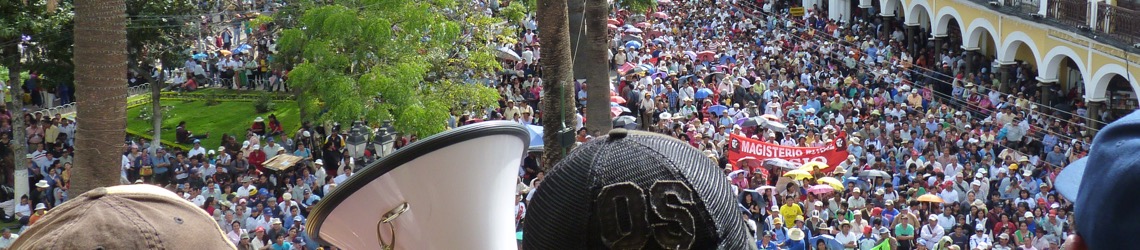
As it happened, today’s desagravio was a complete success. Leaving from the ministadium where the summit is happening, a march of over 1,000 people traversed all over Sucre, including the plaza where local leaders were humiliated. As women filed through Sucre’s streets, wiphala and Bolivian flags in hand, shouting slogans for unity and against racism, scores of people came out in the streets: a few hostile but calmed by our numbers, and many visibly relieved and excited to have the march there–applauding as the march went past.

Campesinas on the streets of Sucre

The act was a defiance of fear. For me, a little, and for the movement a great deal. It’s hoped that it can change the dynamic in the streets and in this department. The section I marched with had a frequent chant: “Viva la esperanza. Basta de racismo. [Long live hope. Enough of racism.]” For now, I just want to convey that it happened, and happened in peace and providing some inspiration.

Indigenous, Feminist and Campesina Women March through Sucre

Delayed blogging: Settling in

[June 12] It snowed yesterday in El Alto. Not what I expected when I took the microbus (read: minivan with signs) up to the University there. Verdict: winter is real.

The event that the snow and bad directions made me miss was held again down here in La Paz around dinner time… A professor and a Vice-Minister of Justice talking about redefining policies of criminalization in a plurinational society. The first talk was very provocative–lots about how criminal law (and incarceration) are a last resort for resolving conflict, and we need to think first about the mechanisms creating for mediating conflict. Also, a question I’ve never heard asked before in such a forum: how do we solve the problem of those in prison always, under any type of government, consisting almost entirely of the poor.

There’s a lot of through-the-looking-glass style experiences of ideas you’d never expect to come out of an official’s mouth.

And then there’s the altitude (which has slowed me down, but hasn’t thrown me for a loop yet), the sudden lack of daylight hours, and being in a very different city. But I’m well, and housed for the next week or so here in La Paz (two floors above the crazily beautiful but excessively spacious place I looked at a couple days ago).

Blogging from Bolivia…

I’ll be in Bolivia for at least the next four weeks, and Ecuador after that. I’m flying to the Andes to get an up-close look at the very remarkable social changes that have been going down here since 2000. I’m feeling very curious and optimistic, and here’s a bit of why…

In January 2000, with many of us freshly back from the WTO protests in Seattle, we were still thinking in terms of cracks in a monolith of corporate-backed power. A “Washington Consensus” imposed policies on Latin America that would be unthinkable in the U.S.–rolling back guaranteed social services, accelerating the growing extraction of oil, gas and timber, privatizing resources like water, and assigning the costs largely to the poor. It was called structural adjustment, because it was negotiated to make the debts owed by the countries of the South payable, but with everyone selling off their country at lower and lower bids, it never even balanced the books.

Ecuador’s January 2000 national uprising was the first of many to topple a neoliberal government, even if only for a few days. It wouldn’t be the last time mass unarmed movements succeeded in doing so. A few months later, tens of thousands in Cochabamba, Bolivia occupied the center of their own town in the culmination of a months-long conflict with Aguas de Tunari (owned by San Francisco’s Bechtel), who had assumed private control over the cities water supplies and proceeded to double (or more) the bill. The privatization was reversed and the city’s water system is now a massive experiment in a community controlled utility.

Life in both countries has simply gotten a lot more interesting each year since. Stay tuned for the latest.

FBI Informants Tracking Terror, or Manufacturing Terror?

Inside the Green Scare

Elle Magazine has a profile piece of “Anna”, a young woman who volunteered to be an informant for the FBI on the anarchist scene. As it turns out, she was lurking at at least a couple of gatherings I’ve been to, the late 2003 protests against the Free Trade Area of the Americas in Miami, and the 2004 RNC protests. The presence of a an infiltrator, pretending sympathy and often acting as a street medic, honestly, makes my skin crawl. It is all the worse for those she developed seemingly long-term relationships with, and worst of all for Eric McDavid, now sentenced to some 20 years in prison for something he never actually did, but was co-planning with FBI informant/pseudo-anarchist Anna.

And of course, it only strengthens the argument for those many times when the most compelling direct action strategy relies on bringing people in, and generating the numbers to do what a few people with the option of surprise can’t.

Anyway, you can now meet the informer, in Elle’s profile article, posted on Indybay for what seem to be solid fair use reasons. It would be unfair to not let people on Eric’s side respond, as one does anonymously here. See also Friends and Family of Eric McDavid.

p.s. More from CrimethInc.

Update: This is still one of the most visited articles on my blog. You can read a broader context on conspiracy charges as a tool of repression, and how to respond, in “The Age of Conspiracy Charges” (I wouldn’t go that far in naming it.).

And the Black & Brown Scare

Meanwhile the Liberty City 7 case, charging seven poor men in Miami with an “aspirational rather than operational” plot to attack the Sears Tower, gets ready for a third trial.

Serious coverage on that is also available at the Black Agenda Report.

Your rights in New York

bag search on the subwayHaving people visit from out of town is a reminder of what inconveniences & impositions we get used to living in New York. Aside from the random convergence of police cars in downtown & midtown to practice, definitely one of the most unnerving is the randomly asserted right to search your “large backpacks and packages” on the subway. Somehow, the knowledge that this search is not exactly mandatory, courtesy of the Fourth Amendment (that whole “search and seizure” thing), and therefore can be refused, makes me feel better. So as a public service to New Yorkers, here’s what you can do if you’re not interested in your bag being searched:

If you choose to walk through a random search area and are stopped, you may refuse to be searched. In fact, Police Commissioner Raymond Kelly has said that you are free to “turn around and leave” any subway system where police are conducting random searches.…Calmly and clearly say “Officer, I do not consent to any searches. I’m going to exit the station.”Then immediately exit the station — and do not return through the same entrance.  

Thank Flex Your Rights’ Citizen’s Guide to Refusing New York Subway Searches for this information, and this handy (if somewhat alarming) flyer.More on how to expand your First Amendment rights in New York City soon… 

Ongoing protests against war in San Francisco, Washington

New York: At least seven people blockading the entrance to L-3, a military and intelligence contractor which had interrogators at Abu Ghraib, were arrested this morning, in a protest that had the support of a couple dozen early morning antiwar protesters.Larger actions are happening in the national capital and the capital of the Left Coast…Washington: Civil disobedience at the IRS, multiple locations to follow.San Francisco: A network of mobile protests, office blockades, and a die-in closing Market St. at the moment is going on. News is available by radio at 102.5 FM in SF, and online at radio.indybay.org and the SF Bay Independent Media Center. Read the plan from Direct Action to Stop the War.Was it worth it?

GNN on Tibet struggle

The video collective Guerrilla News Network’s recent documentary on the Tibetan exile drive for independence asks some provocative questions, especially now that fighting back against the police has emerged as a tactic in recent days.

September 11th was a tragedy for the American people, but it was a boon for totalitarian regimes around the world. In the pursuit of its so-called “war on terror,” the United States has forged military alliances and inked trade deals with some of the world’s most repressive regimes. On September 13, 2001 China was quietly admitted to the World Trade Organization, and given Most Favored Nation status by U.S., despite the fact the country is one of the world’s worst human rights abusers.

With its economy booming, China has become desperate to exploit Tibet’s vast mineral and fuel reserves – and that has meant keeping a tight grip on any moves towards Tibetan autonomy. Arrests, torture and destruction of local culture continue despite the tireless work of Tibetan exiles and their high-profile western allies. In fact, the situation grows more dire by the day. Yet unlike an increasing number of indigenous liberation movements, Tibetans have not resorted to violence to achieve their goals.

In Faith in Exile, GNN asks, “Does the non-violent resistance of the Tibetan people provide a valuable lesson for a world in turmoil?”

The war “plan” that wrecked Iraq

As someone who was watching the US government march to invade Iraq from the streets of San Francisco, and from countless antiwar events, giving more of an insider’s view has been both chilling and darkly fascinating. A big help is last summer’s PBS documentary, No End in Sight.

Strangely for me after watching the film last night, this morning’s New York Times covers one of the main hidden histories exposed by the documentary. Early on in the occupation, sometime in the month of May 2003, a few highly placed Defense Department officials decided to disband the Iraqi army, without so much as asking Secretary of State Powell, National Security Adviser Rice, or the U.S. Army.Plans to screen and reconstitute the force were pushed aside, and Iraqi officers offering help had to be ignored. The Army’s head of policy in Baghdad, John Hughes remebers:

Later, a battalion commander from the 101st Airborne came in—to see me, and he said, “Hey, sir, I’ve gotta talk to somebody, I’ve got a group of Iraqi generals and colonels that want to talk to somebody from ORHA.”

And they—over the course of the war, even before the war, had been removing computers and software —of personnel lists from the Ministry of Defense and storing them at their home, because they knew they were not going to win this war.

And they wanted to help reestablish the Iraqi military with the Americans.

…

Absolutely. And I took intelligence officials with me to meet with these men. And these guys were willing to—to explain or provide information on anything that they could.

They were saying to me, “Colonel Paul, Baghdad’s burning. You tell me, and I can have 10,000 military police ready for you next week.”

I took that back, nothing ever became of it.

We were also going to—take some Iraqi units and let them become the labor force for reconstructing Iraq. If you needed the rubble from a bridge cleared, they would do that. And there on the news one morning was the announcement that the Iraqi army had been disbanded and abolished by—Ambassador Bremer.

You want to talk about feeling like the ugly American, that’s what I was. You know, here I was, trying to work with these men, to help them rebuild their country, to—to bring their soldiers under some semblance of control. And instead, they’re told they’re not worth the time.

Just two months later, lines had been drawn, and another reality began to unfold:

Hussein Saber shook with fury as he lay on a dirty hospital bed last night and told the story of another day in Baghdad, a city torn apart by killings, misunderstanding and the startling failures of America’s military occupation.

Yesterday Hussein, 33, should have collected a $50 (£30) emergency payment which all Iraq’s now unemployed soldiers are due to receive. The money did not arrive and so he and hundreds of other frustrated young men poured towards the gates of the US-led authority to protest.

Within minutes he was shot in his right side by a young, nervous American soldier. Hussein survived but two other Iraqis standing next to him in the crowd were killed.

…

“I hoped and I wished that when the American forces came they would bring us democracy and freedom but unfortunately we have seen the opposite,” said Hussein, a non-commissioned officer in the air force for the past 18 years. “The Americans are going to get hurt if the situation remains as it is.” (Rory McCarthy, “Just another day in Baghdad,” The Guardian, June 19, 2003)

Normally, I’m cautious about getting too deep into debates among war planners. The argument usually turns into some idea that if only more competent people were in charge, everything would go smoothly. In the context of one country ruling over another country, such an outcome seems extraordinarily unlikely. However, it is people who strive to do their very best under whatever circumstances that leave behind the archive and their regrets, both of which help us understand how an enterprise like our new colonialism could ever have happened.

This news and a lot of details in the film raise a deeper question. Aside from proving that a high tech, high corporate profit, but smaller military without the bother of too many actual American citizens on the ground, did Rumsfeld and Bremer have plans of their own? Was leaving Iraq in chaos, whatever the motive, something they were consciously pushing their colleagues and superiors aside to do?

When “up and coming neighborhood” means losing your home…

While in Washington, I stayed just in my old neighborhood, Adams Morgan. Just blocks away, a new Metro station opened just before I moved out, and the eight years since have seen enormous investment by developers in the Columbia Heights neighborhood. Usually, the corporate media is there to celebrate moments like this, producing headlines like this one in the Washington Post: “A Rapid Renaissance in Columbia Heights: Retail-Based Renewal A Contrast to ’60s Strife.” Gray Brechin’s phenomenal history of San Francisco, , makes the point that this is rarely a coincidence, and that major newspapers have long had a financial interest and close family ties to real estate developers.

This left me walking through the box-stores, remaining affordable apartments, and new luxury condos with a friend who spent time organizing, and occupying abandoned buildings, with Homes Not Jails in the District. We were left to talk about the horrible fact that new, shiny buildings force one to cringe about who got pushed out. Now, some local organizing has meant that tenants in some buildings have gotten upgraded housing, but that’s not the whole story.

As it turned out, the very next morning the Post redeemed itself a bit and started publishing a series on how landlords have pushed out their lower middle class tenants to sell buildings as condos. Called Forced Out, it’s good reading for what displacement looks at the level of a neighborhood. In this case, the one I used to live in.

Dozens of landlords refused to make repairs, forcing families to live in filth — at times without heat, hot water or electricity. Other landlords delivered urgent letters or mass notices demanding that tenants leave.

In the past four years, landlords emptied more than 200 buildings from Columbia Heights to Southeast, most of them rent-controlled, thwarting the intent of one of the nation’s toughest tenant rights laws with the approval of the city government, a Washington Post investigation found.

It was the hidden toll of a frenzied condominium boom that turned aging neighborhoods into coveted urban communities.

In one building, what D.C. Council member Jim Graham, called an “aggressive, relentless” campaign to empty the building, was followed by a fire:

Within hours of the November 2006 fire in Adams Morgan, investigators declared arson: Inside the apartment building, they found a charred plastic container that had been filled with a mixture of gasoline and alcohol, stuffed in a plastic shopping bag. The liquid was poured in the basement near 12 electrical boxes and on the second floor, just below Begum’s apartment. Flames quickly choked the building, searing walls and melting lights.

Net result, everyone had to move. The landlords sold the property for $4 million.

On the South Side of Chicago, this was the story of the 1960s and 70s, when absentee landlords bailed out of responsibility and took the insurance money and ran. The vacant lots weren’t always vacant. In the District, the fires seem to still be burning today.