On Charles McMillian, outstanding witness in the murder of George Floyd

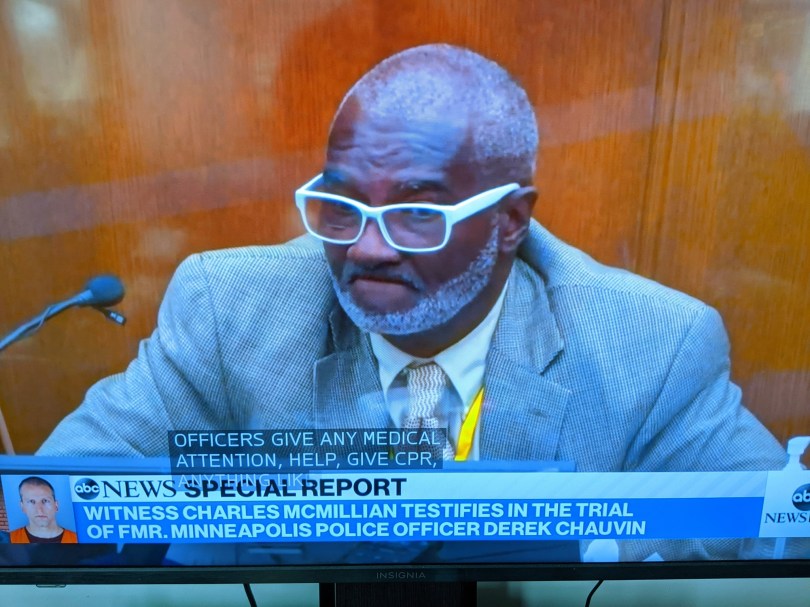
This is Charles McMillian, who begged George Floyd to do anything to survive, and who begged Officer Chauvin to stop killing him. I love this man’s courage, his caring, his ability to put on a suit and hope that his words will matter in the trial of Floyd’s killer in the way they didn’t matter in the moment Floyd’s life hung in the balance, and I love him in his grieving for the helplessness of that situation in public.

It was and remains a crime for him to have lifted a finger; and more importantly to have pushed a cop aside to save George Floyd’s life. It was and remains a crime for the teenager who knew it was wrong and made a video record for the world to take that killing knee off of that dying neck. It was and remains a crime for the bystanders who tried pleas, who tried insults, who tried logical reasoning and public shame to just stop the killing. Had they touched the killer, it would legally have been assault. More importantly, had the killer responded by shooting them, I doubt we would even be having this trial.

It is a wrenching injustice that in May 2020, Charles McMillian was forced to beg George Floyd to try to save his own life. As much as it is a wrenching injustice that George Floyd’s anguished reply was “I can’t.”

This is the danger of investing some people with the power of being the law. And the danger of failing to strip them of that protection when they turn their badge into a license to abuse and kill.

And also, the fact that Chauvin did this in front of our elder, our youth, our children, our cameras all mean something. That he did not relent in his killing act even when George Floyd was dead. He must have needed to show that all their cries would go unheard. And he acted in the tradition of a long line of white men and law men brutalizing one of us in public to terrorize us all.

March 31, 2021

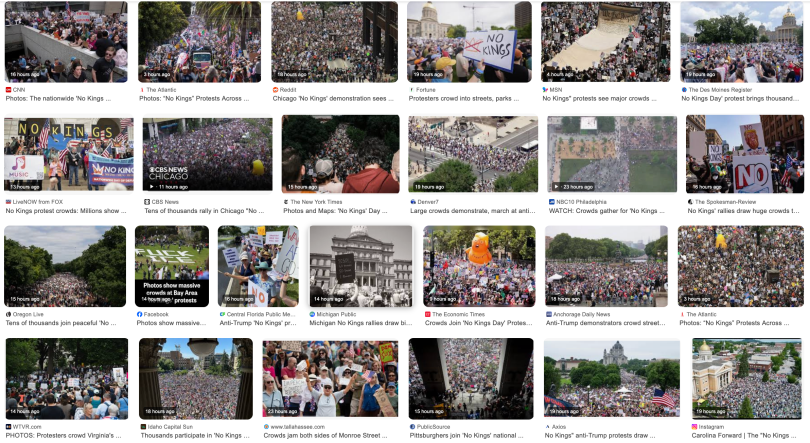
Grid of images of No Kings protests on June 14, 2025

No Kings protests were extraordinary. How exactly?

Americans, citizens and immigrants alike, protested on Saturday, June 14, in exceptional numbers as a wave of No Kings protests became the most widespread public repudiation of the second Donald Trump administration. These protests, which were undoubtedly energized by the standoff between Los Angeles-area communities and Federal troops, could mark a turning point from isolated protests to mass resistance.

Protests are called demonstrations for a reason. And these were displays of political strength for a movement that has a lot to prove: that it better represents the country than a president elected with a slim plurality in November 2020, that it is better able to capture public enthusiasm than an incipient fascist movement, and that it is undeterred by the state violence shown through military deployments, arrests of opposition leaders, and near-disappearances of a growing number of immigrants.

So what does success look like for a mass display of public will?

One simple metric is comparative: did a the anti-Trump movement out-organize and out-turnout their opponent. And here, the juxtaposition with Trump’s military parade — a celebration of the US Army’s 250th birthday on Trump’s 79th — will be unforgettable.

The King’s Parade vs No Kings Protest

News Eye (@newseye.bsky.social) 2025-06-14T22:36:16.034Z

But in a larger sense, protesters make a political statement through crowds (and yes, through many other kinds of actions, but June 14 was largely a day for crowds). When they succeed, that message is “indisputable in its overwhelmingness,” as Argentina’s Colectivo Situaciones described the protests that brought down three presidents on December 19 and 20, 2001. Through some alchemy of place, time, presence, voice, and action, crowds constitute themselves into the “The Voice of the People.” And assert that they, and not their government, will decide the future.

I want to use this occasion to share how those of us who study mass protest try to conceptualize just how protests achieve that kind of political impact.

Charles Tilly, who with various colleagues has probably done the most to examine the protest demonstration as political form, has a four-word summary of what protesters are actually demonstrating. And Tilly’s model is interesting in part because it situates demonstrations as just one form of collective political action (or “contentious politics”), alongside riots, strikes, revolutions, and among many other attempts at disruption or representation. Demonstrations are a social transaction where movements accept that a government system will persist, but where governments are moved to recalibrate their actions based on shifts in popular support and public mode. In that frame, Tilly et al. argue that protesters are engaged in displays of WUNC: worth, unity, numbers, and commitment.

  • Worth: Protesters present themselves as worthy of political participation, rather than exclusion from decisions about their own fate. This might be especially relevant for groups, from working-class laborers in the 19th century to women in the suffrage movements to minorities of various enfranchisement movements, who are formally excluded from participating in official politics. This is self-presentation as an argument that one deserves a place at the table.
  • Unity: Protesters come together and present a common voice. This may be the most basic element of what a common protest is, and everything from a speaker’s dais to roars of approval to marching side-by-side demonstrates this unity of purpose, both to participants themselves and to their audience.
  • Numbers: The size of a protest illustrates the larger capacity of a movement to catalyze political action, to show up again, and to influence democratic outcomes. When the 2006 immigrant protests promised, “Hoy marchamos, mañana votamos / Today we march, tomorrow we vote,” they were offering their quantitative weight to political actors that would accept their agenda.
  • Commitment: To a greater or lesser degree, protests demonstrate the willingness of participants to do hard things, to devote a share of their time to political action, and to make sacrifices for a cause. This is why long marches, gatherings in spite of rain or cold, and endurance of repressive violence—fire hoses, dogs, tear gas, projectile weapons—are so impactful. And why activists can create their own endurance tests—sit-ins, extended vigils, hunger strikes—to show others what they are willing to do.

What‘s great about this framework is that it doesn‘t just make sense of how movements have an impact, but also gives some sense of what goals organizers might have in choosing different protest forms.

But when I tried to understand the movements I have worked with, I came to feel that other dimensions were important as well. As I’ve written: “But what if grassroots movements see themselves not just as claimants before the state, but as a rival power to it? What if they claim a bit of sovereignty for themselves? The mobilized communities described here do use their unity and numbers to illustrate their claim to represent the public as a whole. To create the shared impression that “everyone” is part of a mobilization, however, they also highlight diversity among themselves and carry out geographically expansive protests. And they demonstrate effective practical sovereignty over urban spaces and persistence in the face of state violence.”

These are, I think, four new dimensions. A mobilization that claims sovereignty has worth, unity, numbers, and commitment, but is also diverse, widespread, irrepressible, and in control. What do these four adjectives mean?

  • Diverse: This includes and goes beyond the intersectional identities notion of diversity. Yes, it’s about including those oppressed, marginalized and excluded. It is those who were scorned claiming political voice. But also yes, it’s about joint action across lines of difference, showing people working together despite privilege and division. It is uniting to fight together. And yes again, it‘s about those sectors of society that have been pitted against each other finding common cause. It’s realized though unexpected juxtapositions: Teamsters and Turtles together at last, the office worker in a suit throwing back a tear-gas canister.
  • Widespread: Movements demonstrate their political significance by being ubiquitous: We are everywhere. At the height of their water privatization protests, Cochabambans moved to erect road blockades on every street they could find. And in the United States, we’ve seen a move since at least Occupy in 2011 to maximizing the number of protest locations. This was definitely a feature of the 2020 Black Lives Matter protests, possibly the most widespread protest mobilization in American history. Here in 2025, No Kings seems to have doubled down on this strategy, meaning that many metropolises could boast multiple urban and suburban protests on the same day: as many as fifty separate locations in the San Francisco Bay Area. Much of the celebratory sharing that happened yesterday was geographical, with images from places like Boise, Salt Lake City, or Hattiesburg (Mississippi) treated as mic drop moments.

Do you know how badly you have to screw up as a Republican to get this kind of turnout in IDAHO? #NOKINGS

Heather M. Collins🗽 (@heathersdesk.bsky.social) 2025-06-14T19:44:59.284Z

The last two elements of my list may just be at the horizon for the current protest wave in the USA, but they mark out where things could go as the protester–government standoff evolves.

  • Irrepressible: When a movement surges back in to the streets after repression, it showcases the limits of state power. This feeling is definitely significant right now, with these protests surging both in places where police and military violence was displayed over the past ten days, and showing up in new places in outraged reaction. Anyone who has been on the streets when police have backed down, or gave up their hold on even a block of the city to allow protesters to surge in, knows the electricity that goes through a crowd that has lost its fear and disempowerment. Finding ways to protest through, or in spite of, physical attempts to prevent you from doing so is a powerful political statement.
  • In control: Beyond that, lies the experience of protesters actually choosing what happens in the streets. Of public collective decisions on what happens next. This is why certain kinds of rallies and assemblies are uniquely empowering, because people choose on the spot what do, where to go, how to escalate, and whether to persist until their demands are one. The collective experience of direct action is its own unique form of self-empowerment.

The United States is a massive country with many cities, countless communities, and many, many places of gathering. It’s an exceptional challenge to walk forward through the different kinds of collective power sketched out here all at once. When face-to-face in one place we can get a sense of our potential, but we’ll need to find ways of keeping track of that across many settings.

Synthetic journalistic, movement media, and academic accounts can give us perspective, and I hope this outline of elements of power can help orient those accounts. Counting the number of locations, as being done by the Crowd Counting Consortium, is vital information. Yet summaries of crowd size and dispersion are useful, but also not enough. We need to thicken these accountings of where and how many with considerations of which alliances are emerging, which sectors of society are participating, and how daring and how contagious actions are. As well as what is working despite the kinds of force directed against it.

In the past, with thinner forms of communication and a greater reliance on centralized mass media, singular national protest gatherings may have been more important in building this shared sense of working together and achieving power. So did roving concentrated mobilizations, whether that was the trail from Birmingham to Freedom Rides to Selma to Chicago, or from Seattle to DC to Cancun to Miami. Now, in part because the adversary is more directly the national government, an Everything Everywhere strategy seems to be taking shape.

Front cover image from l'Humanité, a Paris newspaper. Shows a confrontation on a highway between black-clad soldiers and American civilians, one of them holding an American flag.

Resistance to Trump reaches its first turning point

“The Whole World Is Watching.” It’s been decades since American protesters chanted this sentence at American police in an effort to deter violence and brutality. But it has perhaps never been more true than right now. The political drama of the USA in 2025 has the world riveted, and I as I walked through the modern train station in Potsdammer Platz, built where the Berlin Wall once stood, the face offs, a pillar at the bottom of stairway brought the confrontation between Federal troops and Los Angeles protesters to life in the middle of Germans daily commute.

And without a doubt, Los Angeles marks a dramatic new turn in the authoritarian rollout of the second Trump Administration. After months of high-consequence policy changes and comparatively isolated forms of protest, the situation is shifting towards an open confrontation and nationwide resistance. The Immigration and Customs Enforcement (ICE) raids on everyday Angelenos have prompted a public reaction by a community that doesn’t have the luxury of waiting until November 2026. And the president’s long-advertised desire to confront protesters with the United States military is finally being realized.

Both the roundup of ordinary civilians and the militarization of American cities push beyond existing expectations. They embody the threat of a different country, one where freedom is utterly denied to a millions and dramatically curtailed for the rest of us.

Everything I’ve said so far is, I think, obvious whether one is within range of the tear gas, across town, across the state, or across the ocean. But that’s not why I write this post. Instead I want to share a bit of perspective as someone who spent a decade puzzling through the sometimes deadly and sometimes transformative dance between protest and repression, including how Bolivians flipped the most heavy-handed domestic military deployment into the forced end of a presidency.

First and foremost, state crackdowns like Trump’s deployment of the National Guard and the Marines are exceptionally risky moves for rulers. The repressor imagines that such a show of force will rapidly bring about a scene of submission: arrested or injured opponents, a fearful majority of the population, and a quieter country. But the truth is, there’s no single outcome when an unarmed populace faces down an armed military. And nothing demonstrates a government’s weakness more powerfully than when even its deliberately trained soldiers can not obtain compliance with its orders.

Second, a crackdown in one place can kick up either mass demonstrations of repudiation or many sparks of daring rebellion across the country. Or both, which is what the invasion of Los Angeles has appeared to do this week. Spreading out protests when repression is concentrated is a winning tactical approach.

Sometime in the coming days or weeks, American protesters will make the turn from a solidarity movement with Los Angeles to a national mobilization in defense of freedom and democracy.

Third — and these may be the two ideas I most want to share widely because they is not common sense to many Americans — widespread confrontational protest and massive shows of popular opinion are both essential, and need not be in competition with one another. In Bolivia, in Argentina, in Thailand, in Ukraine, in Egypt, and in Chile, people who succeeded in national political turns did both of these things. As seen this week, acts of confrontational action can deter or delay the mass detention and deportation of our neighbors; they also can hold space in times of protest. On the other hand, acts of mass participation literally demonstrate that the public rejects a government and its policies. They create moments of collective purpose that strengthen their participants and remind allies elsewhere that they are not alone, and that we can win. (See below the line for how I described them working together in Cochabamba, Bolivia.)

This month, and especially this weekend, people primarily oriented around one or the other of these goals will likely be side-by-side in the street. Those who define themselves around what I’ve called “The Tactical Argument of our time” (whether nonviolent action can/is better at/is necessary for/could never/is counterproductive to bringing about revolutionary change), may be primarily worried about whether their preferred tactical approach is being permitted or blocked. My suggestion instead is to consider how much more powerful this movement could be if both flourished. And then to do the work of both helping people stay safe(r) as they speak, act, and resist.

Solidarity from Berlin.


p.s. Here’s how I described these two sides of successful uprisings in my research on Bolivia:

To win, the Coordinadora had to wield mass pressure, establish its legitimacy, gain a seat at the bargaining table, and convince the government to completely reverse the privatization. The moment of mass pressure involved blockades and other disruptive actions to win the annulling of the contract. The moment of legitimacy consisted in convening assemblies, cabildos, and an unofficial referendum or consulta popular to register public opposition to water policies. … While pressure and legitimacy represent two distinct moments of the mobilization, they worked in tandem, like two legs walking: Road blockades organized across the city and the surrounding region built up into an overwhelming civic strike, while marches flowed together into large-scale meetings called cabildos, often held in the central plaza. The civic strike was the cabildo’s operative arm, its means of exerting pressure; and the cabildo was the strike’s brains and voice, the only place from which it could claim sovereignty. Without either, the Coordinadora and the Water War it fought, would have amounted to nothing.

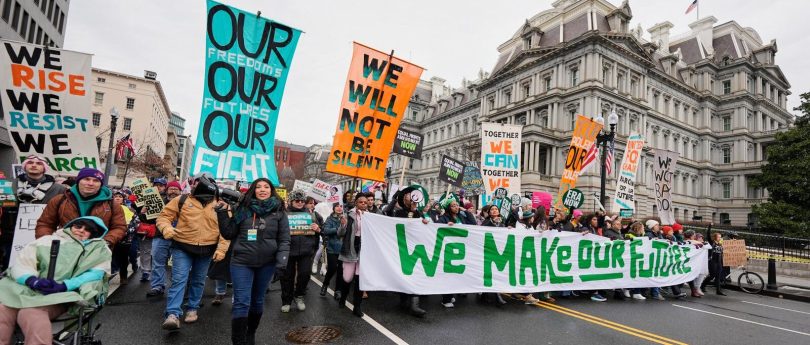
People's March, Saturday, Jan. 18, 2025, in Washington.(Mike Stewart | AP Photo/Mike Stewart)

Trump’s authoritarian turn is everyone’s problem

It’s May 2025, and it feels like every new conversation (in my circles? in the United States? far beyond that?) needs to start with an acknowledgement of the bleak bigger picture on the national and global stage. Like every How are you? could be personal, but could also be a How are you coping with these unfathomable times?

In my circles, a short phrase circulated in 2020–22: “Pandemic fine.” It was a way of addressing this uncertainty, this complication, this brokenness in brief, humane terms. With an unspoken subtext something like this: “My loved ones and I had a reasonably good day, though before bed I will be checking the charts that reveal that 2,592 of my countrymen have died yesterday of a disease that didn’t exist three years ago. And that reasonably good day was made as we navigate all the ways we know to live differently to make that number a bit smaller than it otherwise would be.”

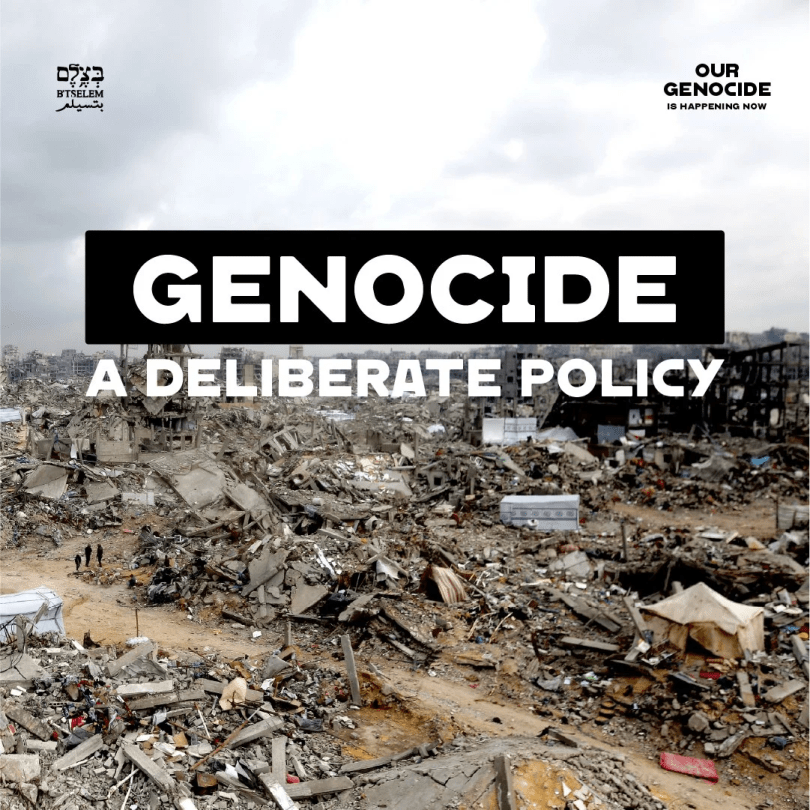
Also in my circles, this attentiveness and yet also disconnect around the COVID pandemic was eventually displaced by the mounting horror of the Israeli genocide in Gaza. Which is something we didn’t have to plan our everyday behavior around. But which was present in our consciousness in a new and visceral way. The first live-streamed genocide brought us inches away from a tide of human suffering and calculated cruelty that was unimaginable. And while it felt like awareness of this new horror was uneven in the United States, the half or more of us who were aware could not look away. Our day-to-day lives coincided with both this atrocity, and with the broken promise of post–World War II life: “Never again.”

Less publicly, and I imagine among a smaller set of Americans than these last two, a dawning realization of the reality of massively disruptive climate change came up again and again in 2024. The city-shaking and sometimes city-shattering disasters that accompany the global rise in temperature knocked on more places I know in 2024, most memorably Asheville and Los Angeles. Those of us for whom climate is an area of expertise know the worst is still yet to come, and in the absence of rapid emissions reductions, the tempo and scale of these disasters will only rise. Among ourselves, we talk about the opposing demands for hope and clarity. and we mourn those places and lifeforms that can no longer be saved.

And for the United States, a further damaging shift came in with the Trump administration, and its dramatic efforts to take off the limits on repressive power; stigmatize and reverse efforts towards racial and gender inclusion; and dismantle a swath of institutions. We’ve see a former president who dreamed of being a dictator hire a phalanx of officials who are actually working to make him one. Moves from an authoritarian playbook are underway in the American state, even as crown jewels of that state — the Centers for Disease Control, PEPFAR, the National Endowment for the Arts , the list goes on — are cast aside. The White House directs a crackdown on the most vulnerable while also starting fights with pillars of its own power: the Ivy League, elite law firms, the Federal Bureau of Investigation.

Here there has been no silence. The details are too incredible, the variance with routine channels of action too extreme, the impacts too widespread for us to not bring these things up, just when we check in with each other. Public protests have popped up at a much faster pace this year than in 2017, with sustained regular demonstrating turning into a feature of the political landscape.

Department of Homeland Security (DHS) Secretary Kristi Noem receives a tour of the Terrorist Confinement Center CECOT with the Minister of Justice and Public Security Gustavo Villatoro in Tecoluca, El Salvador, March 26, 2025. (DHS photo by Tia Dufour)

But also, the warning signs of a more repressive turn are real and obvious: snatch squads targeting outspoken student activists; the use of immigration enforcement as political police; unaccountable detentions of lawfully arriving visitors; and the out-of-country imprisonments in El Salvador’s no-way-out prison CECOT. Again, those of us who have made our lives work studying such systems of power, as well as those who grew up living through authoritarian turns, are unified in seeing the dangers here.

Okay, so now what?

We’re up against a wildly ambitious White House intent on turning the US government into an authoritarian state, but also a White House that is doing so with self-weakening abandon. Starting from a bare plurality of voters, and the smallest possible majority in Congress, it is pursuing a maximalist agenda by largely ignoring the legislative process altogether. Its attacks on diversity, on queer rights, on opposition figures personally push otherwise moderate people into opposition. Its crudeness inspires more revulsion than it does participation. Trump’s absolutely Nixonian inability to treat powerful opponents differently than he does powerless ones continues to generate shock and outrage.

After a winter of cowardice, capitulation, and collaboration — with CBS, Columbia University, and the tech oligarchy as its most visible symbols — there’s a new balance of initiative. There will be battles in the courts, defiance from campuses, insubordination in federal offices and occasional bravery in state houses, and many, many reasons to get out in the streets.

Much of US activist practice is centered on raising awareness and visibility. But nothing could be more visible than the situation we confront. (We can retire the bumper stickers that say, “If you’re not outraged, you’re not paying attention.” Everyone is paying attention.) We’ll have to learn the forms of praxis that transform numbers into disruption, and disruption into power.

But I like our emerging coalition. And I like our chances.

Lead Photo: People’s March, Saturday, Jan. 18, 2025, in Washington.(Mike Stewart | AP Photo/Mike Stewart)

Inset Photo: Department of Homeland Security Secretary Kristi Noem receives a tour of the Terrorist Confinement Center CECOT with the Minister of Justice and Public Security Gustavo Villatoro in Tecoluca, El Salvador, March 26, 2025. (DHS photo by Tia Dufour)

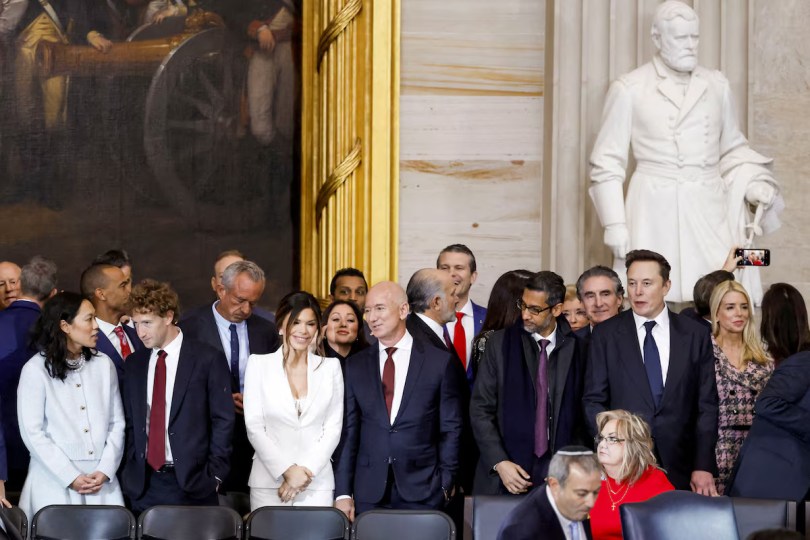
(L-R) Priscilla Chan, Meta CEO Mark Zuckerberg, Lauren Sanchez, businessman Jeff Bezos, Sundar Pichai, and businessman Elon Musk, among other dignitaries, attend Donald Trump's inauguration as the next President of the United States in the rotunda of the United States Capitol in Washington, DC, USA, 20 January 2025.

Prom for the US tech oligarchy

It was an inescapable image of the 2025 presidential inauguration: the joint appearance of Mark Zuckerberg (CEO, Meta), Priscilla Chan (co-CEO and operating leader of the Chan Zuckerberg Initiative, and Zuckerberg’s spouse), Jeff Bezos (founder, Amazon) Lauren Sanchez (Bezos’ fiancée and co-chair of the Bezos Earth Fund), Sundar Pichai (CEO, Alphabet/Google), Elon Musk (CEO, Tesla, SpaceX, and Twitter), Tim Cook (CEO, Apple), and Sam Altman (CEO, OpenAI). Upstaging governors and the incoming president’s cabinet, this roster of the giga-rich offered the blessing of the Silicon Valley to President Donald Trump and offered themselves as an on-stage symbol of what has been variously named the tech–industrial complex (by outgoing President Joe Biden), the Broligarchy (by Carole Cadwalladr among others), the attention economy (by Chris Hayes), and less recently surveillance capitalism (by Shoshana Zuboff).

If the inauguration served as something of a prom for tech oligarchs, it’s also a critical moment to think about how their power operates. It’s both quantitatively more extreme than prior rounds of monopoly capitalism, and tied to extraordinary ideas about future sources of wealth. As individuals, the founders and CEOs atop these corporate entities have way more power than even US corporate tradition usually provides.

The extraordinary personal concentration of dollars and power

First off, there’s a LOT of wealth in that one row: $653 billion among Chan, Zuckerberg, Bezos, and Musk

Google’s Pichai holds $1.3 billion, but he stands in the shadow of founders Larry Page and Sergey Brin, who have $266 billion together. The gap between Google founders Page and Brin, and current CEO Pichai highlight an staggering first-mover/founder advantage in many Silicon Valley firms, entrenching enormous wealth in early owners of these corporations. And these gaps are enabled by a corporate structure that provides founders with enormous voting power and disproportionate ownership of what eventually become large corporations.

Within the companies, they hold an extra level of voting power that exceeds even their share of the wealth.

One way that Google’s founders institutionalized their freedom was through an unusual structure of corporate governance that gave them absolute control over their company. Page and Brin were the first to introduce a dual-class share structure to the tech sector with Google’s 2004 public offering. The two would control the super-class “B” voting stock, shares that each carried ten votes, as compared to the “A” class of shares, which each carried only one vote. …
This arrangement inoculated Page and Brin from market and investor pressures, as Page wrote in the “Founder’s Letter” issued with the IPO: “In the transition to public ownership, we have set up a corporate structure that will make it harder for outside parties to take over or influence Google.… The main effect of this structure is likely to leave our team, especially Sergey and me, with increasingly significant control over the company’s decisions and fate, as Google shares change hands.” (Zuboff, Surveillance Capitalism)

This makes actually-existing Google and Meta a lot closer in internal power dynamics to Elon Musk-owned Twitter than to Microsoft. Hence, this month’s turn-on-a-dime rejection of DEI and fact-checking by Mark Zuckerberg at Meta may reflect a kind of economic power unique to this sector, where founder-owners can exercise personal rule.

Outsized market values based on imagined future control

Despite the unusual internal structure, these are still publicly traded companies whose value is tied up in market expectations, and still massive employers whose functions depend on keeping their employees vaguely satisfied. In fact, tech firms with ties to the attention economy make up the majority the very largest companies by market capitalization—what shareholders estimate they are worth.

The five companies behind the presidential dais—Meta, Amazon, Alphabet/Google, Apple, and Tesla—weigh in at $11.16 trillion in market value. Adding in Microsoft (same sector, same inaugural donations, not on the dais) and NVIDIA and Broadcom (physical suppliers to this boom), we get a combined market capitalization of $19.21 trillion.

These corporations get a disproportionate amount of investor dollars, representing something approaching a quarter of the global stock equity market (estimated at $78 trillion in mid-2024). Needless to say they are a far smaller share of the global economy, whether measured in dollars of revenue or number of workers.

Collectively, stock markets imagine that these companies have not just their present revenue streams, but future control over larger and critical part of the global economy. Part of their monetary value is stories of future value, stories that may in part be fantastical. And their leaders’ personal wealth is heavily tied to just those stock market values: fundamentally they are fully invested in selling a narrative in which their products—advertising and marketing, behavioral prediction, digital infrastructure, and increasingly artificial intelligence will one day claim nearly all the value of the economy.

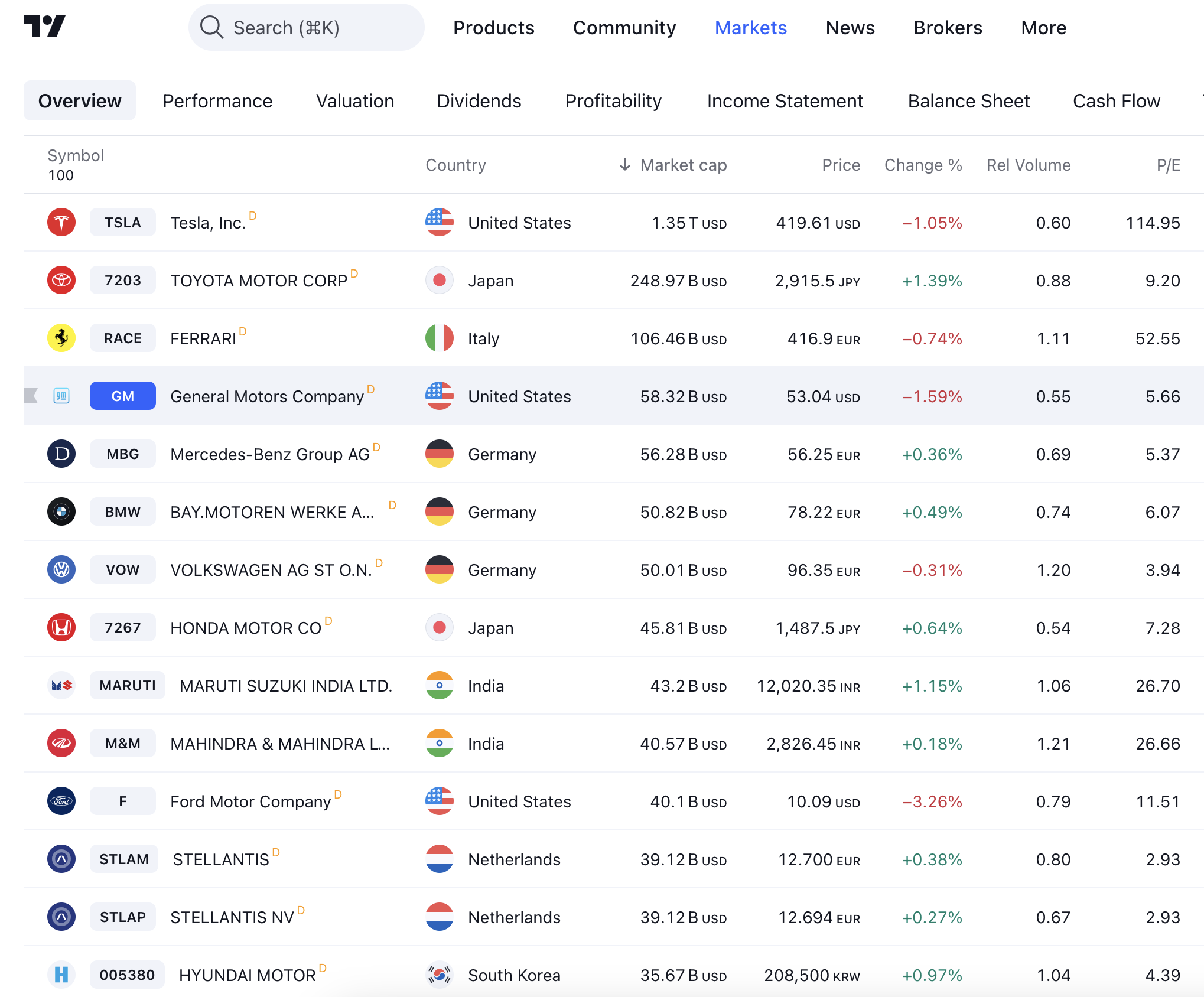
Tesla’s value in the stock market exceeds that of all other automakers put together, and is 114 times its earnings, while other carmakers (except Ferrari) run from 3x to 30x. Analysts estimate that over three-quarters of Tesla’s perceived value comes down to robotaxis and self-driving cars, technologies it has yet to deliver. Most of Musk’s wealth is from others’ bet that he has the secret key to the future.

So aside from the usual asks around taxes, subsidies, and freedom from regulation, these oligarchs will be seeking a way for the US government to sustain the illusions and collective future fantasies that amplify their wealth.

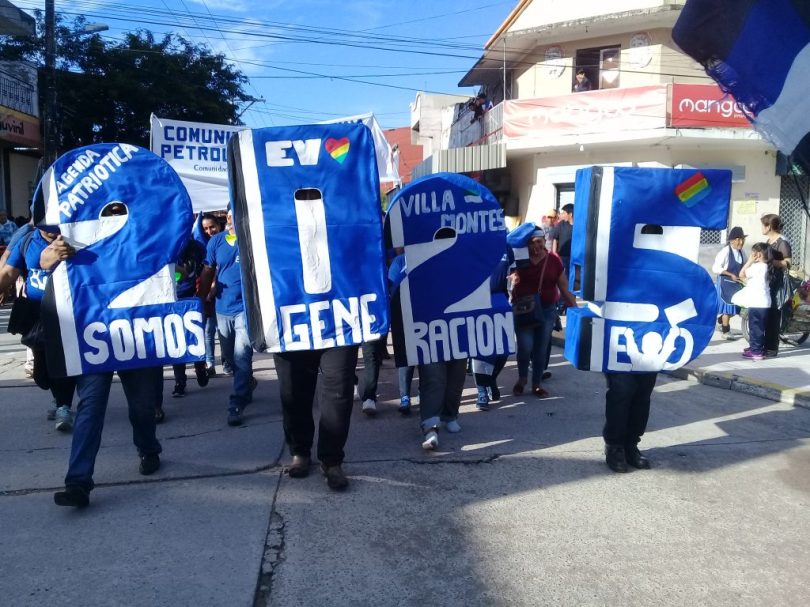
Members of Generación Evo march in Yacuiba in support of his 2025 candidacy.

Evo Morales faces criminal investigation over sexual relationship with teenage girl

Five years after his ouster from office, former president Evo Morales is suddenly facing a serious investigation into his apparent sexual relationship with a minor at the height of this presidency in 2015–16. The allegations cover the illegal and coercive nature of the relationship as well as allegations that the girl’s parents traded sexual access to their daughter for political favors from Morales. The fact of Morales’ sexual act appears to be proven by the subsequent birth of a child in February 2016, on whose birth certificate (revised in 2018) Morales’ name appears as father.

However,  the underlying charge of estupro (roughly, but not exactly equivalent to statutory rape) cannot be prosecuted without the participation of the alleged victim in the prosecution. The criminal investigation therefore rests on the link between the then-57-year-old president’s coercive sex with a fifteen-year-old and public corruption. Per the prosecutors’ document seeking Evo Morales’ arrest:

The teenager had been enrolled by her parents in the Generation Evo youth group “with the sole purpose of being able to climb politically and obtain lucrative benefits, that is, to get what they wanted in exchange for their minor daughter, among them to obtain privileged positions, economic stability and political benefits, being this in such a way that by convincing, pressure practically forced the teenager to maintain a carnal access with … Evo Morales Ayma”. (“¿Cuáles son los detalles del escándalo en la denuncia contra Evo Morales?”, Opinion, October 3, 2024 )

Prosecutors allege that the parents were repaid with multiple benefits from the Morales administration, including a failed nomination of the victim’s mother to be a regional legislative candidate. 

The investigation of the case by Bolivian prosecutors was first prompted by a complaint from the Vice Minister of Transparency Guido Melgar, just three weeks before the end of Jeanine Áñez’s interim government. The recent prosecution concerns the same victim, but with new charges—sex trafficking and corruption—that can be considered without her filing a complaint. Restrained from progressing for years, and challenged by Morales as politically motivated persecution under both the presidencies of Jeanine Áñez and Luis Arce, the case has finally convened the former president to testify on October 10.

And he, in turn, has convened his political allies to resist the prosecution in the streets.

A history of allegations surrounding Morales

These new allegations, as so often is the case in sexual scandals, have a history. In February 2016, Carlos Valverde revealed that Evo Morales had a 2007 affair with Gabriela Zapata, then an 18-year-old lobbyist for a Chinese firm seeking contracts with the government. The affair proved embarrassing for Morales, then seeking a mandate for re-election, but was soon overshadowed by the woman’s evident deceit about having a child with Morales. Zapata was eventually convicted on other influence-trafficking charges, though Morales’ complaint against her for psychological abuse (regarding the alleged child) failed.

Following Morales’ forcible ouster in 2019, the president fled in to exile in Mexico and Argentina. The interim government that followed pursued investigations of his relations with underage girls, eventually arresting Noemi Meneses, who was 19 at the time, and seizing her phone. Prosecutors leaked extensive transcripts of her text messages with Morales dating back several years. A March 2020 profile piece on Morales by John Lee Anderson (among other things, one of Che Guevara’s biographers) described an unnamed young woman in Morales’ entourage-in-exile,  suggesting a relationship he wanted kept out of the press. 

As we spoke, I became aware that a young woman was listening to us from a chair a dozen feet away. She had straight dark hair in pigtails, and she was dressed in jeans and a black T-shirt, with the word “LOVE” in sparkly white letters. She and Morales occasionally exchanged glances and smiled. At one point, Morales interrupted our conversation to tell my photographer not to take pictures of the woman. Later, as Morales posed for photographs, she asked me to take her portrait using her phone. She stood with her back to the garden wall, giggling playfully at Morales, who was posing a few feet away.

Anderson later identified her as Noemi, writing on Twitter, “Why do you think I mentioned her? Anyone will realize that I included her exactly because her youth caught my attention, although I never knew her age, so I could not affirm that which I didn’t know.”

It was at this time that Guido Melgar first raised the question of a second victim in Yacuiba, the girl about whom Morales is currently expected to testify.

New allegations regarding Morales in exile

This week, a new witness has stepped forward, both confirming that Noemi Meneses was resident with Morales in Argentina, and alleging that the pattern of trading sexual access to children for political favors from Morales continued during 2020.

These explosive allegations come from Angelica Ponce, formerly a national leader of the Confederación Nacional de Mujeres Interculturales de Bolivia, the women’s organization of agrarian colonist communities. Ponce campaigned in 2019 for Evo Morales’ re-election. She took a role in 2021 in the Arce government as head of the Autoridad Plurinacional de la Madre Tierra, an environmental agency. In 2022, Ponce publicly broke with Evo Morales, accusing him of everyday sexism on his return from exile. Her public critiques quickly led to her expulsion from the Intercultural women’s federation.

Speaking to the press on October 14, Ponce recalled her visits as a leader to Evo Morales’ residence-in-exile in Argentina, including with representatives of victims of the Senkata and Sacaba massacres.

It’s important to recognize that Evo Morales, yes, was living with minors in Argentina. I am a witness to that, so I think it’s important to denounce before the international community that a person of this measure is threatening the stability of Bolivia. … He was with Noemi and with three minors. … I went with the injured of Senkata and Sacaba, and he didn’t even want to receive me with the injured people. He would rather still be with the girls, with the minors.

And if we can speak of it—the former organizational leaders, the former officials, those of us who passed through there—Evo publicly said: all of those who needed public works done would give him a girl. And so, no one can stay silent any more. God is going to see us, God is going to judge us, brothers and sisters. This man has been a damaging guy, who has made a very lamentable misdeed to rape girls, and who needs to pay in prison.

I, as a former executive leader, I have seen how Evo Morales would take the girls from events delivering public works. [My translation from Angelica Ponce, entrevista, “‘Estuvo viviendo en su mansión con menores’“]

MAS leadership disavowed Evo’s behavior in 2020

By 2020, the question of Evo Morales’ sexual relations with underage girls became both a matter of criminal investigation and political responsibility for the party, appearing in multiple statements by MAS leaders, including future vice president David Choquehuanca, who addressed the issue in a September 2020 interview:

With regard to the denunciations against Morales for statutory rape [estupro], he said that, if there is proof, Morales will have to submit to justice and he said he does not know how many children the former president had during his government.

“I think that he [Evo Morales] has more than the two [children he publicly recognizes], it is possible that he has not recognized them. … I don’t know how many women he will have had [during his term].I cannot say ‘so many women’, but that there have been some. I have said there there is machismo, and that we have to struggle against it.” said [Choquehuanca] in an interview with Radio Deseo.  (https://www.lostiempos.com/actualidad/pais/20200925/futuro-evo-exministros-ponen-aprietos-arce-choquehuanca.)

Likewise, Chamber of Deputies President Sergio Choque Siñani speaking shortly after Luis Arce’s election victory said, “Perhaps [Evo Morales] will return to the country, but he will have to return to take on his own defense with respect to the legal charges that have been openened against him by this interim government, and also by private individuals. The ex-president will have to come and assume his defense, and well defend himself, right, in accordance with what the constitution asks.” “Tal vez retorne al país, pero él tiene que retornar a asumir defensa respeto a los proceso proceso que han aperturado — esta gestión transitoria, denuncias también de personas. Todo ello el expresidente tendrá que venir a asumir defensa, y bueno defenderse, no, de acuerdo al que reza también la constitución.

These statements were part of a broader effort by the MAS-IPSP leaders to turn the page on Evo Morales, both to win the election and to establish a “MAS 2.0” government with its own identity. These efforts would be complicated, however, by Morales’ national and global celebrity status and by his continuing position as leader of the party during the course of the election. Ultimately this led to a formal break in 2023, with Morales and Arce leading two different organizations each claiming to be the rightful Movement Towards Socialism party.

Criminal investigation intersects with Morales’ renewed effort to run for president

Now, with less than a year until the next presidential election (on August 17, 2025), Evo Morales’ faction is pressing for both the MAS-IPSP ballot line and for an end to the charges against Morales, which it terms “judicial persecution.” On both these matters, the ex-president finds himself at odds with the current Arce government, as well as the theoretically independent judicial and electoral branches. The Supreme Electoral Tribunal de-recognized Morales’ faction in October and November 2023. Morales was ruled ineligible to run for the presidency by the Plurinational Constitutional Tribunal in December 2023. The Evista faction faced off with the government in a January 2024 blockade campaign that focused on judicial elections.

Evo’s threatened arrest for failing to testify on October 10 has now been rolled in to his faction’s latest round of mobilization. Backed by factions of the coca growers, intercultural, and peasant unions, these blockades began Monday, October 14 in three points in Cochabamba, with a threat to escalated to nationwide road blockades by the following Monday. Blockaders put forward ten demands: four calling for the roll back of Supreme Decrees issued by President Arce, one calling for a 44-km highway project, one related to fuel supply and prices of goods, two opposing judicial persecution of Evo Morales and his allies, and one demanding his presidential candidacy be recognized.

By the weekend, the blockades had expanded across Cochabamba department and reached isolated locations in Santa Cruz and La Paz. They have isolated Cochabamba from other cities and begun to impact the fuel supply in La Paz and El Alto. But they were limited in scope and number (reaching no more than 24 sites) compared to past mobilizations on behalf of the party, reflecting the concentration of Morales’ base in eastern rural Cochabamba.

It remains to be seen how many rural farmers are willing to mobilize in defense of Evo Morales’ political future, how seriously this mobilization will advance other demands, and how many voters will emerge alienated or disgusted by the charges weighing against the ex-president.

Lead image: Members of the Generación Evo youth organization march in Yacuiba in support of his 2025 candidacy. Evo is alleged to have used Generación Evo coercively as a source of underage sexual partners.

Recent political violence in Bolivia is happening between social movements, not against them

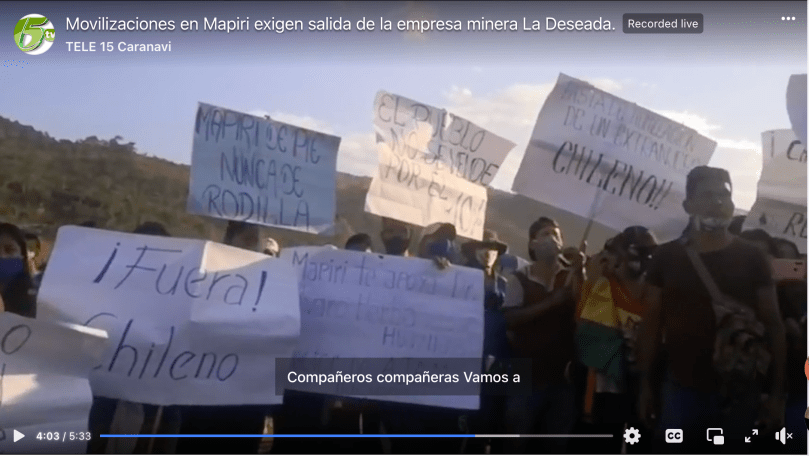
This review of lethal political conflict in Bolivia is cross-posted from the Ultimate Consequences research project website, where I’ll be archiving my commentary and analysis on political violence in the country. Featured photo above shows protesters against the La Deseada mine in Mapiri, in Larecaja Province, where mining conflict have claimed five lives in recent years.

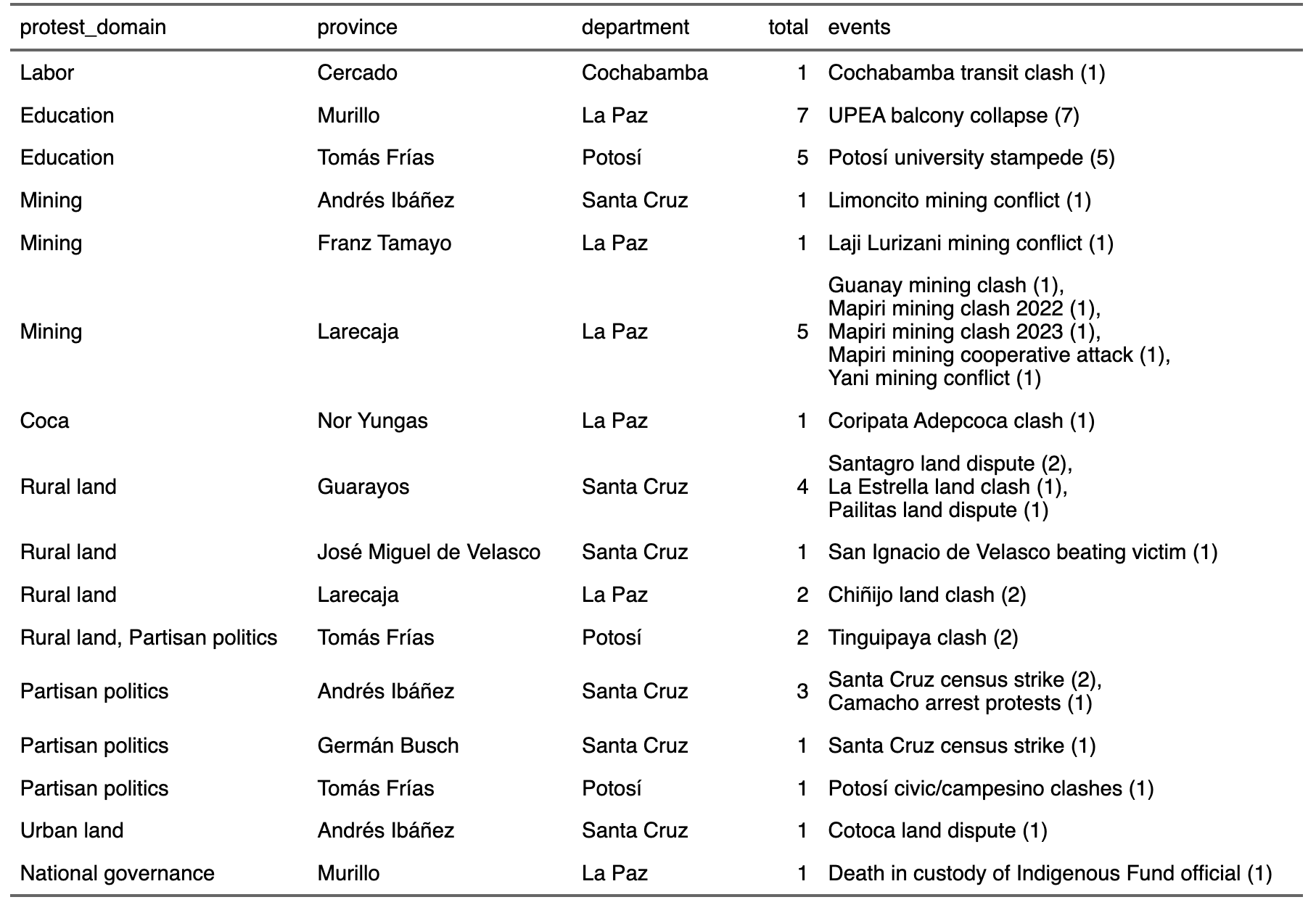
Eleven people have died in social movement-related violence in Bolivia since the beginning of 2023, ten of them the victims of violence carried out by other social groups. These conflicts pitted rural community members against miners, as well as disputes within the same profession, be it mining cooperatives, urban transit drivers, or rival claimants to rural land. Only one death, in January 2023, was caused by security forces, who fired a projectile into the eye of a bystander during raucous protests over the arrest of right-wing governor Luis Fernando Camacho.

In addition, the government of Luis Arce attributed four deaths from medical causes to the side effects of pro-Evo Morales blockades in January 2024. (Per our codebook, we record such collateral consequences but exclude them from other analysis.) For more details on these events, visit Ultimate Consequences’s interactive directory (Spanish version) of all deaths recorded in the dataset. Type “Arce” into the search bar for presidents to just see events during the Arce administration.

Deadly protest events, January 2023–August 2024

The recent events are as follows:

Camacho arrest protests: The December 28 arrest of Santa Cruz’s governor (and ex-presidential candidate) Luis Fernando Camacho touched off immediate protests in Santa Cruz de la Sierra, the regional capital. Following a one-day airport takeover, members of Camacho’s Civic Movement alternated between daytime blockades and nighttime property destruction. On New Year’s Day, police fired a projectile—likely a tear-gas canister—into the eye of Edwin Chávez Durán. The man enduring no fewer than seven surgeries over the next two weeks before succumbing to a heart attack on January 13.

Mapiri mining clash: Amid negotiations upon the filing of mining permits for a mine site located on the Merque river, confrontations began between prospective miners at the site and community members. The mining firm, Minera La Deseada, is described as Chilean, and the workers involed as arriving outsiders, some or all from Caranavi, according to the OTB of Mapiri, led by Ruddy Salcedo. Salcedo describes a Chilean business owner as present at the start of the confrontation, urging them to begin work by force. Community members occupied the disputed site, waiting for police to arrive. In the ensuing confrontation, stones, dynamite, and firearms were used, wounding ten people and killing Jhilmer Cuele Sompero. Community struggles challenging the La Deseada Mine have been ongoing for years; a 2020 mobilization shows leaders describing a five year struggle up to that point. In 2020, they were demanding the enforcement of a ruling by the national mining authority AJAM.

Limoncito mining conflict: On March 1, police accompanied an inspection visit by AJAM to document the stone-mining operation of the Dracruz company, in Limoncito, El Torno municipality. The delegation was confronted by mine workers who launched rockets and otherwise attacked the inspectors and police. Amid a retreat, Sub-Lieutenant Ronald Choque Mamani suffered a cardio-pulmonary arrest and collapsed to the ground. (Initial reports of bullet wounds to the officer proved unfounded.) He could not be revived. Five men were taken into custody for investigation by the FELCC and prosecutors. Subsequent inspection on March 10 revealed an unpermitted mining operation extending over 16 hectares of municipal land. Police then took both heavy equipment and documentation from the company. Local residents had complained of the operation, and have an ongoing campaign against other illegal mining operations.

Santagro rural land dispute: In El Puente municipality of Santa Cruz, conflict flared up between members of the Intercultural farmer federation, who established settlements there in December 2023, and the employees of the Santagro soy producing company, which works on the land. The armed confrontation on March 30 claimed the lives of two men, Francisco Morales and Jorge Pérez.

Cotoca land dispute: During a confrontation between established residents and squatters in Cotoca, Herland Salinas Añez was stabbed multiple times, first by a machete and then by a short blade knife (arma blanca) and killed. Several others suffered machete and bullet wounds during the confrontation. Witness reports describe the confrontation as continuing over several days. Police arrested 25 to 33 people, whom they investigated for the illegal land occupation. Per a more detailed report, the housing takeover was sudden and carried out by a group arriving in a van, making the squatters the attackers.

Laji Lurizani mining conflict: Wilmer Chambi Salcedo, 25, was shot and died while in an ambulance transporting him from Apolo to La Paz. He was one of four wounded in a conflict in the Santa Rosa community in the Laja sector of Apolo on September 13, 2023. The violence resulted from a conflict between illegal miners and community members in the protected Parque Nacional y Área Natural de Manejo Integrado Madidi (PN-ANMI Madidi). On September 15, the Autoridad Jurisdiccional Administrativa Minera (AJAM) reaffirmed that no mining rights were granted anywhere in the protected area. The same day, police arrived in the conflict zone and took control of the Laji Lurizani community. Bitza Delgado, the wife of the deceased Wilmer Chambi Salcedo, demanded that the authorities move to find those responsible for his death.

The death marked a continued worsening of violence due to mining conflicts in the Apolo region of northern La Paz. Illegal and informal mining thrives in the region. On September 18, community members of Laji Lurizani arrived in La Paz’s Plaza Murilo to protest the activities of illegal miners and their backers, and the absence of the state. Residents testified and presented photographic evidence of how illegal miners force them under threat of violence to allow them to do what they want in the area.

Pailitas land dispute: A week of armed confrontation between interculturales and peasants disputing land rights in the Forest Reserve of the Ascensión de Guarayos province resulted in the death of the intercultural Félix Ribera Bellido (23) of San Julían and the injury of 14 others. The death occurred early on the morning of December 2, when a conflict erupted between the communities of Pailitas and Santa María (in the Los Londras area). On December 6, the leader of the interculturales of San Julían, Tito Rokas, threatened the death of landowners in the province, claiming they were responsible for the violence. President Luis Arce announced that the violence would not be tolerated and summoned an emergency meeting of ministers to analyze the land conflict and propose structural solutions. The director of the National institute of Agrarian Reform (INRA) emphasized however that the lands being fought over were in fact property of the state, as all of the properties lie withing the Gurayos Forest Reserve. The Bolivian Ombudsman’s Office condemned the violence and called upon all actors to lower the temperature and to find peaceful solutions to the conflict. On January 16, 2024, Heber Sixto Canaza Sacaca (47), one of the leaders of the San Julían syndicate, was charged with homicide, for his role in inciting the violence on December 2, and for land trafficking, due to his promise to deliver properties in the municipality to intercultural groups. He was apprehended and taken into custody on January 15 and transferred to Santa Cruz by the FELCC. Sixto Canza had also been previously involved in another armed conflict in the Las Londras area in 2021, during which a group of journalists, police, and businessmen were kidnapped and tortured.

Cochabamba transit clash: A taxi driver suffered blunt force trauma while being attacked by drivers of a rival union of drivers disputing their line. One report indicates he and his brother were dragged out of their vehicle and held in another, possibly suffering the wound when jumping out of the vehicle. A doctor described blunt trauma inflicted by a large stone.

Guanay mining clash: Conflict among miners resulted in two injuries (both with metal shrapnel) and the trauma-induced heart attack of Mauricio Soliz Miranda.

Yani mining conflict: National Police intervened in the Yani community of Sorata municipality where two groups of cooperative miners were in open confrontation. This confrontation included injuries from firearms suffered inside the mine the night of July 25. Sent to accompany officials from AJAM and to de-escalate the conflict, the police were confronted by members of one side of the dispute. Reportedly, the miners threw rocks and dynamite at the arriving police, and set the hill on fire. Caught in the flames, two police officers suffered severe burns to 70% and 80% of their bodies respectively. One of those burned, Fabricio Reynoso Gutiérrez, succumbed to his injuries in a La Paz hospital. Altogether, four police were hospitalized. Two alleged perpetrators were arrested and held in preventative detention. One party to the dispute was the Cooperativa Minera “Señor de Mayo”, seemingly the side complaining of illegal occupation of their stake, while the other side (per a social media post circulated by Señor de Mayo) is known as Hijos de Ingenio. The latter allege further violence by Hijos de Ingenio, including a shooting on the following day.

Past annual reviews of political violence on Carwil without Borders: 2022 | 2021 | 2019 crisis | 2012. More tagged Lethal Conflict

Suwalki, 1937/2002

In the summer of 2002, I went on a winding journey from Berlin northwest to Mecklenburg–Western Pomerania in Germany, then east through Gdańsk and Białystok in Poland, to ultimately reach the town of Suwałki in northeast Poland. This route had been charted by my mother to follow our family tree, seeking out each place named among her Christian German ancestors (via her father Carl) and her Polish Jewish ancestors (via her mother Ruth). My fascination with the Polish labor-uprising-turned-democracy-movement Solidarity had added Gdańsk to the itinerary.

My mother’s genealogical travelogue for the journey is fabulously detailed, naming each place we visited, meal we had, and fruit we tasted. After sharing a dinner of bread, cheese, and fruit in a park, we took a late night train from Gdańsk at 12:50am. It being the Corpus Christi holiday, the train car was crowded with late-night revelers and we had to step off the train at another stop to find our sectioned-off sleeper car. Traveling no more than 35 miles per hour, and changing trains in Bialystok we made it Suwałki by midday.

My grandmother Ruth, her five sisters and one brother, were born in Cleveland to Kalmos Rubenstein and Minnie Gottlieb Rubenstein, from 1901 to 194. Their parents, in turn, had been born in the late 1870s in the Suwałki governorate, both Jewish subjects of the Russian Empire. The records my mom compiled indicate they married in Russia in 1900 before embarking on the journey across the Atlantic. A history of the Jews of Suwalki suggests many ups and downs as Jews surged into the area fleeing pogroms deeper in Russia, played a major role in the economy, and built dozens if not scores of community institutions in the town. South of Suwałki, the Russian Empire helped organize the vicious Białystok Pogrom of 1906. But the great looming disaster of the region was of course the Nazi invasion of 1939 and the extermination campaign against Jews that followed.

In Vorpommern, near the Baltic Sea, my mother and I had stopped in the churchyards of a handwritten list of towns. In their cemeteries, often small plots that were used again and again over the centuries, we scanned the gravestones for familiar surnames. Often we found these most by the low stone walls on the edge of the cemetery, where the oldest headstones were moved and stacked up once they were on the verge of being forgotten. In Suwałki, however, this was a different experience. As my mom recorded (all text is purple is hers),

In Kaletnik’s graveyard, all the graves we found were marked by crosses. The faces, their “blue eyes and blond hair” did not read as Jewish and seemed, as she wrote, confirmation that “Hitler achieved what he set out to do.” The rural lives we saw being lived didn’t match her expectations.

Four years earlier, we had sought out the town of Suwalki in a book of survivors’ names in Washington’s Holocaust Museum; there had been no entries beneath it.

At the furthest point of our travels, then, we reached the abyss, still craving some recognizable way to envision the lives we could never reach.

Until a few weeks ago, in my living room.

Read More »
Five formally dressed lawyers sit at a long brown wood table at the International Court of Justice. They are South Africa's delegation, each dressed in black suits: three men have dark African skin, one lighter skin woman in the middle, and one European-descent man on the left. Two of them, and many people seated behind them wear long cloths with the colors of the post-Apartheid South African flag. A South African Broadcast Corporation news chyron at the bottom reads: "South Africa presents its case against Israel at the ICJ"

Gratitude for South Africans at the ICJ

South Africa’s existence as the country it is now is the result of a remarkable global collective struggle that many US residents played a part in. This struggle was only in small measure a legal one, but it built on the ways democracy, anti-racism, and equality of all nations were built into the global legal architecture since 1945. Apartheid was overcome in part by UN institutions deeming apartheid itself a crime.

Perhaps some day, decades from now, Palestinians and Israelis will sit side-by-side and advocate for the rights of others (whether as representatives of two states or one), and will remember their own troubled history and how they overcame it by ending violence and ensuring equal rights for all. If so, it too will be in part because voices worldwide could not abide the violent present, and used every means they could, including courts and diplomacy, boycotts and arms embargoes to chart another path..

First Generation B(l)ack

In 2002, my mother Carolyn James (1936–2023) and I traveled to Berlin, to Mecklenburg–Western Pomerania, to Danzig, to Suwalki, to Warsaw, and to Auschwitz in search of our ancestors and relatives. This essay, from 2002, reflects on what I, a descendant of these lands but also of Africa, found.

There is a different view of Europe when you look at it as if it were North.  The month I spent this spring crisscrossing the continent was not my first encounter with semi-post-imperial Europe as an African.  But it was definitely the first time I was traveling to find my way home. 

The trip was something my mom had been dreaming of for a long time — back through months of Saturdays we spent tracing the pathways of our family before microfilm machines or hitchhiking her amazing record-keeping on my computer skills.  I inherited or learned the need for detail, for stories, for a map to the past, and threw in history, sociology, and mysticism. 

I needed these tools not just to assist my mother’s effort to create an almost-encyclopedic genealogy of both sides of my family, but to truly get a handle on what I inherited from the past.  Jewish, Polish, German, and African; Kabbalah and animism, goddess and Christ; resistances and fascisms: by high school I would summarize my background and then add “Most of them one of wanted to kill each other.”  When you know your most intimate identities are a battlefield, walking about on disputed territory is almost a sacred experience — pushing these forces out of your head and into history. 

Read More »