
In 2012, photographer and videographer Roshdi Sarraj (Twitter|Instagram) co-founded Ain Media with Yaser Murtaja (Instagram). Both used up-close and drone-mounted cameras to document the life of the everyday life, wartime suffering, and protest movements of Gaza. I became aware of Murtaja and Ain Media’s remarkable work through his last piece, documentary coverage of The Great March of Return, celebrated on this blog as the world’s most daring protest. In footage shot for an envisioned documentary, Murtaja captured the collective organizing, on-site medical care, patient journalism, and defiant risk-taking that made the protest possible.
And he was killed for that journalism, shot by an Israeli sniper beside his collaborator Roshdi Sarraj.
It was Sarraj who narrated Murtaja’s last moments to the world:
“Yaser and I were preparing a documentary about the Great Return March that started a week and a half ago. Yaser thought of making a documentary about it and picked some characters to follow: a nurse, a doctor, a twelve-year-old student, all of whom had joined the protests.
“Friday morning, we went over and started filming. We recorded the Friday prayers near the border and, right after the prayers, were surprised when the Israeli soldiers started shooting at us. One of those bullets unfortunately hit Yaser. He had a flak jacket on that said “PRESS” in large, clear print, and a protective helmet.
“He fell right away. People ran over to him, and I heard screams: ‘A journalist is injured, a journalist is injured.’ I ran over and found out it was Yaser, my friend. Yaser was awake the whole way to the hospital. He was in a lot of pain, saying, ‘My stomach, how bad is my injury? There is a lot of pain; my legs are numb.
“He died around 1:30 A.M. I was there. I never left. His brother and another friend of ours, the three of us were there the entire time. His family came by, his uncles, but we felt that his condition was getting more stable, so some of them left to get some rest and come back in the morning, hoping that he would be better by then. By then, he had passed.”
Roshdi Sarraj recalled then, “I have known him since we were children; we used to hang out a lot and we both wanted to be filmmakers. This is why we started a media company together in 2012, and we worked with a lot of people, both locally and internationally. He was more than a brother to me.” Ain Media continued, employed two dozen people, and produced thousands of works.
AlSayyad, Yasmine. “Watching a Fellow-Journalist Die in Gaza.” The New Yorker, April 10, 2018. https://www.newyorker.com/news/as-told-to/watching-a-fellow-journalist-die-in-gaza.
Above all, they continued to document reality in Gaza.
Last Tuesday, Sarraj posted about his current work, “A lack of media coverage from Gaza due to the killing more than 12 journalists, the bombing, and the blackout of electricity and the Internet. However, we are still trying to withstand and continue coverage so the world can see the Israeli crimes in Gaza.”
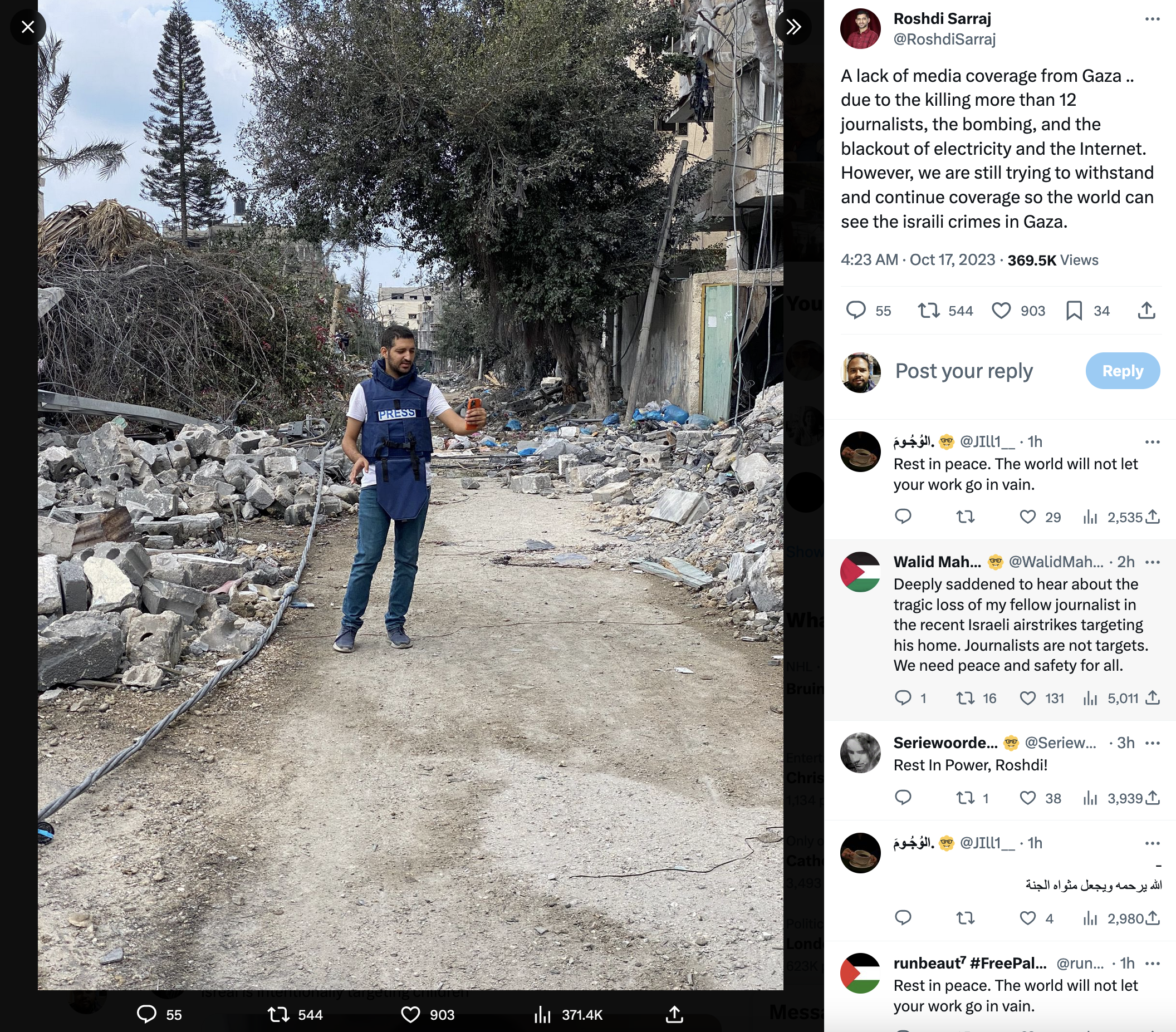

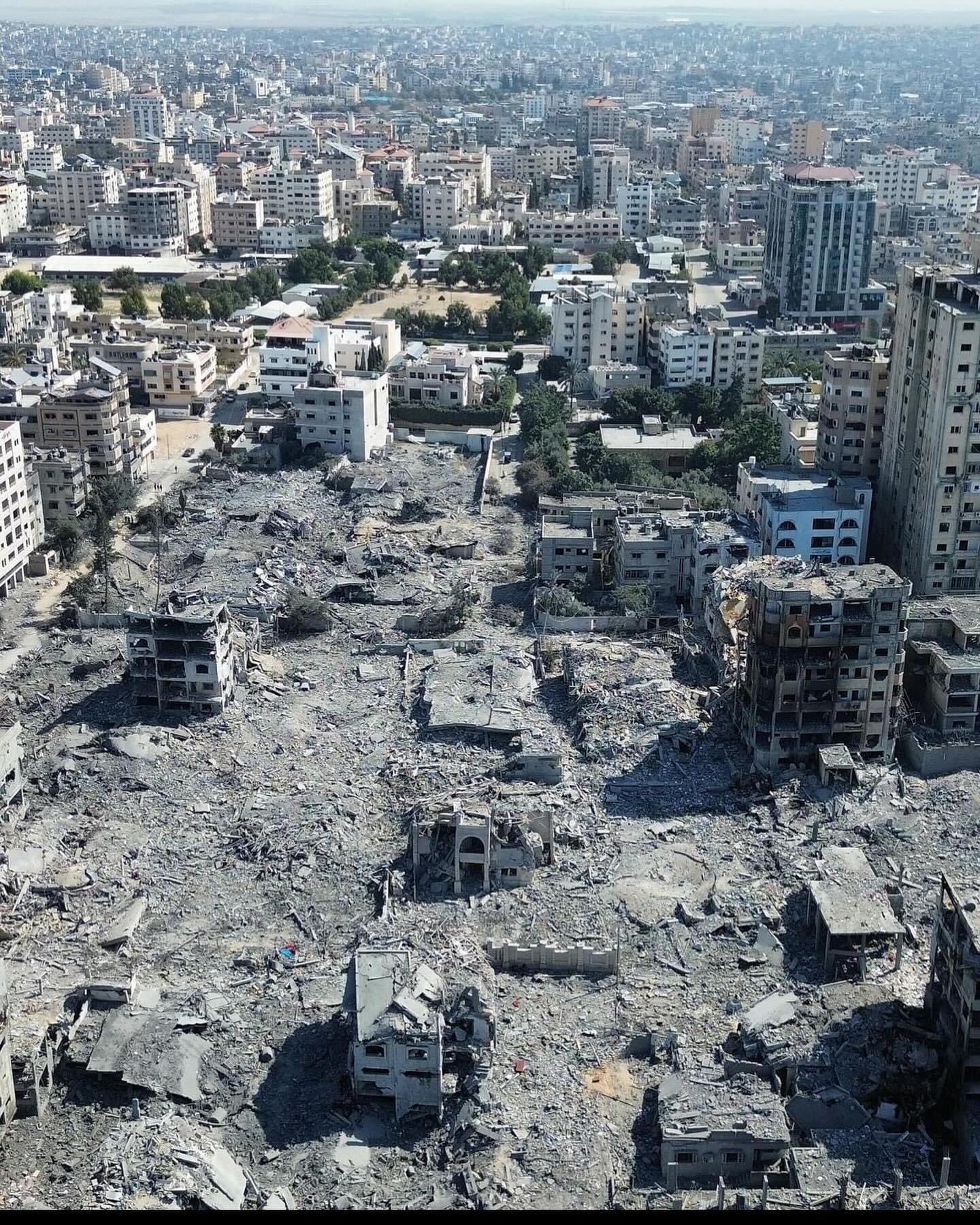
Today, the world learned that Roshdi Sarraj too had been killed by an Israeli warplane. Quds Media posted his last photograph, stunning evidence of the devastating nature of Israel’s 2023 attack on Gaza City.
Seven weeks ago, Sarraj shared a profile video to his public Instagram account, a montage of his joyous moments and his work documenting life in Gaza. He thanked his Ain Media colleague Ibraheem M. Lafi (Instagram) for the compilation.
Ibraheem M. Lafi, too, was shot and killed by Israeli fire at the Erez Crossing at the north end of Gaza on October 7. He was 21. Here’s Sarraj’s memorial post reacting to his colleague’s death.

Like the entire families in Gaza that have been entirely or nearly entirely killed in Gaza, the journalistic community of Palestine is bearing an unfathomable burden. This would be tragic and outrageous enough in itself. But these brave souls are also are strongest link to the reality of the situation on the ground, the best way we have to share the vital humanity and lived experiences of those under attack on an unimaginable scale.
 Carwil without Borders