Indigenous survey tour reports broad local opposition to highway in TIPNIS

As the Bolivian government sat down with CONISUR in La Paz, there was a crucial missing party: the Subcentral TIPNIS, the titleholder to the collective lands that make up all of the Isiboro Sécure National Park and Indigenous Territory except for the colonized Polygon 7. The Bolivian government was unwilling to formally exclude the Subcentral and its national parent organization, CIDOB, but instead invited it to send representatives within 48 hours (CIDOB did offer to meet in Trinidad, in 20 days). The Subcentral’s absence from these negotiations is perhaps the most enigmatic aspect of the latest turn of this kaleidoscopic conflict, but it has a simple, practical explanation.

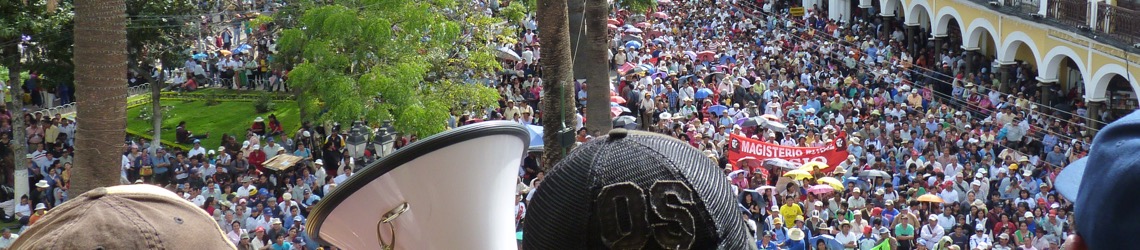
While CONISUR marchers advanced towards La Paz, the Subcentral TIPNIS and CIDOB were on their own tours through the communities of the National Park. One delegation headed by CIDOB President Adolfo Chávez travelled the Isiboro River; a second, headed by Subcentral President Fernando Vargas visited communities on the Ochoa River; and a third went along the Sécure River. Last week they made a preliminary report that 32 of the communities they visited were firmly against the proposed Cochabamba–Beni highway crossing through TIPNIS, three others supported the road, while Oromono and Ushve, located in the north section of the territory were divided on the issue. The Subcentral-CIDOB tours also are laying the groundwork for a new national march (CIDOB’s Ninth National March) in protest of the highway. Fernado Vargas reported that there are 31 communities left to visit, eight of which are in the colonized southern region.

The results so far refute claims by the MAS government that CIDOB and the Subcentral lack contact with base communities, and far surpass the government’s assertion that they represent just 20 of the 64 communities in TIPNIS. The logistical coordinator of last year’s march has also confirmed that residents of 64 communities participated in the long trek to La Paz, although some may have joined after the march’s departure from Trinidad due to organizational difficulties. The results are also consistent with radio-transmitted interviews with TIPNIS communities conducted by the Erbol community radio network following the passage of Law 222.

The logistics of this poll are also a reminder of the existing methods of transport inside of TIPNIS and of the pace required for a comprehensive consultation of its communities on anything. River transport is the predominant form of contact between TIPNIS communities, one which is adapted to the landscape and geographic placement of communities. While proponents of the interdepartmental road have suggested that access to health, education, and development will come from ending TIPNIS communities’ isolation, the road will not in fact reach most communities directly. Indeed, when the pro-road CONISUR marchers met with Evo Morales, [he rebuffed their requests for local branch roads] that will connect their communities to the highway, citing a lack of funds. Accessible health care and education require not a highway (which will also bring deforestation and increased narcotrafficking), but meaningful state investment in facilities that are accessible by the TIPNIS indigenous’ own highways, the rivers that flow through the Territory.

Pablo Solón speaks out for meaningful consultation on TIPNIS

Pablo Solón, Bolivia’s former Ambassador to the United Nations, has been a critical global voice on behalf of the new Bolivia. He worked to secure critical global victories like the UN General Assembly’s recognition of the human right to water and sanitation, and to advance the frameworks of harmony with nature and the rights of indigenous peoples on the global stage. When plurinational Bolivia took a principled stand challenging collective inaction and market-based pseudo-solutions in the Copenhagen and Cancún climate talks, he was the country’s most eloquent voice (see, for example, this op-ed from Cancún). His diplomacy combined the capacity for principled opposition (Bolivia stood among three dissenters in Copenhagen, and alone in Cancún) with tenacious work to build a majority (140 nations joined in backing the right to water). Solón is also committed to diplomacy among movements, supporting indigenous and environmental movements’ access to negotiations in Copenhagen, attending the US Social Forum in 2010, and co-organizing the World People’s Summit on Climate Change in Cochabamba. In September 2011, just after the police raid on the pro-TIPNIS Eighth National Indigenous March, he publicly called on Evo Morales to rethink his position on the Villa Tunari–San Ignacio de Moxos highway, arguing, “One cannot speak of defending Mother Earth and at the same time promote the construction of a road that will harm Mother Earth, doesn’t respect indigenous rights and violates human rights in an ‘unforgiveable’ way.”

Now that the TIPNIS conflict has been reframed by the government’s passage of a so-called “prior consultation” law, Solón is adding is his voice on what “consultation” should mean. (Elsewhere, he has emphasized the existence of alternate routes for the highway, as well.) The following is a complete translation of a February 13 blog post by Solón on the subject:

Last Sunday I was at Erbol [Bolivian community radio network] being interviewed by its director Andrés Gómez, and conversing about TIPNIS and the consultation. Suddenly, I said to him: “How about if I come and ‘consult’ with you about amputating your arm.”

He responded, “Ah, no! Not that!”

“And what if I tell you that only in doing that can your life be saved.”

He responded, “Well, that is different”

And I replied, “But then I have to demonstrate to you that the only alternative that would save your life is to amputate the arm”

That’s how it is,” sighed Andrés.

The construction of a highway that cuts through the heart of TIPNIS is like amputating an arm. Before proceeding to consult with you as to whether I should amputate or not, I have to demonstrate that it is the only option, that there is no other choice, that without it any integration whatsoever between Cochabamba and Trinidad is impossible, that any other alternative is riskier, not technically viable, or financially unsustainable. It’s not right for you to accept losing an an arm unless I first put all the options on the table. This is the case with TIPNIS.

They want to have a consultation without first having realized a serious analysis of the alternatives for integration by road.

The obligation that comes before any consultation whatsoever is to bring together a commission in which all participate: the TIPNIS indigenous, the representatives of Cochabamba and Beni, the national government, experts on engineering and the environment. This commission is to bring us in a reasonable period an analysis of all the possible routes for integrating Cochabamba and Trinidad by road, together with their costs, impacts on indigenous communities, and on our Mother Earth. Once we have all these alternatives, then on that basis, it is possible to conduct a responsible consultation.

There are those who say that to go alongside TIPNIS or any other option is not viable. Perhaps they are correct… but this has not been demonstrated. Therefore, what is appropriate is to analyze, without passions or caprice, all the options. The result of the study o the different options will perhaps lead us to the conclusion that there is another option, or there are various other options, and that it is not necessary to conduct a consultation to see if TIPNIS should be cut in half, or it will lead us to a consultation to decide clearly between one option or another, knowing the pros and cons of each one.

What one cannot do is to “consult” with someone as to whether their arm should be amputated or not, without showing them the other options.

Debating Tactics: Remember to ask, “What works?”

Our tactical debates should solve protesters’ problems, instead of dividing movements

In the midst of Yet Another Tactical Debrief, this time on the recent Move-In-Day–turned—street-semibattle—then—mass-arrest at Occupy Oakland, I ended up tossing out on Twitter a cluster of successful movement moments, some of which involved fighting back against cops—Stonewall, Cochabamba Water War, anti-apartheid defiance campaign, Tahrir Square 2011—and others of which involved a calculated refusal to fight back, even to the point of enduring direct state violence: anti-nuclear demos, the 1980s Central America solidarity movement, Gandhian salt march. In my estimation, every single one of these was successful, which raises the question of what they had in common.

What these moments do not share in common is their achievement of a universally correct balance of nonviolence and forcefulness, self-sacrifice and safety, or daring and accessibility, but rather their solution to an immediate and tangible tactical problem which had been totally disabling to their movements. Without these solutions, the trajectories of their movements were towards frustration with the possibilities of action, and thereby to spirals of apathy and spurts of ineffective outrage. With them in mind, the trajectories shifted to hopeful emulation, contagious optimism, and surges in new participation, leading to a whole new scale for participation.

The Miami Model is a global problem (as the New York Times acknowledges for Bahrain), how do we work out a solution?

(very long post follows the break)

Read More »

Ignored options for Beni highway would protect TIPNIS

Update, March 4: The Bolivian Highway Administration’s (ABC) recent call for a “technical debate” on the highway route makes for headlines that sound like this impasse might clear. But the framing continues to exclude all of the meaningful alternatives presented here. ABC administrator José King continues to discuss alternatives for only Segment Two of the highway, between Isinuta and Monte Grande. Isinuta is on the southern boundary of the park (!). (ABC’s map with these cities is here) Of course, he can then insist that other alternatives that start from Isinuta cut through more forest than the proposed route. Meanwhile, despite eight months of demands to suspend construction, ABC continues to build Segments One and Three of the road (the pause, reported here, seem to have been resolved by mid-February). Until that construction stops, the only sensible read of the situation is that the Bolivian government has no intention of consulting the indigenous on the overall route of the road.

This map, produced by Cochabamba daily newspaper Los Tiempos, is the most important omission from the new round of debate on TIPNIS. It was reposted yesterday by Bolivia’s highly respected former Ambassador to the United Nations, Pablo Solón (@pablosolon). The map shows shows four options to the currently under-construction route that will divide the Isiboro-Sécure Indigenous Territory and National Park in half, and which is protected to accelerate deforestation in the park, leaving 64% of it deforested within 20 years.

Map of four options to the Cochabamba-Beni highway through TIPNIS

Nowhere in the recent debate has the government put these options on the table. The Prior Consultation law, formally promulgated by Evo Morales this week, does not allow a regional discussion on these other paths. Why is the government maintaining such silence? Why is it not interested in other routes? There are three possible reasons: 1. The ink is dry on a the loan-and-construction contracts with Brazil, so the government would prefer to avoid any further complications. 2. Close allies of the government in the cocalero movement will benefit from the soon-to-be-deforested land made accessible by the road, and from a second illicit export route in a way they would not from the alternate routes. 3. The government wants to illustrate that head-on opposition from grassroots groups will not change its policies on economic planning, and so is being rigidly inflexible on re-routing the road outside of TIPNIS.

Solón and TIPNIS communities have both vocally called for alternatives to be placed on the table. It remains to be seen how much mobilization will be required for this to happen.

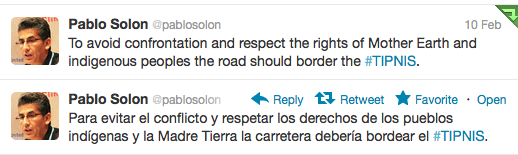
Pablo Solon tweets for alternate route for TIPNIS highway

TIPNIS: Government to authorize not-so-prior consultation

Following the arrival of the CONISUR march in La Paz, the governing MAS party shifted its public position towards being an arbiter between indigenous groups in TIPNIS. After welcoming CONISUR march, President Evo Morales and MAS legislative leaders backed away from CONISUR’s proposal to simply revoke Law 180 protecting TIPNIS. Instead, they coalesced around a new legislative initiative: a “prior consultation” law on the issue.

Prior consultation is a fundamental principle of indigenous rights, and an important part of the environmental review process. In the case of the Villa Tunari–San Ignacio de Moxos Highway, currently under construction, consultation with indigenous communities has been anything but prior. Indeed, no consultation was pursued at all on Segments I and III of the highway, despite some complaints from the Multiethnic Indigenous Territory I, which is crossed by Segment III. Negative environmental reviews were avoided by the firing of Vice-Minister of the Environmental Juan Pablo Ramos in 2010, and the official responsible for TIPNIS in the National Protected Area Service, Vladimir Ortolini, in October 2011.

Now with Segments I, III, and a small portion of Segment II under construction, the government proposes a public consulatation with indigenous peoples inside of TIPNIS. The consultation is to be authorized under a new law, which has already passed the Senate and has been reviewed without change by the Chamber of Deputies’ Constitution Committee. The consultation will be organized by the independent electoral branch of the Bolivian government, be conducted under the norms and procedures of indigenous governance, and take place in five languages. The issues at hand are:

  • “Consideration and definition of whether the Isiboro Sécure Indigenous Territory and National Park is an intangible zone, and about the construction of the Villa Tunari – San Ignacio de Moxos highway.” Consideración y definición sobre si el Territorio Indígena y Parque Nacional Isiboro Sécure – TIPNIS, es zona intangible o no, y sobre la construcción de la carretera Villa Tunari – San Ignacio de Moxos;
  • “Consideration and decision concerning the safeguard measures for protecting the Isiboro Sécure Indigenous Territory and National Park, as well as those measures to prohibit and remove immediately illegal settlements within the demarcating line, and to determine the measures to maintain the zoning specified in the TIPNIS management plan.” Consideración y decisión sobre las medidas de salvaguarda para la protección del Territorio Indígena y Parque Nacional Isiboro Sécure – TIPNIS, así como las destinadas a la prohibición y desalojo inmediato de asentamientos ilegales, dentro de lal ínea demarcatoria, y determinar los mecanismos para mantener la zonificación establecida en el Plan de Manejo del TIPNIS.

In effect, this gives TIPNIS indigenous communities, from the Subcentral and CONISUR a round of consultation, lasting up to 120 days. There have been no statements offering to suspend construction during this time. These issues are precisely those addressed by last October’s Law 180, and agreed between the Subcentral and the government in late November. Apparently, that agreement will go unimplemented.

Evaluations of the law

The proposed consultation has been widely critiqued for its timing, which clearly is not prior to the project in question. The Andean Information Network argues that this model for consultation is “potentially viable,” but comes too late for TIPNIS where “it is improbable that this initiative will alleviate tensions or resolve protracted friction.”

The Subcentral TIPNIS and CIDOB are not impressed by this new consultation, and are preparing to re-mobilize should it pass. Yolanda Herrera, president of the Permanent Assembly for Human Rights in Bolivia; the Bolivian Forum on the Enviornment; and Adolfo Moye of the Subcentral have all spoken out against the proposed law. Human Rights Ombudsman Rolando Villena warned that the “unilateral” drafting of the law would “increase the resulting divisions within the lowland indigenous movement and affect its unity and strength, as well as [unleash] a series of probable conflicts at the national level” “aumentar los eventuales desencuentros al interior del movimiento indígena de tierras bajas y afectar su unidad y fortaleza, además de una serie de probables conflictos a nivel nacional.”

Left by the wayside again are alternate proposals for the highway route. As has been noted here before, leaving Segments I and III in their current locations makes a deforestation-inducing route through TIPNIS inevitable. However, numerous engineering groups have proposed alternate routes for a Cochabamba–Beni highway, and will do so again tonight in La Paz (webcasted, even). In the US context, where environmental impact assessment (but not prior consultation) has long been a required part of every “major Federal action” (under the National Environmental Policy Act), the presentation of genuine alternatives is the required first step for meaningful assessment. Bolivia would do well to follow that model.