Bolivia’s political landscape 2012: Departments and Municipalities

Summary: The governing MAS party has greatly expanded its legal influence at the regional and local level since surviving the political crisis of 2008. It extended its reach even beyond its electoral successes of April 2010 by way of savvy parliamentary maneuvers and by pushing aside opponents under indictment. However, in localities like Sucre and Quillacollo, it has been unable to convert interim office-holding into a new electoral majority. Instead, 2011 saw increased frustration with the national party from within parts of its left grassroots base. At the Departmental level, the MAS has put representatives or allies into the governor’s chair, but indigenous delegates have acted independently to lead Legislative Assemblies in two departments.

much more after the jump

Read More »

The deadly Yapacaní mayor’s office clash in perspective

In Bolivia’s highly mobilized and turbulent political climate, mayors have been pushed out not just by a formal indictment, but also by social pressure from their constituents. Such mobilizations led at least 9 mayors to step down themselves or be replaced by city councils as between April 2010 and December 2011. However, in two major cases, the national government has appealed to the courts to defend its own mayors from removal by their councils. The cities involved were Sucre, where interim mayor Veronica Berríos was pushed aside for peasant leader and councilman José Santos Romero in January 2011, and Yapacaní, Santa Cruz, where the council suspended David Carvajal for the second time in December 2011. Both of these cases involved local MAS councilmembers backing popular pressure for MAS mayors to resign. In effect, the national MAS is standing by its embattled mayors and against its own base. In terms of procedure, the national MAS is rejecting mass mobilization to topple leaders in favor of revocation referendums, which are only possible halfway through a five-year term.

In Sucre, the Guarantees Tribunal of Chuquisaca’s Superior Court of Justice restored Berríos to the post of Interim Mayor after just 17 days. However, local officials remained frustrated with the national party (as represented by Minister Wilfredo Chávez). Neither MAS nor Berríos was able to mount the kind of dramatically successful administration that could win over moderate voters for the MAS in time for December elections. When two parties in the city’s highly fractious right-wing formed an alliance last month, they won a solid plurality and ended the MAS’ hold on the Mayor’s chair.

Last week’s events in Yapacaní reprised this story, but with a tragic and fatal ending. National officials again stood by the controversial suspended mayor, David Carvajal. Again, their defense was successful in court, but resented at the grassroots level. In Yapacaní, there is no right-wing to speak of, and peasant movements predominate in the municipality. (Instead, a division between primarily rice-growing agrarian colonists and coca growers expanding from the neighboring Chapare region seem to have taken on a political dimension.)

The national government clearly expected resistance to returning David Carvajal to the Yapacaní city hall, and deployed at least 450 National Police to make that possible. The Inter-institutional Committee of Yapacaní, which had earlier organized road blockades demanding Carvajal’s resignation, organized to block his return. Clashes left three protesters dead, two from gunshot wounds: Abel Rocha (age 27) and Michael Sosa (23). Eliseo Rojas (22) was reportedly electrocuted during a crowd attack on the police barracks.

Important questions have been raised about the circumstances of these men’s deaths, including in this article by the Andean Information Network. As in at least two other incidents of protester deaths (a Movimiento Sin Techo land occupation in La Guardia, Santa Cruz in April 2010; and a regional blockade in Caranavi in May 2010), the national government claims to have prohibited the use of firearms by police, but commanders on the scene deployed them anyway. Police Commander Lily Cortez is alleged by eyewitnesses to have fired some of the fatal shots.

In another time or another country, the protesters’ aggressiveness might be enough reason for mainstream commentators to ignore such issues. But in the turbulent world of Bolivian protest, allowing things to turn deadly raises questions of good governance. The center-left Página Siete, for example, editorialized:

The terrible events of Yapacaní could have been avoided. Not in the final hours, but rather before. The City Council accepted the exit of Carvajal and nominated a replacement, also of the MAS. It was at that moment that the governing party could have acted, advising Carvajal to renounce his position definitively so that new elections could be called.

If the relevant minister, Wilfredo Chávez, was obliged to send at least 600 police troops, it was because he knew the gravity of the matter. It was logical that violence would be unleashed again, as had already occurred at the end of last year. Therefore, Minister Chávez was conscious of the explosiveness of the situation. If he himself gave the order to send no less than half-a-thousand police, it was because he feared a popular reaction against the departed mayor. Thus, he acted with the knowledge that the situation could get out of control. And today we must lament four more deaths from political repression in the history of our country.

Los terribles sucesos de Yapacaní podrían haberse evitado. No en las últimas horas, sino antes. … El Concejo Municipal aceptó la salida de Carvajal y nombró en su lugar a un reemplazante, también del MAS. En ese momento es que el oficialismo podría haber actuado en primera instancia, aconsejándole a Carvajal renunciar a su cargo definitivamente para llamar a nuevas elecciones.

Si el ministro del área, Wilfredo Chávez, estuvo obligado a enviar a por lo menos 600 efectivos policiales es porque sabía de la gravedad del asunto. Era lógico que la violencia se iba a desencadenar nuevamente, como ya ocurrió a fines del año pasado. Por lo tanto, el ministro Chávez tenía conocimiento sobre lo explosivo de la situación. Si él mismo dio la orden de enviar nada menos que medio millar de policías es porque temía una reacción popular contra el alcalde saliente. Por lo tanto, actuó a sabiendas de que la situación podría descontrolarse. Y hoy debemos lamentar otras cuatro muertes por represión política en la historia del país.

Similarly, Franklin Garvizu, who represents Yapacaní in the Plurinational Legislative Assembly, voiced his frustration with the government for failing to deal with Carvajal’s corruption or to seek a negotiated solution. Garvizu  visited three ministers—Carlos Romero (Presidency), Claudia Peña (Autonomies), and Wilfredo Chávez (Government/Interior)—seeking a delay to the return of the mayor. “It was requested that they generate a space for concord. There was a judicial resolution, certainly, but there had to be a moment to apply it, and that moment was not immediately through police [force].” (Audio recording by Los Tiempos) “They have not listened, they haven’t had the capacity to convene a meeting to seek an alternative solution. The attitude of the ministers is what makes it understood that they have not let the true facts of the matter reach President Evo Morales. No han escuchado, no han tenido la capacidad de convocar a una reunión, para buscar una solución alternativa. La actitud de los ministros es lo que hace entender que no han hecho conocer sobre los verdaderos hechos al presidente Evo Morales.” (El Día)

The night of the deadly clashes David Carvajal pledged to resign, and he has followed through with that pledge. Councilman and fellow MASista Zenobio Meneses has taken the mayor’s chair in Yapacaní. However, the national government’s handling of the situation illustrates the dangers of excessive partisanship and will surely call into question its commitment to a “zero corruption” standard for local officials.

Update: For more on the aftermath, you can read this article “Yapacaní, solo quedan cenizas [Yapacaní, only ashes remain].” By late February 2012, the investigation into the calshes at Yapacaní had stalled, largely because both local political factions are MAS affiliates with little interest in embarrassing the national government. Nonetheless, there was an early-March blockade demanding an investigation. Lily Cortez was promoted to the rank of general in the Bolivian police in 2013, and became its National Director of Planning in December 2013.

Indigenous Bloc in Bolivian Parliament Now a Reality

Six indigenous deputies in Bolivia’s Plurinational Legislative Assembly stepped forward today to form an Indigenous Bloc (bancada indígena) within the parliament. The bloc consists of Deputies Justino Leaños (Potosí, alternate), Blanca Cartagena (La Paz, alternate), Teresa Nominé (Santa Cruz, alternate), Pedro Nuni (Beni), Bienvenido Zacu (Guarayo people, Santa Cruz), and Cristina Valeroso (Guaraní people, Tarija, alternate). [Update, 19 Jan: La Razón reports that Julio Cortez (Pando) and Bertha Ramallo (Pando, alternate), special indigenous constituency deputies who had affiliated with the right-wing Progress for Bolivia Plan-National Convergence bloc have also affiliated. Initial reports have some discrepancies: La Razón does not include Leaños, while Los Tiempos omits Teresa Nomine. A final count may require a couple days. Página Siete adds Sonia Justiniano (Beni, alternate) and confirms all nine listed here: 3 voting members and six alternates.] The move, endorsed by the National Commission of the Confederation of Indigenous Peoples of Bolivia (CIDOB), followed a series of announcements since the late September raid on the national indigenous march in defense of TIPNIS.

All members in today’s announcement except Justino Leaños represent special indigenous constituencies and were chosen by community procedures rather than elected to represent the Movement toward Socialism (MAS) party. Pedro Nuny, who will lead the bloc, emphasized this allegiance yesterday: “Nos debemos a la CIDOB, por ellos estamos en la Asamblea Plurinacional y si nos ordena votar en contra del gobierno, lo haremos, haremos todo lo que esté a nuestro alcance para proteger nuestros derechos, en especial el territorio indígena” “Our obligation is to CIDOB, it si on their behalf that we are in the Plurinational Assembly and if they order us to vote against the government, we will do that, we will do everything within in our reach to protect our rights, and especially indigenous territory.” (Opinión, 17 January)

Nonetheless, their separation from the MAS has been the most controversial aspect of the move. Indeed, at today’s press conference, the degree of separation to be expected depended on the leader speaking. The following are the disparate statements made:

Adolfo Chávez, President of CIDOB: “Tendrán una responsabilidad de asumir una bancada indígena al interior del seno del Movimiento al Socialismo que significa que no tienen la obligación de abandonar el curul tal como lo habían señalado muchos diputados del oficialismo, ya es una decisión que el diputado Pedro Nuni sea quien asuma la jefatura de bancada de los indígenas.” “They will have the responsibility of becoming an indigenous bloc inside the heart of the Movement towards Socialism, meaning that they are not obliged to abandon their seats as many governing party deputies have signalled. It has already been decided that Deputy Pedro Nuni will assume the leadership of the indigenous bloc.” (Los Tiempos)

“Nuestros hermanos diputados asumen esta gran responsabilidad para hacer cumplir los derechos que corresponden para los pueblos indígenas” “Our deputy brothers and sisters are taking on the great responsibility of ensuring that the rights which belong to indigenous peoples are fulfilled.” (El Día)

Deputy Pedro Nuni, President of the Indigenous Bloc: “Si nos reconoce o no la Asamblea Legislativa Plurinacional es otra cosa, pero nosotros trabajaremos y no seremos parte de los 2/3 del oficialismo, porque muchas veces somos objetos de manipulación.” “Whether the Plurinational Legislative Assembly recognizes us or not is another matter, but we will do our work and we will not be part of the governing party’s two-thirds majority, beacuse many times we are objects of [their] manipulation.” (El Día)

The issue of a two-thirds majority has been a prominent issue for press discussions on the Indigenous Bloc. The MAS won 88 of 130 seats in the Chamber of Deputies in December 2009, and has 26 of 36 Senators. However, four La Paz deputies belong to members of the Without Fear Movement (MSM) which ran in alliance with the MAS, but declared its independence in 2010. The Indigenous Bloc subtracts three more voting members from the MAS, leaving them with 82 deputies, or 63% of the lower house, and pushing them below two-thirds of the entire Assembly.

The two-thirds threshold was the subject of an extended controversy in the Constituent Assembly of 2006–2007, but it’s unclear how effective a one-third minority will be in stopping legislation. [Update, 19 Jan: La Razón reports that a 2/3 majority is required both for impeachment and for the approval or modification of laws.] However, indigeneity is a central value of the process of change in Bolivia, and this is one more step that questions whether the MAS is the true standard bearer of that process.

Indigenous Organizations Denounce Conisur March

The following is a 6 January 2012 pronouncement by the indigenous peoples of the Isiboro Securé National Park and Indigenous Territory, of Beni, and of the lowlands as a whole, denouncing the pro-highway march, defining their relation with CONISUR, and critiquing how the march was organized. In Spanish only for now.

“Ante una difusión mal intencionada de una marcha de pueblos indígenas contra los acuerdos del TIPNIS,La Ley N’ 180 y la representación de los comunarios de los Pueblos Indígenas, las organizaciones del movimiento de las Tierras Bajas dirigidas por la CIDOB [Confederación de Pueblos Indígenas de Bolivia], e integradas por la CPEM-B [Confederación del Pueblo Etnico Mojeño–Beni]. CPIB [Confederación de Pueblos Indígenas de Beni]. CMIB [Confederación de Mujeres Indígenas de Beni]. G.C.T.s. (Gran Concejo de Tsimane). [Subcentral] TIPNIS. Sub central Sécure. hacen conocer a los ciudadanos bolivianos:”

A Tale of Two Bolivian Mayors in Trouble with the Law

The following post was written on 3 August 2010 and distributed elsewhere. Since then, two of the three non-MAS governors have been suspended following indictment. At the municipal level, a complicated sequence of indictments, suspensions, public pressures, and (finally in December 2011) special elections have played out. I’m reposting this as background to the politics of recent months.

Under Bolivian law, public officials under indictment may be removed from office. This has created a cascade of controversial suspensions and resignations across the country. So far, the most dramatic cases have been the mayors of Sucre and Potosí, whose very different crimes illustrate the broad scope of the law, and the consequences (perhaps unexpected) of multiple laws that reduce public officials’ discretion.

On April 4, Sucre elected Jaime Barrón as its new mayor. Barrón, the rector of the country’s oldest university had headed the Inter-Institutional Committee, something like an expanded Chamber of Commerce. The Committee threw itself into the political arena in 2006, demanding that all governmental powers be restored to the small, colonial city, and allying itself with the right-wing political opposition in the east of the country. Protests in support of this demand escalated into attempts to shut down the Consituent Assembly, and physical attacks on MAS-affiliated members of the assembly, particularly female representatives who wore traditional indigenous dress.

In May 2008, the Inter-Institutional Committee mobilized again, this time to prevent President Morales from coming to Sucre to attend a ceremony distributing ambulances to rural mayors in Chuquisaca, the department of which Sucre is the capital. Clearly under orders to show maximum restraint, the national police withdrew from the stadium where they were confronted by angry crowd, consisting in large part of students from Barrón’s university. Evo Morales cancelled his visit, leaving the peasant leaders who came to Sucre to endure the crowd’s wrath. That wrath played out over the ensuing hours, during which many of the peasants were surrounded inside a house, threatened with death, and escorted downtown by the crowd. In the central square, on live television, they were publicly humiliated, stripped to their underwear, forced to kneel, to kiss the colonial Chuquisaca flag, and to chant anti-Evo and anti-MAS slogans, under pressure of kicks and blows. The day has become one of the most infamous examples of racist violence in recent Bolivian history.

Pro-MAS informants I interviewed a month later claimed that Barrón used the university to encourage and organize students into such militant street groups. César Brie’s documentary on the day’s events shows Barrón as part of an Inter-Institutional Committee delegation that arranged the police force’s departure. And an a parliamentary inquiry found that Barrón joined in May 20 planning meeting to prevent Morales arrival, supplied transport in official university vehicles and weapons to the clash groups, and observed without intervening the public humiliation.

As a result, prosecutors indicted Barrón for a number of crimes in late April. Barrón took office the following month, but quickly ran afoul of the Municipalities Law, whose Article 48 forbids formally indicted officials from remaining in office. The Municipal Council formally removed Barrón on June 23, and controversially voted to replace him with a member of the MAS party, Verónica Berríos. For one chaotic day, June 24, supporters of Barrón and his PAÍS party stormed into the CIty Hall and physically prevented Berríos from entering the Mayor’s Office. Berríos announced her willingness to govern the city from an office in an outlying district strongly aligned with her party. However, the following day, Barrón called on his forces to pull back and recognized his own suspension. Nearly a month later, he announced his final resignation from office, thereby requiring a new election to fill the office (Berríos is only the Interim Mayor). That, however, is five months away fifteen months away.

Orchestrating a public, physical attack on one’s political opponents is one extreme of the application of the “suspension of authorities” provision of Bolivian law. At the other extreme is the current situation of Potosí’s mayor, René Joaquino. Joaquino is the founder of the independent left party Social Alliance, and has served as the highland city’s mayor since 1996. He, too, is under indictment, but in his case the charge is the irregular purchase of used cars for the Municipality, in 2006. Joaquino does not deny the purchase, which he claims saves the municipal government money over the previous practice of renting vehicles. A demonstration in support of him in April included the public display of the municipal vehicles involved.

Last week, the issue reached the suspension stage in Potosí’s city council, in which supporters of Joaquino have a majority. However, they felt themselves constrained by a provision of law which allows public officials to be sued for “fulfillment of responsibilities” if they fail to carry out their legal mandates. In an attempt to prevent Joaquino’s suspension, scores of his supporters also massed into city hall, and conducted a sit-in to prevent the City Council from meeting. The following day, the Civic Committee of Potosí (Comcipo) began a department-wide strike and road blockade campaign over a series of unrelated regional demands. The national government, however, has accused Comcipo of conducting the strike in political support of Joaquino. Comcipo representatives completely discount this, saying if Joaquino is convicted, he must go to jail. The prosecutor, likewise, denies political motivations in making the used car purchasing charge.

Looming on the horizon are a series of potential prosecutions of primarily opposition lawmakers. The most directly political of these involve the 2008 referendums held in the media luna departments (Santa Cruz, Beni, Pando, and Tarija) to approve their controversial statutes of autonomy. At the time, the government and the indigenous/popular movement held that these votes were unconstitutional and boycotted the votes. Recently, the prospect of holding the departmental governments, and their highest officials, liable for misuse of public funds in holding these referendums has come ever closer to reality. This would involve putting sitting governors of three departments—which is every governor not belonging to the MAS—on trial.

Somewhere between the alleged crimes of Jaime Barrón and of René Joaquino lies the boundary of “high crimes.” However, in today’s Bolivia, indictment rather than impeachment is the mechanism for suspending officials from office, and a lower standard is in play. Political conflicts are increasingly being played out in the prosecutor’s office. And formal complaints are often threatened or filed in the midst of verbal disputes between politicians. (For instance, Ruben Costas, who also could be indicted for the Santa Cruz referendum, baselessly accused Vice President Álvaro García Linera of narcotrafficking, for which the Vice President has now presented a charge of defamation.) At the same time, both these cases illustrate that public protest, outside or inside City Hall, also determines the outcome of these political struggles.
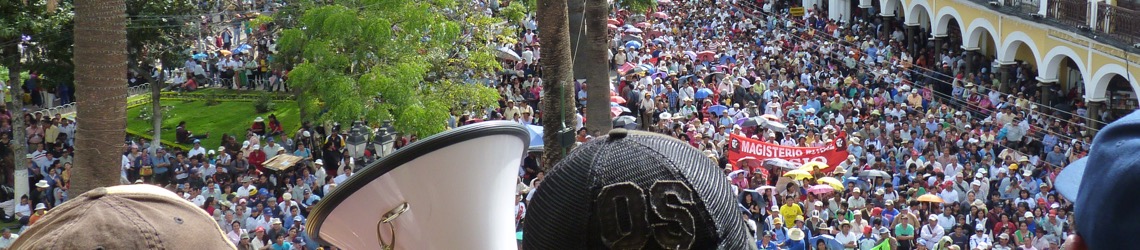
MAS campaign to reverse agreement, build highway through TIPNIS reaches legislature today

The campaign by Evo Morales’ Movement towards Socialism (MAS) party to resume construction of a controversial new highway (background: 1 2 3 wikipedia) through the protected Isiboro Securé National Park and Indigenous Territory enters a critical phase today. While a pro-highway march has just reached Caracollo (Oruro), a six-day march away from the capital, the Bolivian Plurinational Legislative Assembly will take up consideration of the march’s demands today. The march, officially led by CONISUR, an organization of indigenous people living in the southern, colonized zone of TIPNIS, has had open support of the MAS from the start. Its legitimacy has also been called into question by the national indigenous confederation CIDOB and a wide swath of Bolivian media from the right to the independent left, including the community radio network Erbol.

Erbol has an informative run-down today of the “five MAS strategies to achieve the construction of the TIPNIS highway” since it signed an agreement with the Subcentral TIPNIS, CIDOB, and CONAMAQ to shelve the project in October. These strategies are:

  • A December 9 rally in Cochabamba in support of construction, organized by the Governor’s office of Cochabamba. Work hours throughout the department were adjusted to assure attendance, and government officials spoke out about being obliged to attend.
  • The CONISUR march, begun December 19/20 at Isinuta, on the edge of TIPNIS.
  • The December 16 suspension of Beni governor Ernesto Suarez Sattori, indicted for governmental financial irregularities. Suarez had been the most prominent official in the region to criticize the project and showed a willingness to support alternate routes for the road. His successor, Haisen Ribera Leigue, is a right-wing legislator who has since been disavowed by his party for joining the MAS vote to suspend Suarez. Ribera has joined the call to annul the law protecting TIPNIS, and build the road.
  • The Plurinational Encounter to Deepen the Change, a three-part “consultation with civil society” on the part of the Bolivian executive branch, included the highway in its agenda for Cochabamba and Beni. The meeting was boycotted by the indigenous federations CIDOB and CONAMAQ as part of the fracturing of the Pact of Unity (wikipedia).
  • The effort to annul the law in the legislature, which will begin today. Eleven legislators who met with the CONISUR marchers will make their report today, after which relevant legislation will be gestated in committee. The MAS Cochabamba delegation has already pledged to support reversing the protection of TIPNIS. Senate President René Martínez claims to have a 2/3 majority in support of the iniciative, a claim that others contest in light of indigenous and Without Fear Movement legislators withdrawing from the MAS delegation.
  • Plus (not cited by Erbol): The government continues to stall on its agreement with the CIDOB and Subcentral TIPNIS to put forward official regulations for the law protecting the territory.

While no vote is expected today, the engagement of the Plurinational Legislative Assembly on the issue of reversing the protection of TIPNIS marks a culminating moment in the MAS strategy to go ahead with the road. The government continues to ignore alternate routes for connecting Cochabamba and Beni that fall outside of the indigenous territory and national park, and continues to make winning this fight a political priority. The time for environmental and indigenous rights supporters to turn their attention back to this issue is now.