Denying Reality to Defend Power

Self-censorship may not be the most pernicious form of censorship out there, but it certainly can reorient one’s perspective on what really is happening in the world. It’s strange enough to interact with people without a shared vision of what is actually happening in the world. Even stranger is to watch people deliberately repress their own knowledge in the service of a political agenda, whether that’s misinforming the public about global warming, “protecting” secrets that have already been released, or sustaining a deceptive narrative of the Great Recession.

One

Democracy Now! has obtained the text of a memo that’s been sent to employees at USAID. This is to thousands of employees, about reading the recently released WikiLeaks documents, and it comes from the Department of State. They have also warned their own employees. This memo reads, quote, “Any classified information that may have been unlawfully disclosed and released on the Wikileaks web site was not ‘declassified’ by an appopriate authority and therefore requires continued classification and protection as such from government personnel… Accessing the Wikileaks web site from any computer may be viewed as a violation of the SF-312 agreement… Any discussions concerning the legitimacy of any documents or whether or not they are classified must be conducted within controlled access areas (overseas) or within restricted areas (USAID/Washington)… The documents should not be viewed, downloaded, or stored on your USAID unclassified network computer or home computer; they should not be printed or retransmitted in any fashion.” That was the memo that went out to thousands of employees at USAID. The State Department has warned all their employees, you are not to access WikiLeaks, not only at the State Department, which they’ve blocked, by the way, WikiLeaks, but even on your home computers. Even if you’ve written a cable yourself, one of these cables that are in the trove of the documents, you cannot put your name in to see if that is one of the cables that has been released. (Democracy Now!)

The Library of Congress followed suit in blocking Wikileaks, prompting a lively debate among librarians on information access.

Two Media Matters exposed the following memo from Fox News managing editor Bill Sammon: “…we should refrain from asserting that the planet has warmed (or cooled) in any given period without IMMEDIATELY pointing out that such theories are based upon data that critics have called into question. It is not our place as journalists to assert such notions as facts, especially as this debate intensifies.”  To quote Media Matters,

“Contrary to Sammon’s email, the increase in global temperatures over the last half-century is an established fact. As the National Climatic Data Center explains, the warming trend ‘is apparent in all of the independent methods of calculating global temperature change’ and “is also confirmed by other independent observations.'”

(Further outrage from the über-centrist National Wildlife Federation)

Three

The bipartisan Financial Crisis Inquiry Commission was established by law to “examine the causes, domestic and global, of the current financial and economic crisis in the United States.” …

It’s a straightforward story, but a story that the Republican members of the commission don’t want told. Literally.

Last week, reports Shahien Nasiripour of The Huffington Post, all four Republicans on the commission voted to exclude the following terms from the report: “deregulation,” “shadow banking,” “interconnection,” and, yes, “Wall Street.”

When Democratic members refused to go along with this insistence that the story of Hamlet be told without the prince, the Republicans went ahead and issued their own report, which did, indeed, avoid using any of the banned terms.

That report is all of nine pages long, with few facts and hardly any numbers. Beyond that, it tells a story that has been widely and repeatedly debunked — without responding at all to the debunkers. (“Wall Street Whitewash,” by Paul Krugman)

It’s been said that, Everyone’s entitled to their own opinions; but everyone is not entitled to their own facts. Someone tell Fox News, the State Department, the Library of Congress, and the Financial Crisis Commission.

1.3 Million Asians* built this World Cup host

Tommy: Yea, its an Irish ship.
Fabrizio: It’s English…no?
Tommy: No, it was built in Ireland. Fifteen thousand Irishmen built this ship. Solid as a rock.
(Titanic)

These lines rolled off the tongues of actors in James Cameron’s 1994 film, showing just how accessible a mentality that’s critical of capitalism (who owns the things a society makes anyway?), of ethnic bias (who are you calling a second class citizen?), and of xenophobia (among white countries, at least) is to Americans today. The RMS Titanic was in fact built in Belfast by Irish workers. Workers and third-class passengers, often Irish, numbered disproportionately among the dead in the ship’s maiden voyage sinking.

Flash forward a century from the Titanic, and we can see that the luxurious extreme of modern life is still often made possible by the hard work of second-class non-citizens. Case in point, the winning bid (official website) to host the 2022 World Cup, Qatar.

Qatar is an absolute monarchy, ruled by an Emir and a 35-member Consultative Council, currently appointed. Elections for the Council were promised for 2007, 2008, 2010, and are now promised for 2013, although municipal elections have already been held. Qatar is proposing to build or upgrade twelve stadiums, each with a capacity of 40,000 or more for the 2022 World Cup.

Or rather, Qatar is proposing that foreign workers build or upgrade twelve stadiums. As of 2008, most everyone in Qatar was a foreigner: 1,305,428 people, making up 86.5% of the population, and rising. A year earlier, 92.5% of workers in Qatar were foreign nationals, including 72,765 domestic service workers (International Labour Organization, International labour migration and employment in the Arab region). Population estimates for Qatari citizens alone vary widely, although 180,000 in 2006 is one estimate. Those with citizenship could not fill the stadium seats to be built for the World Cup.

Throughout the region’s tiny monarchies, grouped in the US-allied Gulf Cooperation Council, citizenship coexists with a temporary rotating underclass of workers, who lack the right to organize and do not receive the social benefits they make possible. Their hardworking stays in the region are organized through the Kefala or sponsorship system (some times called Kafeel, the word for sponsor). Sponsored workers have their residence rights strictly conditioned on the approval of their employers. This results in illegal abuses such as “working and living conditions, irregular payment of wages and, in extreme cases, retention of travel documents. Foreign workers are more often than not forced to accept these circumstances having incurred the costs of finding jobs and travelling.” Or as the Guardian puts it less diplomatically:

Workers arrive in the country heavily indebted, having borrowed from moneylenders or mortgaged their land to finance inflated travel and visa costs. Their passports are immediately and customarily confiscated and they are typically forced to sign a revised contract that pays them a significantly lower rate than was originally agreed.

The results are depressingly familiar: unpaid wages, inhumane living conditions, unsafe working conditions and suicides.Qatar, one of the wealthiest countries in the world, has been referred to as a “death trap for hundreds of thousands of construction workers” from some of the poorest countries in the world. Female domestic workers, meanwhile, are not covered by national labour law – an omission which, as Amnesty International rightly pointed out, “allows employers to exploit, enslave, abuse, assault and injure their domestic workers with virtual impunity”. There is a strong argument for saying that in the worst cases of abuse, the treatment of migrant workers constitutes slavery in international law.

The ILO is forced to make extremely minimal demands for the labor rights of migrants, such as its recent calls for Kuwait and the United Arab Emirates to reform the sponsorship system, institute a minimum wage, and allow unions to form. (A theoretical right to unionize was established in 2005, but only applies to worksites with 100 or more Qatari nationals. The AFL-CIO’s Solidarity Center reports no unions have yet formed; more from them here.)

Like the Titanic, the World Cup is the ultimate in luxury. It will be up to a global public to decide whether it can stomach a worldwide party built by rights-free labor. For now, at least, we can stop saying that Qatar is hosting a World Cup, and start saying that Indians, Pakistanis, Filipinos, Bangladeshis, Egyptians, and Yemenis are making possible a celebration of sport most of them could never afford to attend.

* Yes, the title is not technically accurate: I know Qatar is in Asia. However there is no short, identifiable word for the vast region that provides migrants to the Middle East monarchies. Maybe they’re should be. Also, I know that more than 1.3 million people (the current number of foreigners present) will have cycled through Qatar during the run-up to its World Cup bid. Sadly, details are hard to come by. Labor history is disadvantaged from the start under conditions of large-scale exploitation.

Bolivia’s anti-racism law at the center of face-off with corporate press

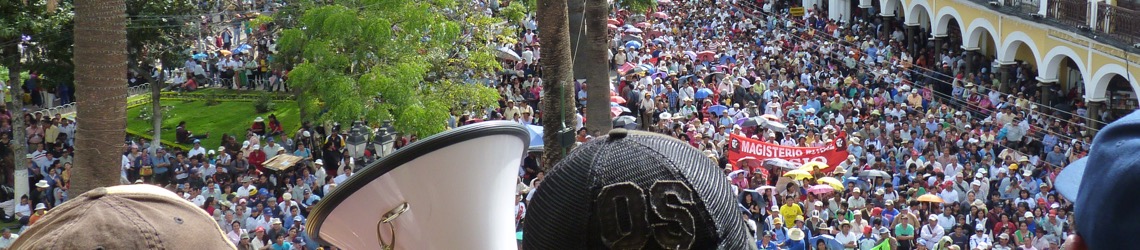
Since August, one issue has generated more headlines here in Bolivia than any other: The Law Against Racism and All Forms of Discrimination, which was debated and passed by the Plurinational Legislative Assembly (aka, the parliament) in late September.

The remarkably short Law 045 is the Bolivian equivalent of more than a generation of civil rights law in the United States. It bans discrimination by public officials and private businessmen, criminalizes verbal and physical aggressions, charters educational efforts on discrimination, creates a national commission on issues of discrimination, and imposes sanctions on the media for circulating “racist ideas.” The scope of the law is broad, including discrimination on the basis of race, ethnicity, religion, language, age, sexual orientation, disability, and pregnancy, among other statuses. A such, it is parallel to American laws from the 1948 integration of the Armed Forces to the 1965 Civil Rights Act to the yet-to-be-passed Employment Non-Discrimination.

So, it would not be shocking if wide range of controversies had emerged over the manifold implications of the law. But this has not occurred. One single controversy, however, has risen to national prominence.

Two articles of the proposed legislation, Articles 16 and 23, have been roundly criticized by the mainstream, privately-owned press. Article 16 makes publications subject to economic fines and even closure for circulating racist ideas. And Article 23 removes any special immunity for members of the press from prosecution under the law. The mainstream press has characterized the articles as the rebirth of a 1980s proposal for prior press censorship, known as the Ley de Mordaza (the Jaws Law, for its ability to crush the press). They led marches across the country as the law was being considered, and coordinated a nationwide protest by in which newspaper covers all read only: “Without freedom of expression, there is no democracy.”

As an (US) American, of course, these provisions are shocking. Our Voltaire (“I detest what you have to say but will defend to the death your right to say it”)-to-American Civil Liberties Union tradition of free speech is, however, a globally extremely tolerant position. (I’ve written before about how our notion of the freedom of the press is, on the other hand, a highly restricted vision of public access to the media, essentially limited by press ownership.) Following the nightmares of World War II, the global human rights regime initiated by the Universal Declaration of Human Rights drew the line on free expression at racism and incitement to war, which it said should be prohibited. International conventions follow these lines by banning “racist incitement.” Germany bans Nazi parties, advocacy of and apology for genocide, and rallies by the racist right. Several other Latin American countries have restrictions on racist media which include prison terms, unlike the Bolivian law. Both the OAS president and the UN human rights representative who have visited in recent weeks have emphasized that the law is appropriate, although the line between racist incitement and free expression must be scrupulously drawn. They’ve also urged the private press to end their boycott of the rule-making process on the legislation.

Strangely, however, the American standard is irrelevant to the debate here. In three months, I have not heard or read a single defense of free *speech* as opposed to free *press* on these issues. No one is suggesting that criminalizing calling someone an “Indio de mierda” (“shitty Indian”) to their face is inappropriate. (Doing so in the United States would of course ignite a national firestorm over “thought police” and be overturned in short order by any competent Federal Court.) There has been a great deal of concern about whether the a TV station filming and disseminating that act would be liable to prosecution (the government regulations proposed on the issue now make it clear that such reporting of others’ speech will not be subject to sanction).

Aside from marches, the press and many media workers’ unions have used a one-day strike, hunger strikes in Santa Cruz, and an immense petition campaign to oppose the law, which sailed through the MAS-controlled parliament. On November 26, they submitted a sample selection of signatures to Vice President Álvaro García Linera. The press claims to have gathered one million signatures, although they are still being sent to a single place to be verified, and the eight books they handed over only come to some 32 thousand. Which brings us to the current impasse: while the new Constitution permits citizen initiatives as part Bolivian democracy, there is no enabling legislation yet to regulate the process. The press is depending on the moral weight of its gathered signatures (one million is a substantial portion of Bolivia’s 10.6 million inhabitants) to kickstart the initiative process. So far, the government seems resistant. And so, a policy controversy seems about to cross over to a crisis of democracy.

Meanwhile, the mainstream press is not the only voice on this issue. During the debate, a book was published on racism by the press over the last century in Bolivia. This racism runs up through the media’s overt collaboration with (really, rallying for) attacks on indigenous protesters in Cochabamba in January 2007 and Sucre in 2006, 2007, and 2008. The cocalero movement has declared itself on alert in defense of the law, and marched here in Cochabamba. And a stream of “alternative media” which includes indigenous radio producers, radical working-class publications, and (strangely given the name) workers in the government-owned media, has taken a distinct position calling for professional standards and arguing that racism and free expression are fundamentally different. They’ve also used the anti-racism law as an opportunity to argue for systematic coverage of indigenous issues and use of indigenous languages in the media.

For me, this storyline is a fascinating instance of public debate in the process of rights-making, an opportunity to see the shape of the Bolivian legislating process (very little of which takes place inside the walls of the Legislative Assembly), and another turn in the kaleidoscope of political alliances here in Bolivia. It’s also forcing me to reconsider (although not yet change) my ideas of what free expression is. I’ve conducted some interesting brief interviews with the alternative press on this, and hope to delve more as the story develops.

Local road blockade challenges Egyptian election fraud

On Sunday, Egypt held parliamentary elections which are widely known to be neither free nor fair (denunciation by the Carnegie Endowment for international peace). The elections were a demonstration of the government’s plans in advance of the 2011 elections, when long-time president Hosni Mubarak may make way for his son to rise as a successor. Unlike the media frenzy over the selection of Kim Jong-Il’s son to receive a special title, little mainstream outrage has been directed at Mubarak’s machinations. Egypt remains under its third decade of emergency rule (which ban demonstrations and some opposition parties), and is the largest non-democratic recipient of United States’ foreign aid by far. It’s also the largest undemocratic country in the Middle East, helped to remain so by our tax dollars, and military and diplomatic support. It’s the clearest sign that the alleged US policy to support democracy in the region is a joke.

In the absence of outside support, people in Egypt have made a number of challenges to this situation. One of the latest was the mid-day peaceful uprising on Sunday by residents of Balteem and Hamoul against voter fraud. Their actions were in defense of independent candidate Hamdeen Sabahy (profile). Since 1995, three of Sabahy’s voters have been killed by Egyptian riot police, while he won office in 2000 and 2005.

Blogger Baheyya has an hour-by-hour account of local resistance (h/t to The Arabist). Here are some highlights:

8:30 am. Sabahy’s representatives rush to photocopy the new certification papers required to gain access to polling stations. Early that morning at 12:30 am, Sabahy’s campaign was dumbfounded to learn of sudden new regulations for the papers, requiring that they be stamped from police precincts rather than notary publics as had been announced earlier. Certain that this is an 11th hour rule manipulation to bar Sabahy’s agents from accessing polling stations, campaign workers spend all night driving to police stations to get the necessary stamps.

9:10 am. The first reports of foul play trickle in. Candidate agents from 12 polling stations phone in that they have been kicked out of polling stations, and one says her certification papers were ripped up despite having the necessary police stamp.

1:00 pm. Sabahy’s representatives sent to Hamoul and agents of other candidates who are sympathetic to Sabahy begin to phone in reports of ballot-stuffing in favor of Abdel Ghaffar in villages surrounding Hamoul.

1:50 pm. Balteem’s main streets are lined with men congregating and sitting on the sidewalks, expressions somber and nerves frayed. A procession of cars and pickup trucks loaded with youth speed past in the direction of the highway. “They’re blockading the highway!” Spontaneously, Balteem and Borg youth decide to blockade the highway to protest what is now a certain sense of election rigging. The news travels like wildfire and some cars change route and head for the highway rather than Sabahy’s house. Frantic calls to campaign cars instructs them to make sure no women are headed to the highway, in anticipation of violence between protestors and riot police.

2-4 pm. Town youth blockade the highway with burning tires and clumps of tree branches and wooden sticks. Highway traffic comes to a standstill, with freight trucks backed up as far as the eye can see. A campaign worker says to no one in particular, “Didn’t I say that this morning was the quiet before the storm?”

4 pm. Townspeople converge on Sabahy’s courtyard and the candidate comes out to speak, standing on a pick-up truck. Livid, fiery youth and men climb on the pick-up truck and demand revenge. Sabahy struggles to control the crowd’s emotions, saying he’d rather withdraw and give up his seat than join this scandalously handpicked parliament. A fully veiled woman in black climbs on the truck and pulls the microphone from his hand, screaming, “Don’t you dare withdraw, Sabahy! Don’t you dare withdraw!”

The crowd chants, “Balteem boxes won’t leave! Balteem boxes won’t leave!” By law, counting stations for the entire district are located in Hamoul but since Hamoul was experiencing rigging, residents feared their ballots would be destroyed or disappeared en route to the counting station.

Ultimately, these efforts appear not to have saved the day. Instead it was the threat of further government violence that won. Al Ahram reported at 4:35 pm, “Police armored vehicles have stormed Balteem, in Kafr El-Sheikh, firing tear gas and live ammunition into the air.” Later, Sabahy himself convinced his supporters to stand down (again, the full day is here):

7:00 pm. Sabahy comes out and is immediately mobbed by the crowd, lifting him on their shoulders and giving him a hero’s welcome. He gives a rousing speech in which he denounces the government and several Amn al-Dawla officers by name for fixing the elections in Hamoul, and reiterates his position of withdrawing from the elections. The crowd presses him to authorize and lead a peaceful protest march to the police station to protest the rigging, but Sabahy fears security forces’ violent response and does not want injuries and casualties among his supporters, as in the past. The back-and-forth goes on for an hour that feels like an eternity, but in the end Sabahy prevails and the people are dejected, though none take matters into their own hands as some did that afternoon.

Somewhat obnoxiously, a government spokesman claimed, “The [governing] party’s careful selection of its candidates was a factor in defeating big opposition names such as Hamdeen Sabahi.” Sabahy withdrew from the race, and made these comments later: “The rigging proves that the [governing] NDP wants no opposition in parliament. With the new parliament, we will see increased restrictions on freedom of expression, including new restrictions on the media.” Whatever the wisdom of backing down (and no one should be too eager to second guess such moves when lives are at stake), residents’ willingness to take their anger to the streets are remarkable under so much pressure.

p.s. Apparently, Egyptian President Hosni Mubarak would like another dictatorship in Iraq, according to advice he gave to US officials (Thanks, Wikileaks).

The US-Bolivia Relationship

Last week, Bolivia hosted a conference of defense ministers from all the countries in the Americas. This became front-page news here mainly because of the speech by President Evo Morales and proposals put forward by Bolivia. It also seems to have attracted at least a little attention in the United States.

US Defense Secretary Robert Gates came to Bolivia with the public agenda of discouraging Bolivia-Iran economic cooperation. He was actually surprisingly diplomatic in his complaints, saying from the outset that Bolivia has the right to have relationships with whomever it chose, but cautioning that Iranian interest in Bolivia’s untapped uranium and joined Bolivia-Iran plans for civilian nuclear plants will be closely monitored.

During the summit, Evo’s opening speech criticized the United States’ history of intervention in Latin American democracies. He claimed that popular democracies are “three and one” in resisting attempted coups backed by the United States. The three are Venezuela (2002), Bolivia (2008), and Ecuador (2010); with the one being Honduras (2009). In fact, they are two inaccuracies in this score: the recent police revolt in Ecuador did not have any apparent American backing, as President Rafael Correa has said publicly; and Evo, like many other observers, leaves out Haiti (2004), the only case in which Americans had an on-the-ground role. The real score is a less optimistic two for the democracies, two for the United States-backed coups against them.

Nevertheless, what has gathered media attention is not Evo’s accuracy, but his audacity in making such a comment in front of a senior American official. The Heritage Foundation responded by saying that, “Morales demonstrated in his speech a quantity of venom, a lack of restraint, and complete disrespect for the U.S. that befits a bully and tyrant.” Heritage joins several right-wing congress members and urging more hostile relations between the United States and Bolivia.

It is difficult to imagine exactly what that would mean since the two countries have had not had ambassador-level relations since 2008, when Bolivia expelled the US ambassador for coordinating Bolivia’s right-wing opposition at a time when it was seizing and burning government buildings and taking over gas infrastructure. After the Obama election, both countries have expressed a desire for renewed relations and cooperation, but the Bolivian proposal for a treaty of mutual respect has languished inside the United States State Department. While in August of this year, the countries announced “90% agreement” on the treaty, there is then no action since. Now that members of the new Republican House majority are making angry noises about Bolivia, it will be even more difficult for the Obama administration to make headway on mending the relationship.

I’ve been meaning to write a bit of background about the US-Bolivian relationship, and the realistic and unrealistic fears of the Morales administration about US intervention. The threat is real; no one who pursues an independent policy as a Latin American president can ignore what happened to Salvador Allende (Chile, ousted by a US-backed coup in 1973); Maurice Bishop (Grenada, invaded by the US in 1983); and Jean-Bertrand Aristide (ousted by CIA-paid Army officials in 1991); and what nearly happened to Hugo Chavez in 2002. However, the rhetoric of foreign interference often gets carried over into domestic politics. A quick summary might be: Just because they are out to get you doesn’t mean you’re not paranoid; and, Just because you’re paranoid doesn’t mean they aren’t out to get you. However, since nearly 1,300 documents on just what the US Embassy has been doing in Bolivia are being released by Wikileaks beginning this week, I’ll suspend judgment on just who is paranoid until I read the documents.